You got through the illness, then came home far weaker than you expected. Here is why that happens after 50 and what the first two weeks are for.
You got through it. The infection cleared, or the surgery went well, or the tests came back better than anyone feared. Someone wheeled you to the door and you went home.
Then you tried the stairs you have climbed for thirty years, and you could not do it.
Nobody warned you about that part. The discharge paperwork covered your medicines and your follow-up appointment. It probably said very little about why your legs feel like they belong to someone else.
This is one of the most common experiences in older adult health care, and one of the least discussed. It has a name. It has research behind it. And the two weeks in front of you matter more than almost any other stretch of your recovery.
Call your doctor today if you notice any of these
Most of what follows in this article is about patience and steady effort. This part is not. Some things after a hospital stay need a phone call the same day, not a wait-and-see.
Call your doctor's office today if you notice:
- A fever, or a surgical wound that looks redder, more painful, or is draining cloudy fluid
- New shortness of breath, or breathlessness that is getting worse
- Swelling, pain or tenderness, warmth, or a change in color in one calf
- Sudden weight gain over a day or two, or swelling in both ankles and legs that is new
- New confusion, or a sudden change in alertness in someone who was thinking clearly
- Being unable to keep food or fluids down
- A fall, even one where nothing seems broken
- New weakness that is getting worse day by day rather than slowly better
- Pain that is climbing rather than settling
- Any new problem with passing urine, or a wound that reopens
Two of those deserve a note. The Centers for Disease Control and Prevention says outright that if you have signs of a surgical wound infection, including redness and pain at the site, drainage, or fever, you should call your provider immediately. And the CDC advises anyone with swelling, pain or tenderness, warmth, or discoloration in a leg to see a doctor as soon as possible, because those can be the signs of a clot.
Call 911 instead of waiting if you have chest pain or discomfort, sudden severe breathlessness, or the sudden one-sided face or arm weakness and slurred speech that can mean a stroke. The CDC's guidance on stroke signs is plain: if you see them, call 9-1-1 right away.
Everything else in this article assumes those boxes are clear.
Why you are weaker than you expected
Here is the part almost nobody explains before discharge.
The weakness has a name
Doctors call it hospitalization-associated disability. It means losing the ability to do basic everyday things, like dressing, bathing, or walking to the bathroom, as a result of the hospital stay itself.
In a 2011 review in JAMA, Kenneth Covinsky and colleagues wrote:
This hospitalization-associated disability occurs in approximately one-third of patients older than 70 years of age and may be triggered even when the illness that necessitated the hospitalization is successfully treated.
Read that last clause twice. The treatment can work perfectly and the weakness can still arrive. That figure describes people older than 70. If you are in your fifties or sixties, your risk is lower, but the same process is at work.
The days after discharge are their own condition
In 2013, the cardiologist Harlan Krumholz described something related in the New England Journal of Medicine. He called it post-hospital syndrome, and defined it as an acquired, temporary condition of raised general risk.
His piece is a short perspective article without an abstract, so rather than quote a paper we could not read in full, we went to a 2015 review in Arquivos Brasileiros de Cardiologia that explains the idea. That review describes a set of stresses built into a hospital stay: "constant alarm noises, low temperatures, and excess brightness, modify the circadian rhythm and sleep quality." It adds that "prolonged fasting and malnutrition during hospitalization are known to change the metabolic and immune systems."
In plain terms: broken sleep, missed meals, unfamiliar surroundings, and lying still. None of those is your original illness. All of them leave a mark.
How little movement actually happens in a hospital
This is the piece that surprises people most.
Researchers at a Department of Veterans Affairs hospital strapped motion sensors to 45 older medical patients and watched what they actually did. The patients were all men, average age 74, and more than three quarters of them were willing and able to walk a short distance on their own.
Across the measured stay, 83 percent of their time was spent lying in bed. The median time spent standing or walking was 3 percent of the day. That is 43 minutes.
That is one small study, from one hospital, in 2009, and all the participants were men. It does not describe every hospital. But it shows how quickly a person who can walk stops walking once they are admitted.
What that much stillness costs
A separate study put 11 healthy older volunteers, average age 67, on 10 days of bed rest with plenty of protein. Not ill. Not recovering from anything. Just lying down.
Their knee extension strength fell by about 13 percent. Their stair-climbing power fell by about 14 percent. Their aerobic capacity dropped by about 12 percent.
And here is the honest half, which matters: their scores on standard physical performance tests were not significantly different afterward. The losses showed up in laboratory measurements before they showed up in what the person could visibly do.
Eleven healthy people is a very small study. But it is a clean one, and it tells you something useful. If ten days of rest does that to a well person, a week in hospital while fighting an infection does more.
The reassuring part is that this is common and often temporary. The actionable part is that it responds to activity.
The first two weeks, block by block
The theme for the next fortnight is little and often. Not heroics. Not a comeback. Short, frequent, boring efforts that add up.
Days 1 to 3: land safely
What is normal. Deep fatigue. Sleeping badly and at odd hours. Feeling wobbly when you first stand. Needing to sit down partway through something you used to do without thinking. Less appetite than usual.
What to aim for. Get out of bed and into a chair for meals. Stand up and move, even a few steps, every hour or so during the day. Sit on the edge of the bed for a moment before you stand, because standing quickly is how people fall in week one. Keep a clear path to the bathroom, with the lights working and the rugs out of the way.
What would make you call someone. Anything on the list above. Also: if you cannot safely get yourself out of bed at all, that is a different situation and it needs your doctor now, not a physical therapy appointment. We cover that scenario separately in our guide for families whose parent is too weak to get out of bed.
Days 4 to 7: build a rhythm
What is normal. Better stretches and worse stretches, often in the same day. Still tiring fast. Appetite starting to return. Some people feel noticeably brighter by day five, and some do not.
What to aim for. Get dressed every day. Eat three real meals. Add one short walk indoors, then a second. Put the hourly stand-up on a schedule rather than leaving it to memory, because fatigue makes you forget. If you were given exercises at discharge, do them at the dose you were given and not more.
What would make you call someone. Going backward two days in a row. Pain that is climbing. A new symptom that was not there on day one.
Days 8 to 14: add a little load
What is normal. A clear sense that some things are easier than they were on day two. Also a clear sense that you are nowhere near where you were before the admission. Both are true at once.
What to aim for. Make one walk slightly longer than the day before, not all of them. Start practicing sitting down and standing up from a firm chair as a deliberate activity rather than something you only do by accident. Get outside if the weather and the footing allow it.
What would make you call someone. Two weeks in with no improvement at all, or a new fall, or any of the same-day list. No improvement in a fortnight is information, not failure. It means something needs looking at.
The five things that matter most in two weeks
There is no shortage of advice available to you right now. If you strip it back, five things do most of the work.
1. Get up and move often. Frequency beats duration in week one. Six short efforts spread across the day are worth more than one long one that flattens you until dinner.
2. Eat and drink properly. Appetite is usually poor after a hospital stay, at exactly the moment your body needs building materials. The PROT-AGE study group recommends that healthy older people take in at least 1.0 to 1.2 grams of protein per kilogram of body weight a day, and states that "most older adults who have acute or chronic diseases need even more dietary protein (ie, 1.2-1.5 g/kg body weight/d)." In practice that means protein at every meal, not just at dinner. If you have kidney disease, ask your doctor before you increase protein.
On fluids, the European Society for Clinical Nutrition and Metabolism is blunt in its geriatric guideline: "All older persons should be considered to be at risk of low-intake dehydration and encouraged to consume adequate amounts of drinks." That guideline does not put a number on it, so neither will we. Keep a glass within reach and drink from it.
3. Sleep. You are likely repaying a sleep debt built up over the whole admission. Protect the dark, keep naps short and early, and expect a week or two of untidy nights before things settle.
4. Take the medicines as prescribed, and get the list checked. This one is underrated. A study of 400 patients discharged home from a general medical service found that 19 percent had an adverse event after leaving hospital, with a 95 percent confidence interval of 15 to 23 percent. Of those events, 66 percent were adverse drug events, making medicines by far the most common cause.
That study was done at one hospital and published in 2003, so treat the exact number with care. The direction of the finding is the useful part. Bring every bottle, including the ones from before the admission, to your first follow-up and ask which ones you are still meant to be taking.
5. Keep the follow-up appointments. A 2022 Cochrane review of 33 trials and 12,242 participants looked at structured, individually tailored discharge planning. It found a relative reduction in readmission over about three months, with a risk ratio of 0.89 and a 95 percent confidence interval of 0.81 to 0.97, rated as moderate-certainty evidence.
The authors' own summary is careful. They say such a plan "probably brings about a small reduction" in hospital stay and readmissions, and that the effect on health status is uncertain. So this is not a guarantee. It is a modest, real effect, and the appointment in your discharge folder is part of it.
Getting stronger without overdoing it
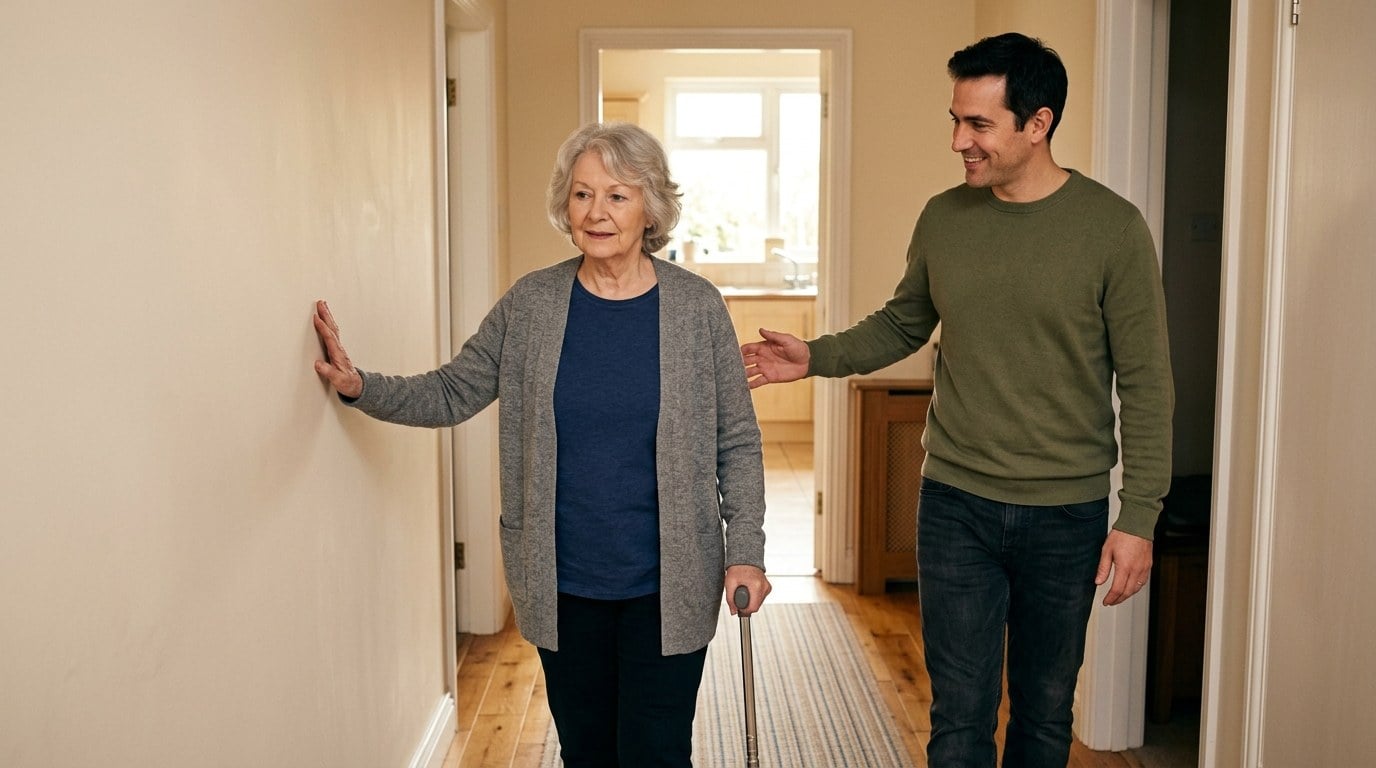
Two things can go wrong in the next fortnight. You can be frightened into sitting still, which makes the weakness worse. Or you can decide to prove you are fine, do too much on day three, and spend day four in bed. Neither is recovery.
What the trial evidence actually shows
The best evidence here comes from trials run inside hospitals, and that matters, so we will say it clearly before the numbers.
In a randomized controlled trial published in the Journal of the American Medical Directors Association in 2020, researchers took 268 hospitalized patients with an average age of 88. Both groups got usual care. One group also did, in the authors' words, "simple supervised exercises (walking and rising from a chair, for a total duration of ~20 minutes/day)."
That group had a lower risk of losing basic function, with an odds ratio of 0.36 measured against their previous baseline and 0.29 measured against their condition on admission.
Now the honest half, which the same paper reports and which is rarely quoted:
No between-group differences were noted for the other endpoints (all P > .05).
In other words, the walking and chair-rising program moved the main outcome and did not move the secondary ones. That is a real finding and it belongs next to the headline.
A second randomized trial, published in JAMA Internal Medicine in 2019, studied 370 acutely hospitalized patients with a mean age of 87.3. The group doing individualized resistance, balance and walking exercises twice daily improved on a standard physical performance battery by 2.2 points against controls, with a 95 percent confidence interval of 1.7 to 2.6.
The most striking number in that trial is not the improvement. It is what happened to the comparison group. On a standard measure of everyday independence, the usual-care group went down by 5.0 points while the exercise group went up by 1.9.
Two caveats you should hold onto. Both trials were conducted with inpatients, supervised by staff, so they do not directly prove what the same exercises do at home. And both studied people much older than most of our readers, with average ages near 88. What they establish is a principle, not a prescription: small amounts of ordinary movement, done consistently, protect function during and after an acute illness.
A safe starting pattern
Every movement below is either seated or done with a solid support within reach. That is deliberate.
- Sit to stand from a firm chair. Feet flat, scoot forward, lean your chest over your knees, push up through your legs with your hands on the armrests if you need them. Sit back down slowly under control. Start with three, twice a day. This is the single most useful thing on this list, because it is the movement that gets you off the toilet, out of the car, and out of bed.
- Heel raises at the counter. Both hands on a kitchen counter, rise onto the balls of both feet, lower slowly. Five to ten.
- Marching in place at the counter. Both hands on the counter. Lift one knee, put it down, lift the other. Ten each side. Keep both hands on the support.
- Seated knee extensions. Sitting tall, straighten one knee, hold for two seconds, lower. Eight each leg.
- Ankle pumps. Sitting or lying, point and flex both feet. Twenty. Useful for circulation while you are still spending a lot of time sitting.
- A short indoor walk. Hallway to kitchen and back, with something to hold on to along the route.
Do not stand on one leg. Do not use the stairs as an exercise in the first fortnight. Do not get down onto the floor to exercise, because getting back up is the risky part and it is not worth it right now.
The rule that keeps you out of trouble
Stop while you still have something left. If you finish an effort and feel pleasantly tired, that was the right amount. If you finish and need to lie down for two hours, that was too much, and tomorrow you halve it.
For reference on the longer arc: a large Cochrane review of progressive resistance training in older adults found that most programs ran two to three times a week and lasted eight to twelve weeks. That review studied older adults generally, not people recently discharged from hospital, so read it as the shape of a sensible program rather than a schedule for next week. It does tell you the honest timescale. Strength comes back over months, not days.
Who does what after a hospital stay

There are several kinds of help available and they are genuinely different from each other. Knowing which is which saves you weeks.
The discharge team. Whoever saw you before you left wrote the plan you are now following. If the paperwork is unclear, or you cannot remember what you were told, call the number on it. That is not a nuisance call. Half the confusion in week one comes from instructions given to an exhausted person on a busy morning.
Your physician. The first port of call for anything medical: the wound, the medicines, the fever, the new symptom, the fatigue that is not lifting. They are also the person who arranges further services if you need them.
Home health. If you cannot leave the house safely, home health is the right answer, and it is a good one. Nurses and therapists come to you, they are set up for exactly this situation, and they can do things no video call can do. Home health is arranged through your physician, so ask them directly. Do not wait for someone to offer it.
Physical therapy in a clinic or by video. This is the right fit once you can get to an appointment, or once you can manage a video visit with someone nearby. A therapist measures where you actually are, which is usually different from where you think you are, and builds the progression from there.
And the thing we need to say plainly: we do not send therapists to patients' houses. HWY Physical Therapy stopped offering that service, and some older pages elsewhere on the internet still say otherwise. They are wrong. What we offer is clinic visits at our two Salem locations and video visits. If what you need is care delivered inside your home, ask your doctor about home health.
If you cannot safely get out of bed, or you have a medical problem that is not under control, you need your doctor first, not us. That is not us being modest. It is the correct order.
One more thing worth knowing. Video visits are genuinely useful in this specific fortnight, because getting into a car is one of the harder things you will do this week.
A 2023 review in Age and Ageing covering 11 studies and roughly 1,400 older adults found physiotherapist-led exercise by video was not inferior to face-to-face care on quality of life, walking distance, and strength measures. It described that care as safe, effective and well adhered to.
The same review found pain outcomes slightly worse by video than in person, which the authors attributed to the absence of hands-on treatment. So it is a real option with a real limit.
If you have never done one and want to know what an assessment actually involves, our guide to a first physical therapy visit after 50 walks through it.
If you are the adult child
You may be reading this because your mother or father came home last week and something is off.
Helping without taking over. The instinct is to do things for them. Resist it where you safely can. Every transfer they make themselves is practice, and practice is the treatment. Stand close, clear the route, take the rug up, and let them do the standing.
There is a real exception. If they are genuinely unsteady, or they have already fallen once, do not let pride run the week. Hands available, decisions theirs.
Watch for the quiet change. New confusion after a hospital stay is not something to wait out. StatPearls describes delirium as "an acute disturbance of attention, awareness, and cognition that develops over a short period and fluctuates in severity," and states that "delirium is a potential indicator of a life-threatening illness, and every episode of delirium should be appropriately evaluated."
The version families miss is the quiet one. The same source notes that the diagnosis "is often missed as clinical manifestations can be subtle, especially in the hypoactive type." A parent who has gone unusually sleepy, withdrawn, or vague is showing you something. Call the doctor.
Signs that mean call now rather than wait for the follow-up appointment:
- Any confusion, drowsiness, or personality change that is new since discharge
- A fever, or a wound that looks worse than it did yesterday
- Breathlessness, or swelling and weight gain appearing together, which the National Heart, Lung, and Blood Institute lists among the signs of heart failure
- One calf that is swollen, warm, or tender
- A fall, whether or not they say they are fine
- Not eating or drinking for a day
- Weakness that is deepening rather than easing
Two things that help more than they look like they should. Bring every medicine bottle in the house to the follow-up appointment. And write down what a good day and a bad day actually look like, day by day, for two weeks. A therapist or a doctor can do a great deal with that record and very little with "they seem tired."
If the situation is that your parent cannot get out of bed at all, that is a different article and we wrote it: what to do when an aging parent is too weak to get out of bed.
Frequently asked questions
How long until I feel like myself again?
We will not give you a number, because no honest source supports one. Recovery time depends on what put you in hospital, how long you were there, how you were doing beforehand, and your age. What we can tell you is the shape of it. Most people notice small improvements within the first two weeks, and rebuilding real strength takes months rather than weeks. The large Cochrane review of resistance training in older adults found most programs ran eight to twelve weeks. Judge yourself against last Tuesday, not against last year.
Is it dangerous to push myself?
Doing nothing carries its own risk, and it is the bigger one for most people. The safe approach is frequency over intensity: short efforts, several times a day, stopping while you still have something in reserve. Anything that leaves you needing hours of recovery was too much. And if you have restrictions from a surgeon, those come first, every time.
My legs feel fine sitting down but give way when I stand. Is that normal?
It is common after a hospital stay, and it is exactly the pattern that the bed rest and hospital mobility research would predict. Standing up demands far more of your leg muscles than sitting does. It is also a fall risk, so treat it seriously: sit on the edge of the bed for a moment before standing, have something solid to hold, and make the sit-to-stand practice a daily habit.
Should I wait for my follow-up appointment before starting to move?
Unless you were given specific restrictions, no. Getting out of bed and into a chair, and standing up regularly through the day, is not exercise so much as normal living, and it is what the hospital-based trials were built around. If you were given restrictions after surgery, follow them exactly and ask at the follow-up when they lift.
What if I had surgery and I am not sure what I am allowed to do?
Ask, and ask specifically. The general question gets a general answer. Ask whether you may put weight through it, how far you may bend it, what you may lift, and when that changes. If your situation involves a broken bone and questions about driving and lifting, we covered that timeline separately.
My parent came home after a stroke. Does this article apply?
Partly, but stroke recovery has its own timeline, its own team, and its own set of decisions, and it deserves better than a paragraph here. We wrote a dedicated guide to the first 90 days after a parent comes home from a stroke.
Does the Neubie help with weakness after a hospital stay?
The Neubie is an FDA-cleared direct current device we use in our Salem clinics, and it is a different technology from a TENS unit. It is not the answer to post-hospital weakness. What rebuilds strength after an illness is getting up, moving often, eating properly, and progressively loading your legs over weeks.
Where to start, if you want help
If you are two weeks out and not moving the way you expected, an assessment is worth more than another week of guessing. A therapist can measure what you have actually lost, tell you whether it is tracking normally, and build the next six weeks around it.
Because travel is hard in this stretch, the easiest way to begin is a Wellness Video Call. It is a virtual appointment, you do it from your own chair, and a family member can sit in from anywhere. If you would rather be seen in person, we have two locations in Salem and we are direct-pay, so no insurance is required.
Book a Wellness Video Call: https://meetings.hubspot.com/raj-pusuluri/virtual-pt-visit
Or call us: (971) 202-1979
HWY Physical Therapy
North Salem: 2615 Portland Rd NE, Salem, OR 97301 (at Center 50+) South Salem: HWY Physical Therapy Clinic South Salem, 180 Ramsgate Square S, Salem, OR 97302
Phone (both locations): (971) 202-1979 Hours: Monday to Friday, 8:00 AM to 5:00 PM Walk-ins welcome at North Salem. South Salem is by appointment only.
Lead clinician: Dr. Raj Pusuluri, PT, DPT
Sources
- Covinsky KE, Pierluissi E, Johnston CB. Hospitalization-associated disability. JAMA. 2011;306(16):1782-1793. PMID 22028354. https://doi.org/10.1001/jama.2011.1556
- Krumholz HM. Post-hospital syndrome: an acquired, transient condition of generalized risk. New England Journal of Medicine. 2013;368(2):100-102. PMID 23301730. https://doi.org/10.1056/NEJMp1212324
- Mesquita ET, Cruz LN, Mariano BM, Jorge AJL. Post-hospital syndrome: a new challenge in cardiovascular practice. Arquivos Brasileiros de Cardiologia. 2015. https://pmc.ncbi.nlm.nih.gov/articles/PMC4651414/
- Ortiz-Alonso J, Bustamante-Ara N, Valenzuela PL, et al. Effect of a simple exercise program on hospitalization-associated disability in older patients: a randomized controlled trial. Journal of the American Medical Directors Association. 2020;21(4):531-537.e1. PMID 31974063. https://doi.org/10.1016/j.jamda.2019.11.027
- Martinez-Velilla N, Casas-Herrero A, Zambom-Ferraresi F, et al. Effect of exercise intervention on functional decline in very elderly patients during acute hospitalization: a randomized clinical trial. JAMA Internal Medicine. 2019. PMID 30419096. https://pmc.ncbi.nlm.nih.gov/articles/PMC6583412/
- Brown CJ, Redden DT, Flood KL, Allman RM. The underrecognized epidemic of low mobility during hospitalization of older adults. Journal of the American Geriatrics Society. 2009. PMID 19682121. https://europepmc.org/article/MED/19682121
- Kortebein P, Symons TB, Ferrando A, et al. Functional impact of 10 days of bed rest in healthy older adults. Journals of Gerontology Series A. 2008. PMID 18948558. https://europepmc.org/article/MED/18948558
- Forster AJ, Murff HJ, Peterson JF, Gandhi TK, Bates DW. The incidence and severity of adverse events affecting patients after discharge from the hospital. Annals of Internal Medicine. 2003. PMID 12558354. https://europepmc.org/article/MED/12558354
- Goncalves-Bradley DC, Lannin NA, Clemson L, Cameron ID, Shepperd S. Discharge planning from hospital. Cochrane Database of Systematic Reviews. 2022. PMID 35199849. https://pmc.ncbi.nlm.nih.gov/articles/PMC8867723/
- Bauer J, Biolo G, Cederholm T, et al. Evidence-based recommendations for optimal dietary protein intake in older people: a position paper from the PROT-AGE Study Group. Journal of the American Medical Directors Association. 2013. PMID 23867520. https://doi.org/10.1016/j.jamda.2013.05.021
- Volkert D, Beck AM, Cederholm T, et al. ESPEN practical guideline: clinical nutrition and hydration in geriatrics. Clinical Nutrition. 2022. PMID 35306388. https://doi.org/10.1016/j.clnu.2022.01.024
- Liu CJ, Latham NK. Progressive resistance strength training for improving physical function in older adults. Cochrane Database of Systematic Reviews. 2009. PMID 19588334. https://pmc.ncbi.nlm.nih.gov/articles/PMC4324332/
- Centers for Disease Control and Prevention. About surgical site infections. https://www.cdc.gov/surgical-site-infections/about/index.html
- Centers for Disease Control and Prevention. About blood clots. https://www.cdc.gov/blood-clots/about/index.html
- Centers for Disease Control and Prevention. Stroke signs and symptoms. https://www.cdc.gov/stroke/signs-symptoms/index.html
- National Heart, Lung, and Blood Institute. Heart failure symptoms. https://www.nhlbi.nih.gov/health/heart-failure/symptoms
- StatPearls. Delirium. NBK470399. https://www.ncbi.nlm.nih.gov/books/NBK470399/
- Telerehabilitation for older adults: systematic review. Age and Ageing. 2023. https://pmc.ncbi.nlm.nih.gov/articles/PMC10657214/
This article is general information, not medical advice. If you have just come home from hospital, follow the instructions your discharge team and your physician gave you.
