Doing your exercises but nothing is changing? The missing piece is usually dose. How hard, how many, how often, and when to make it harder.
You have been doing the exercises. Three months of the same sheet, or the same walk, or the same pair of light weights in the corner of the living room. You have not missed many days.
And nothing has changed.
It is tempting to blame age, or to decide you are simply not a person whose body responds. Both are usually wrong. The far more common explanation is dose. Nobody told you how hard the work was supposed to feel, so you have been doing the right movements at the wrong effort.
This post is about dose, and only about dose. How hard, how many, how often, and how to make it harder over time. If you are looking for exercises to do, we have written that one separately: strength training at home, a guide for older adults. Come back here for the part that decides whether those exercises work.
First, a short safety check
Strength training is safe for most adults over 50. It is not safe for everyone on every day, and a few situations deserve a phone call before you add resistance or push harder.
Talk to your doctor before you start or increase resistance training if any of these apply to you:
- Blood pressure that is not under control, or that you have never had measured
- Chest pain, pressure, or unusual breathlessness when you exert yourself
- A heart attack, heart surgery, or stroke in the past several months
- A recent fracture, or surgery you have not been cleared to load
- Weight loss you cannot explain
- Dizziness, fainting, or a sense that the room moves when you stand
This is not a reason to avoid strength work. It is a reason to start it with the right person watching.
The four dials
Every strength program, from a hospital bedside to a competitive gym, turns the same four dials.
Load is how heavy the resistance is. Repetitions are how many times you move it in a row. Sets are how many rounds of those repetitions you do. Frequency is how many days a week you train.
Most people over 50 who are "doing their exercises" have set repetitions, sets, and frequency reasonably. They do ten of something, once or twice through, a few times a week.
The dial they under-use is load.
This is not a guess. The American Physical Therapy Association thought under-dosing was common enough to name it publicly. It is one of five things the association tells physical therapists and patients to question:
Don't prescribe underdosed strength training programs for older adults. Instead, match the frequency, intensity, and duration of exercise to the individual's abilities and goals.
In plain terms: our own profession says the most likely reason your exercises are not working is that they are too easy.
How heavy should it feel?

Here is the whole answer, from the CDC, in one sentence:
Do muscle-strengthening activities to the point where it's hard to do another repetition without help.
That is the target. Not "until you have done ten." Not "until you feel warm." Until one more would be genuinely difficult.
What that feels like in your body
You do not need a gym, a chart, or a number to find this. You need four checks.
The last two or three repetitions should be hard. Not uncomfortable in a vague way. Hard in the specific way where you slow down, you concentrate, and you would not want to do five more.
You should not be able to do many more. If you finish your set and could honestly have done another eight, the resistance is too light. That set did almost nothing.
Your form has to stay clean. The moment your back rounds, your knee wobbles inward, or you start heaving the weight with momentum, the set is over. Hard is fine. Sloppy is not.
You should be able to speak, but not comfortably hold a conversation. Treat this as a breathing check rather than a measure of weight. The CDC describes the talk test for aerobic activity, not for lifting. Its use here is simple: if you cannot say a short sentence, you are probably holding your breath.
What "hard" does not mean
It does not mean painful. Muscles working hard feel full, warm, and heavy. Sharp pain, joint pain, or pain that lingers the next day is a different signal, and it means you back off and ask someone.
It does not mean holding your breath. Breathe out on the effort. If you find yourself bracing and going red, the load is too heavy or the technique needs a look.
It does not mean going to total failure every time. You are aiming for the edge of hard, not the far side of it.
Repetitions in reserve, and why it is only a rough guide
Trainers describe effort using "repetitions in reserve." Finish a set and ask yourself how many more you could have done. Two left is a hard set. Six left is a warm-up.
It is a genuinely useful habit. It is also less accurate than it sounds, especially in our age group.
A 2025 study in Experimental Gerontology tested this directly in 25 community-dwelling older adults, average age 68. When they stopped believing they had two repetitions left, they actually had about two more than that. The same thing happened at four. Their perceived exertion ratings barely changed between very different efforts, which the authors called limited sensitivity.
This was one exercise, one small group, so do not over-read it. The practical lesson still holds, and it points one way: if you think you have two repetitions left, you probably have more. When in doubt, the honest choice is the heavier one, not the lighter one.
The CDC also describes rating effort on a scale of 0 to 10, where 0 is sitting and 10 is maximal effort. Moderate sits at 5 or 6, and vigorous begins at 7 or 8. Useful as a language, but the same caution applies. Most people guess low.
How many, and how often
The World Health Organization published its physical activity guidelines in 2020. For adults aged 18 to 64, the muscle-strengthening recommendation reads:
Adults should also do muscle-strengthening activities at moderate or greater intensity that involve all major muscle groups on 2 or more days a week.
WHO rates that a strong recommendation with moderate certainty evidence.
For adults aged 65 and over, the guideline asks for more, and asks for it differently:
Older adults should do varied multicomponent physical activity that emphasizes functional balance and strength training at moderate or greater intensity, on 3 or more days a week, to enhance functional capacity and to prevent falls.
Also strong, also moderate certainty. Note the two shifts. Three days rather than two, and balance work woven in with the strength work rather than kept separate.
The CDC fills in the shape of a session. Aim for 8 to 12 repetitions, which counts as one set. Do at least one set, and two or three for more benefit. Cover all the major muscle groups: legs, hips, back, chest, abdomen, shoulders, and arms.
Research on older adults lands in a similar place. A 2015 review in Sports Medicine pooled 25 trials in healthy adults aged 65 and over.
The biggest strength gains came from about two sessions a week, two to three sets, and seven to nine repetitions, at roughly 70 to 79 percent of a maximum lift. The authors also rated the quality of those studies as poor overall, so treat the figures as a signpost rather than a rule.
A realistic starting pattern
Here is a reasonable place to begin. It is a starting point for a general reader, not a prescription for you.
- Two days a week, not back to back, with a third day added once two feel easy to keep
- One or two sets per movement to start
- 8 to 12 repetitions per set
- Enough resistance that the last two or three repetitions are genuinely hard
- Every major muscle group covered across the week, not all in one session
If you are over 65, the WHO recommendation points you toward three days and toward mixing balance work into the same sessions. Build up to that rather than starting there.
How to make it harder, and when
This is the dial nobody touches, and it is the reason month three looks exactly like month one.
Your body adapts to what you ask of it. Once it has adapted, the same load is no longer a challenge, and it stops driving change. That is progressive overload, and it is not a gym concept. It is simply the rule that the work has to keep being hard to keep working.
Making it harder does not have to mean heavier. You have options, roughly in order of how gentle they are:
- Add a repetition or two to each set
- Add a set
- Slow the lowering phase down so the muscle works longer
- Add a third session to the week
- Add resistance
A conservative rule for adding load
Use this. It is deliberately cautious.
If you complete all your repetitions on two sessions in a row, and the last two did not feel hard, add a little resistance next session. Add the smallest increase you can. Then repeat the check.
The ACSM position stand on progression suggests load increases of 2 to 10 percent once you can exceed the target repetitions. That guidance was written for healthy adults in general rather than specifically for people over 50, so read the lower end of that range as the sensible one.
Three rules keep this safe. Change one thing at a time. Never add load and repetitions in the same week. And if form slips or a joint complains for more than a day, go back to the previous step and stay there longer.
What the evidence actually promises
You deserve the honest version, including the parts that are less flattering to us.
The most recent Cochrane review of progressive resistance training in older people was published in 2009 by Liu and Latham. It pooled 121 trials and 6,700 participants, which makes it one of the larger bodies of evidence in this field.
Here is what it found. The reviewers scored each result on a shared scale, where a bigger number means a bigger effect.
Strength responds well. The effect on muscle strength scored 0.84, which the reviewers called large. This is the part that reliably works.
Some specific tasks respond well. Getting out of a chair scored -0.94, a moderate to large effect. The minus sign only means the timing got faster.
Walking speed improves modestly. People walked 0.08 meters per second quicker. Real, measurable, and small.
General physical ability improves only a little. That score was 0.14, which the reviewers called small but significant.
That last number matters more than the first one. Lifting more is not the same as living better, and the second is the thing you actually came for.
A program that doubles your leg strength and changes nothing about your day has missed the point. That is why the work has to connect to whatever you are struggling with.
Safety reporting in these trials was poor, and that is a real limitation. The reviewers noted that aches and strains were reported in many studies. Serious harms were rare, and none were reported as directly caused by the exercise itself. But the authors urged caution in applying the findings to sicker patients, because harm was not recorded well enough to be sure.
Does heavier beat lighter?
For strength, the evidence leans yes. A 2026 review in Geriatrics and Gerontology International pooled 18 studies and 1,283 people aged 50 and over. Heavier training built more leg strength than lighter training did.
Two honest catches come with that. It found no clear difference between the two for bone density at the spine or hip. And fall risk and harms were similar in both groups, which is reassuring on safety but also shows heavier is not a shortcut to everything. The authors themselves asked for better trials.
The strength and size story is not what most people think
In 1994, a New England Journal of Medicine trial put 100 frail nursing home residents through ten weeks of progressive resistance training. Their average age was 87.
Muscle strength rose by 113 percent. Walking speed rose by nearly 12 percent. Stair-climbing power rose by more than 28 percent.
Thigh muscle size rose by 2.7 percent, and that change was not statistically significant.
Read those numbers together. Strength more than doubled while the muscle barely changed size. Early gains come largely from the nervous system learning to recruit what you already have. This is why progress is possible at 87, and why it can start before anything looks different in the mirror.
Two numbers worth knowing
You do not need a laboratory to track this. Two simple measures are used by clinicians worldwide, and both have published thresholds.
The European Working Group on Sarcopenia in Older People set these cut-offs in its 2019 consensus:
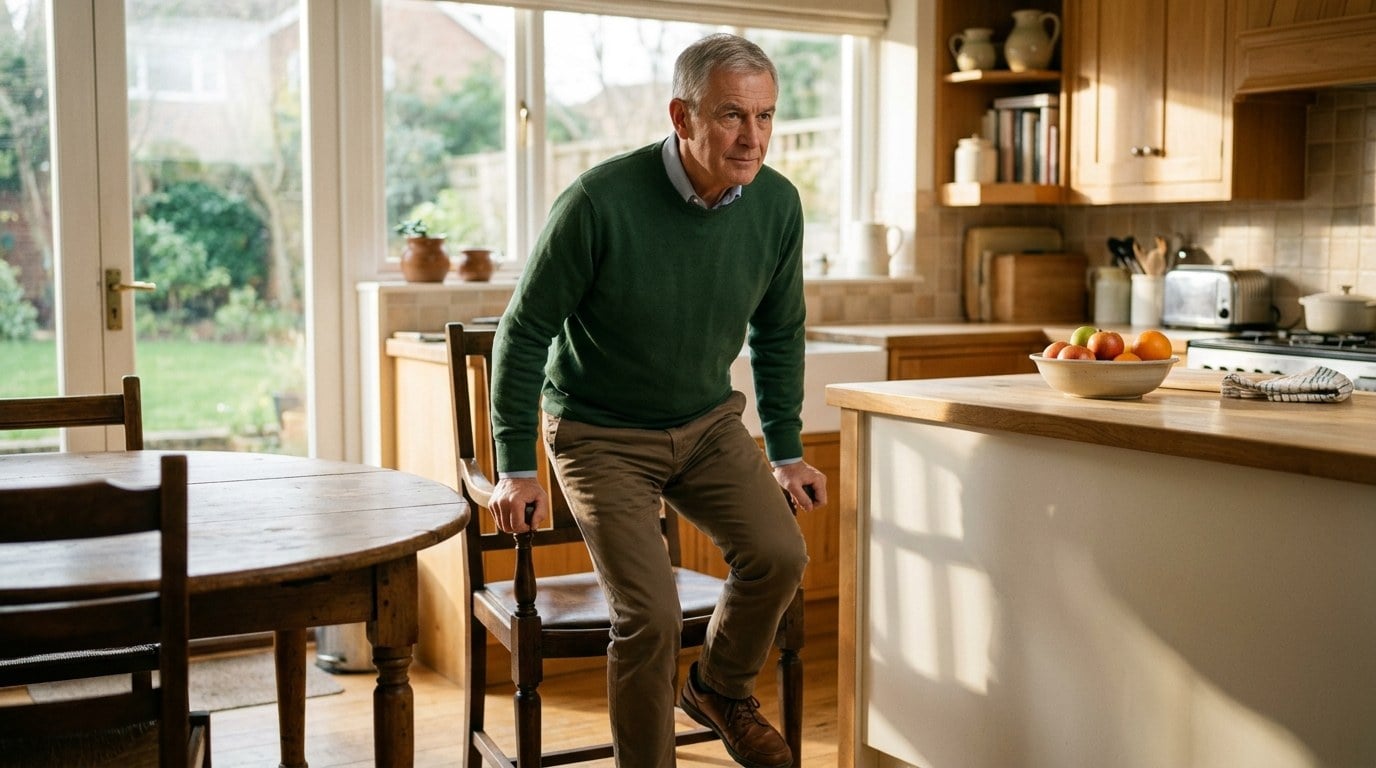
- Five chair rises taking longer than 15 seconds. Stand up and sit down five times without using your hands, and time it.
- Usual walking speed of 0.8 meters per second or slower. That is roughly 4 meters in 5 seconds at your normal, comfortable pace.
Two cautions, both important. These are screening thresholds that prompt a clinician to look further, not verdicts about your health. And the group itself calls the chair stand a convenient proxy for leg strength rather than a precise measurement.
Use them as a personal before-and-after instead. Record both today. Record them again in eight weeks. If the resistance you are using is right, the numbers should move.
For context on what real change looks like, the Cochrane figure for walking speed was 0.08 meters per second. Small numbers, meaningful differences. If walking speed is your main concern, or you are watching it decline in a parent, we go deeper here: why is my parent walking slower and shuffling.
The three mistakes we see most
Too light. This is the big one. In a 2013 study, 20 older women were simply told to pick their own load for 3 sets of 10 to 15 repetitions. They chose roughly 33 to 52 percent of their maximum, below what is recommended for improving muscular fitness. One session, one small group, and still a fair reflection of what we see. Left to ourselves, most of us choose comfortable.
Too few sessions. One session a week maintains. It does not build. Two is the floor for strength, and the WHO asks for three or more once you are 65.
Never progressing. The same resistance for six months is not a strength program after the first few weeks. It is a habit, and habits are worth having, but it will not keep changing you.
What a therapist actually adds here
You can do all of this alone. Plenty of people do. What a physical therapist adds is precision at the four points where guessing costs you the most.
An assessment. We measure where you actually start, including the chair rise and walking speed above, so progress is a number rather than a feeling.
An honest starting load. This is the one people get wrong alone, in both directions. Some go far too light for months. Others go too heavy on a joint that was not ready.
A progression plan. What changes, by how far, and in what order, so the work stays hard without becoming risky.
A review date. A date on the calendar to check whether it worked, and to change the plan if it did not. We wrote about how to judge that honestly here: is your physical therapy actually working.
On food, keep it simple and short. A position paper from the PROT-AGE Study Group recommends that healthy adults over 65 get at least 1.0 to 1.2 grams of protein per kilogram of body weight per day, and at least 1.2 for those who exercise.
There is one exception. If you have severe kidney disease and are not on dialysis, that advice does not apply to you, so ask your doctor first.
One note on technology, because patients ask. The Neubie is an FDA-cleared direct current device we use in clinic, and it is distinct from TENS. It can help with how a muscle activates when pain or a recent surgery is getting in the way. It is not a substitute for lifting something heavy enough, and we will tell you so.
If getting to us is the obstacle, a virtual visit works well for this particular problem. Dose is coaching, and coaching travels down a video call. We can watch your form, judge your effort, and set your next progression from your own living room. We do not send therapists to patients' houses, so virtual is our start-from-home option.
Frequently asked questions
Am I too old to start?
Almost certainly not. The New England Journal of Medicine trial above trained frail nursing home residents with an average age of 87, and their strength more than doubled in ten weeks. Age changes how quickly you progress and how carefully you start. It does not remove your ability to adapt.
Do I need a gym?
No. The muscle does not know what is producing the resistance. Your own body weight, a bag, a band, or a household object will all work, provided the effort meets the standard in this post. What you cannot do is stay at a resistance that is easy, whatever that resistance happens to be.
Should strength training hurt?
Working muscles should feel heavy, full, and warm. Some muscle soreness in the day or two after a new program is normal. Sharp pain, joint pain, or pain that is still there several days later is not part of the plan, and it means you stop that movement and ask someone to look at it.
How long before I notice anything?
Strength usually starts to shift within a few weeks, mostly because your nervous system gets better at using the muscle you have. Changes you notice in daily life, like stairs or getting out of a chair, generally take longer. Eight weeks is a fair first checkpoint, which is why we suggest recording your two numbers today.
I have arthritis. Does any of this change?
The principles hold, and strength work is a standard part of managing arthritic joints. What changes is exercise selection, range, and how quickly you progress, which is exactly the kind of judgment worth getting in person rather than from a blog post.
Can you do this over a video call?
Yes, and dose is one of the better uses of a virtual visit. We can see your technique, question your effort level, and set the next step. If hands-on assessment is needed, we will tell you and bring you in.
What if I have never done anything like this?
Then you are the person with the most to gain, and the person who should not guess at the starting load. Here is what a first appointment involves: what to expect at your first physical therapy visit after 50.
Find your real starting load
If you have been doing your exercises faithfully and nothing is changing, you do not need more discipline. You need a harder, better-aimed dose, and a way to check that it is working.
Start with a Wellness Video Call. It is a virtual conversation with Dr. Raj Pusuluri, PT, DPT, about what you are already doing, what it should feel like, and what to change first. Direct-pay, no insurance required.
Book your Wellness Video Call or call (971) 202-1979.
HWY Physical Therapy
North Salem: 2615 Portland Rd NE, Salem, OR 97301 (at Center 50+). Walk-ins welcome.
South Salem: HWY Physical Therapy Clinic South Salem, 180 Ramsgate Square S, Salem, OR 97302. By appointment only.
Phone (both locations): (971) 202-1979
Hours: Monday to Friday, 8:00 AM to 5:00 PM
This article is general education, not medical advice. Talk with a licensed clinician about your own situation before starting or changing a strength program.
Sources
- Bull FC, Al-Ansari SS, Biddle S, et al. World Health Organization 2020 guidelines on physical activity and sedentary behaviour. Br J Sports Med. 2020;54(24):1451-1462. PubMed | WHO guideline text
- Liu CJ, Latham NK. Progressive resistance strength training for improving physical function in older adults. Cochrane Database Syst Rev. 2009;(3):CD002759. PubMed
- Cruz-Jentoft AJ, Bahat G, Bauer J, et al. Sarcopenia: revised European consensus on definition and diagnosis (EWGSOP2). Age Ageing. 2019;48(1):16-31. Full text
- Centers for Disease Control and Prevention. What Counts as Physical Activity for Older Adults
- Centers for Disease Control and Prevention. Measuring Physical Activity Intensity
- American Physical Therapy Association. Five Things Physical Therapists and Patients Should Question. Choosing Wisely, September 15, 2014. Release
- American College of Sports Medicine. Position stand: Progression models in resistance training for healthy adults. Med Sci Sports Exerc. 2009;41(3):687-708. PubMed
- Gomez-Redondo P, Alcazar J, Valenzuela PL, et al. Validity of repetitions in reserve for prescribing resistance exercise in older adults. Exp Gerontol. 2025. PubMed
- Borde R, Hortobagyi T, Granacher U. Dose-response relationships of resistance training in healthy old adults: a systematic review and meta-analysis. Sports Med. 2015;45(12):1693-1720. PubMed
- Shen YC, Chen KH, Hou WH, et al. Effectiveness of high-intensity versus low-to-moderate-intensity resistance training in improving muscle strength and bone mineral density in older adults. Geriatr Gerontol Int. 2026. PubMed
- Fiatarone MA, O'Neill EF, Ryan ND, et al. Exercise training and nutritional supplementation for physical frailty in very elderly people. N Engl J Med. 1994;330(25):1769-1775. PubMed
- Elsangedy HM, Krause MP, Krinski K, et al. Is the self-selected resistance exercise intensity by older women consistent with the American College of Sports Medicine guidelines to improve muscular fitness? J Strength Cond Res. 2013. PubMed
- Bauer J, Biolo G, Cederholm T, et al. Evidence-based recommendations for optimal dietary protein intake in older people: a position paper from the PROT-AGE Study Group. J Am Med Dir Assoc. 2013;14(8):542-559. PubMed
