Arthritis home care after 50: what the NICE and ACR guidelines say actually helps, what they say to skip, and when to see a physical therapist.
You have been told to keep moving. You have also been told that exercise wears the joint out. Somebody at church swears by a supplement. A relative sent you a brace. An ad promises a gadget that ends arthritis pain in ten minutes a day.
That is a lot of advice pulling in opposite directions. So let us do something simpler. Let us look at what the two big arthritis guidelines actually say, including the parts that are inconvenient for a physical therapy clinic to print.
This article is about what you do for yourself between appointments. It is not about anyone coming to your house. We do not send therapists to patients' houses.
First, a short list that belongs to your doctor
Most joint pain after 50 is not an emergency. A few patterns are still worth a call, because they are not ordinary arthritis.
Contact your doctor if you have:
- A joint that is hot, red and swollen, especially with a fever or feeling generally unwell.
- A knee or hip that gives way under you, more than once.
- Pain that wakes you every night and is getting worse week by week.
- Sudden severe pain after a fall, or a leg you cannot put weight on.
- Unexplained weight loss alongside the joint pain.
- A joint that locks or catches so you cannot straighten it.
- New numbness, tingling or weakness in the arm or leg.
- Morning stiffness that runs well past an hour, in several joints at once.
That last one matters because the diagnostic pattern for common wear-related arthritis is short morning stiffness, not long. NICE lists prolonged morning stiffness as an atypical feature worth a second look.
A physical therapist has a duty to send you on when something falls outside what therapy should handle. A good one will tell you that plainly at the first visit.
The one thing both guidelines agree on
Two independent bodies wrote arthritis guidelines. One is NICE, the United Kingdom's national guideline body. Its osteoarthritis guideline, NG226, covers everyone aged 16 and over, and covers all joints. The other is the 2019 guideline from the American College of Rheumatology and the Arthritis Foundation, which covers the hand, hip and knee.
They differ on plenty. They do not differ on this.
NICE puts it first, ahead of every other treatment:
For all people with osteoarthritis, offer therapeutic exercise tailored to their needs (for example, local muscle strengthening, general aerobic fitness).
In plain words: everyone with osteoarthritis should be exercising, and the exercise should be picked for them.
The American guideline reaches the same place and gives it the highest possible rating:
Exercise is strongly recommended for patients with knee, hip, and/or hand OA.
Two guideline panels, two countries, different evidence reviews, same answer.
But does loading the joint wear it out faster?
This is the fear that stops most people, and it deserves a straight answer rather than a slogan.
In 2025, three researchers reviewed the question for the Journal of Orthopaedic and Sports Physical Therapy. Their key result was this:
Systematic reviews demonstrate that exercise therapy does not seem to harm cartilage structure or quality.
Notice the careful wording. "Does not seem to harm" is not the same as "protects". The honest reading is that the studies looking for exercise-related cartilage damage have not found it.
Here is what is not known, and anyone who tells you otherwise is guessing. These studies follow people for months and a few years, not for the rest of their lives. And nothing here says exercise rebuilds cartilage. It does not. What exercise changes is pain, strength, confidence and what you can do in a day.
Expect it to hurt a bit at first
NICE says this out loud, which is unusual for a guideline:
Advise people with osteoarthritis that joint pain may increase when they start therapeutic exercise.
So a stiff, grumbly first two weeks is a normal part of starting, not a sign you have damaged something. Pain that climbs steadily and stays high is a different story, and that is a reason to change the plan rather than abandon it.
And the honest size of the benefit
The most recent Cochrane review of exercise for knee osteoarthritis pooled 139 trials and 12,468 participants. Against an attention control, pain improved by a mean of 8.70 points on a 0 to 100 scale, with a confidence interval of 5.70 to 11.70. Function improved by a mean of 11.27 points, interval 7.64 to 15.09.
Then the reviewers said something a clinic would rather not quote:
We found that the confidence intervals of mean differences either did not reach these thresholds or included both a clinically important and clinically unimportant improvement.
In plain words: exercise reliably helps, but the size of the help is modest and sometimes small enough that a person might not notice it. That is the real picture. It is still the best-supported thing on the list, and it is free.
What actually helps at home
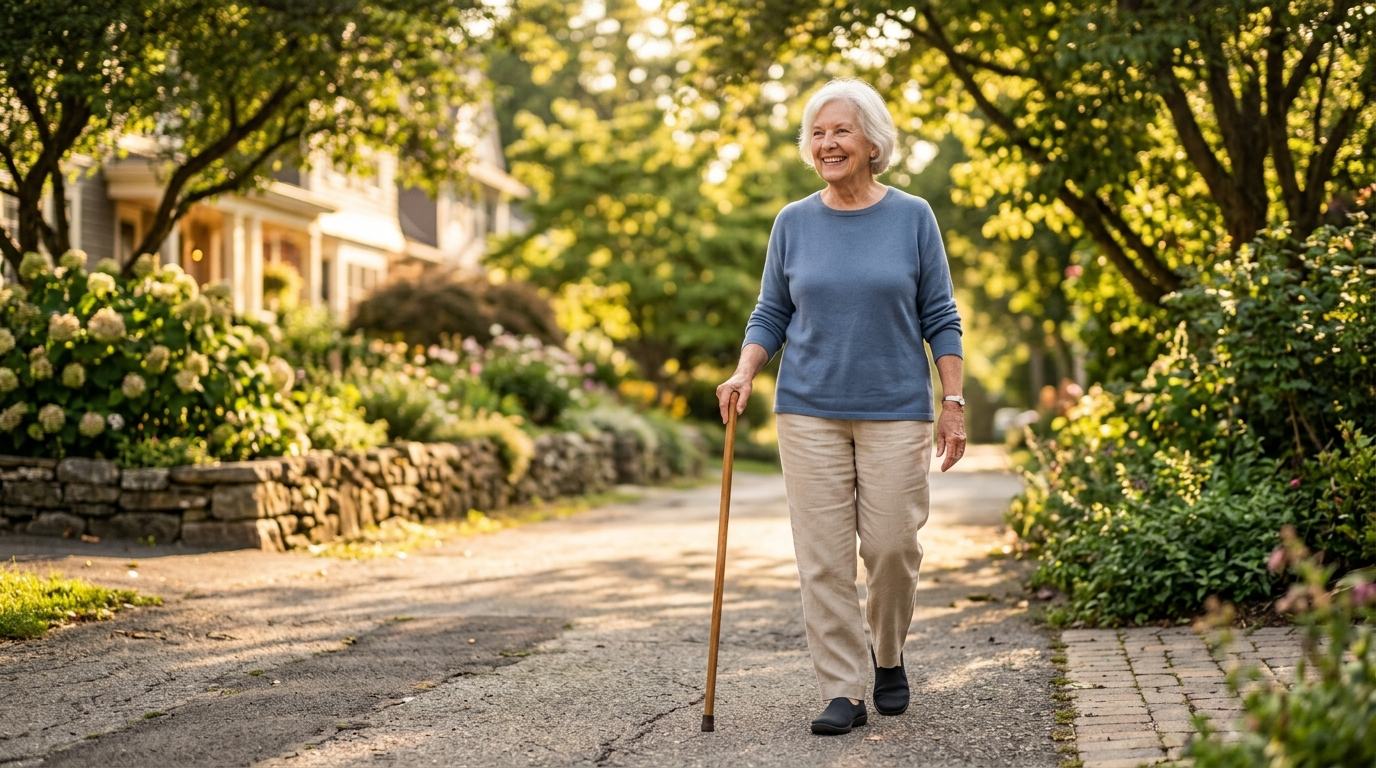
Below is the short list, with the strength of the evidence attached to each item, because "helps" covers a wide range.
Strengthening the muscles around the joint
This is the core of NICE 1.3.1 and the American strong recommendation. Muscles around a joint take load that the joint would otherwise take alone.
Neither guideline names a single winning routine. The American panel says the evidence "is insufficient to recommend specific exercise prescriptions", and lists walking, strengthening, neuromuscular training and pool work among the approaches studied. Choose something you will still be doing in three months.
Staying generally active
Aerobic fitness sits inside the NICE recommendation alongside strengthening. The CDC target for adults 65 and over is at least 150 minutes a week of moderate activity such as brisk walking, or 75 minutes of vigorous activity, plus muscle-strengthening on at least 2 days.
The CDC also addresses the objection directly: "If you have a health condition, such as arthritis, diabetes, or heart disease, it doesn't mean you can't be active."
Weight, if it applies to your knees or hips
This one is handled carefully here, because it is personal and because we are not dietitians.
The American guideline strongly recommends weight loss for knee and hip osteoarthritis in people who are overweight or obese. It notes that benefits start around 5% of body weight and keep increasing above that. NICE 1.3.5 says the same thing in a friendlier way: any amount of weight loss is likely to help, and 10% is likely to be better than 5%.
There is a mechanical reason. A 2005 study of 142 older adults with knee osteoarthritis reported that each pound of weight lost produced roughly a fourfold reduction in the load on the knee per step. That is one study, and it measured loading rather than long-term outcomes. Still, it explains why small changes show up faster in knees than people expect.
We will not give you a diet plan, a target or a number. That conversation belongs with your physician or a dietitian. Note also that this recommendation is for knees and hips. It is not part of the hand guidance.
A walking stick, used the right way
Cane use is strongly recommended in the American guideline for knee or hip arthritis, when the joint is affecting walking, stability or pain enough to justify it. Many people resist this for years, then find it buys them back their walks.
The side matters more than anything else. A small biomechanics study of 14 women with knee arthritis found that holding the cane on the opposite side produced the smallest loads across the sore knee, and that holding it on the same side produced loads higher than using no cane at all.
Cleveland Clinic gives the practical version: hold the cane on the opposite, stronger side, size it so the handle lines up with the crease of your wrist, and step forward with the weaker leg and the cane together.
Heat and cold
Both guidelines treat this as comfort rather than treatment, and the evidence base is thin.
The American guideline rates locally applied heat or cold as conditionally recommended, which is its weaker rating. The standing Cochrane review on the topic dates from 2003 and includes only three trials with 179 patients between them. Ice massage improved knee strength and function in one trial. Cold packs reduced swelling. Hot packs did nothing for swelling, and ice packs did not significantly change pain.
So use whichever one makes you feel better before or after activity. Just do not expect it to change the joint, and do not spend serious money chasing it.
Pacing and planning the day
Nothing in a guideline tells you how to organize a Tuesday. This one comes from practice rather than a trial, and it is worth saying plainly.
Most people with arthritis do everything on a good day and pay for it for three days. Spreading the same work across the week, and breaking long tasks into shorter blocks with a sit-down between them, usually produces more total activity and fewer flares. Treat it as an experiment you run on yourself.
Self-management skills
This is the quiet one, and it carries the strongest rating on the list beside exercise:
Self-efficacy and self-management programs are strongly recommended for patients with knee, hip, and/or hand OA.
"Self-efficacy" means your own confidence that you can manage the condition. It sounds soft. It is one of the better-supported interventions in the entire guideline, and it is why a program that teaches you what to do beats a program that simply does things to you.
Tai chi, and the trial that did not go our way
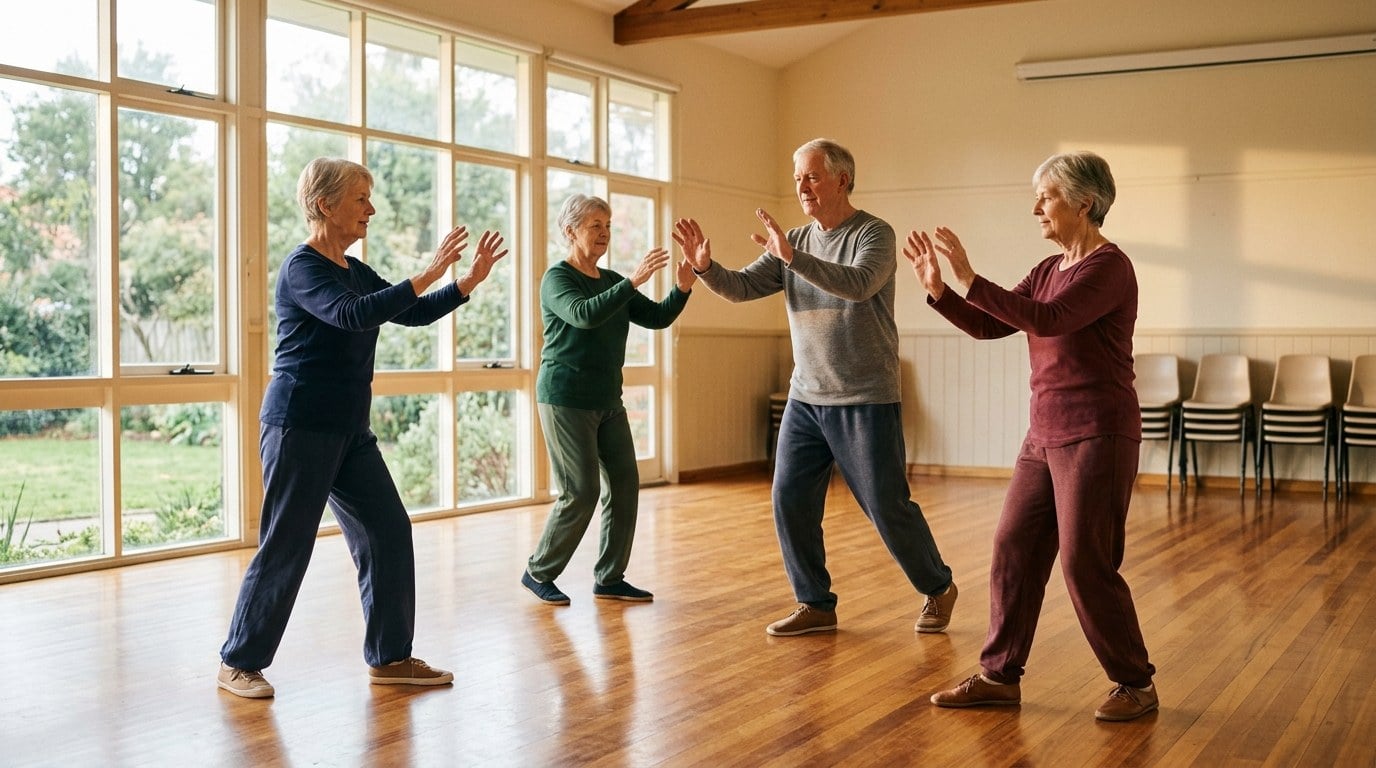
The American guideline strongly recommends tai chi for knee and hip osteoarthritis. That is unusual company for a community exercise class.
The reason is a trial published in the Annals of Internal Medicine in 2016. It was a randomized, 52-week, single-blind comparative effectiveness trial at an urban tertiary care academic hospital. It enrolled 204 people with symptomatic knee osteoarthritis, mean age 60, 70% women.
One group did tai chi twice a week for 12 weeks. The other group did standard physical therapy twice a week for 6 weeks, then 6 weeks of monitored home exercise. The main measure was a standard arthritis score at 12 weeks.
Both groups improved substantially. And then:
The between-group difference was not significant.
The conclusion was equally direct:
Tai Chi produced beneficial effects similar to those of a standard course of physical therapy in the treatment of knee osteoarthritis.
We are a physical therapy clinic, and that trial is a physical therapy clinic getting matched by a class at a community center. We are publishing it anyway, because you deserve the finding rather than the flattering half of it.
Two more details are worth having. The tai chi group did significantly better on depression and on the physical part of quality of life. And no serious adverse events occurred in either group.
The authors named their own limits too. Participants knew which group they were in, which can influence how people rate their symptoms. And the findings came from one hospital, so they may not transfer everywhere.
The practical lesson is not that therapy is useless. It is that the movement was doing most of the work, and a form of movement you enjoy and will keep doing has a real claim on your time.
What the guidelines say to skip
Everything below is scoped to osteoarthritis. None of it is a statement about any other condition.
Glucosamine
Plenty of good, sensible people take glucosamine. This is about the evidence, not about their judgment.
NICE is blunt:
Do not offer glucosamine or strong opioids to people to manage osteoarthritis.
The American guideline reaches the same conclusion independently, and gives it the strong rating, against use, for hand, hip and knee arthritis. Its stated reason is that the data fail to show important benefits over placebo, despite glucosamine being one of the most commonly used supplements in the country.
Two separate panels, looking at the same literature from different continents, landed in the same place.
Please do not treat that as instructions from us. Supplements and medicines belong to a conversation with your physician or your pharmacist, who know your other prescriptions and your kidneys. We are not the right people to tell you to stop something. We are the right people to tell you what the guideline says so you can raise it with them.
The same applies to the medicine recommendations sitting next to that one. NICE also advises against routine use of paracetamol, which is called acetaminophen in the United States, and of weak opioids, except in narrow circumstances. That is a prescribing question. Take it to your prescriber.
Braces, insoles, splints and supports, as a routine purchase
NICE draws a clear line here:
Do not routinely offer insoles, braces, tape, splints or supports to people with osteoarthritis unless: there is joint instability or abnormal biomechanical loading AND therapeutic exercise is ineffective or unsuitable without the addition of an aid or device AND the addition of an aid or device is likely to improve movement and function.
All three conditions have to be true, not just one. So the default answer to "should I buy a brace" is no, and the exception is a specific joint with a specific problem.
Now the honest complication. The American guideline strongly recommends a knee brace for a selected group, those whose arthritis is affecting walking, stability or pain enough to justify a device. It also strongly recommends a thumb-base splint for arthritis at the base of the thumb.
These two guidelines are not really fighting. NICE is describing what to do by default for everyone. The American panel is describing what to do for a person who has already been assessed and found to fit. The practical takeaway is the same either way: a brace chosen for your joint after an examination is a reasonable tool, and a brace bought from an advertisement is a guess.
The electrical and ultrasound gadgets
NICE names these individually:
Do not offer any of the following electrotherapy treatments to people with osteoarthritis because there is insufficient evidence of benefit: transcutaneous electrical nerve stimulation (TENS); ultrasound therapy; interferential therapy; laser therapy; pulsed short-wave therapy; neuromuscular electrical stimulation (NMES).
NICE also says not to offer acupuncture or dry needling for osteoarthritis, while the American guideline rates acupuncture as conditionally recommended. Where guidelines disagree, the evidence is usually thin on both sides.
We should be even-handed about our own equipment here. We use a device called the Neubie, which is FDA-cleared, uses direct current, is not a TENS unit, and is only available in our clinic. It is not an osteoarthritis treatment and we do not offer it as one. Its clearances cover other things entirely.
We are not going to rebuild the whole clinic-treatment argument here, because we already wrote it up properly. If you want the evidence behind ultrasound, traction, dry needling, manual therapy and the rest, read which physical therapy treatments actually have evidence.
Hands are different, and the evidence is weaker
Hand arthritis gets the same strong exercise recommendation in the American guideline as knees and hips. The trial evidence behind it is not as good, and you should know that before you invest three months in it.
The 2017 Cochrane review of exercise for hand osteoarthritis found seven studies. For pain, five trials with 381 participants showed a small benefit, a standardized mean difference of -0.27, interval -0.47 to -0.07. For finger joint stiffness, four studies with 369 participants showed -0.36, interval -0.58 to -0.15.
For hand function, four studies with 369 participants gave -0.28 with an interval of -0.58 to 0.02. That interval crosses zero, which means the result did not reach statistical significance. The reviewers graded the whole body of evidence as low quality.
And the least flattering finding of all, in their words:
The positive effect of exercise on pain, function and joint stiffness was not sustained at medium- and long-term follow-up.
They also recorded adverse events, which were increased finger joint inflammation and hand pain, described as very few and not severe.
So: hand exercise is worth trying, the gains are small, and they appear to fade when you stop. That is an argument for keeping it in your routine rather than doing a course of it and finishing.
One bright spot, already mentioned: a thumb-base splint carries a strong recommendation for arthritis at the first joint of the thumb. That is a rare thing for a splint, and it is the exception inside the general advice against routine supports.
What a structured program looks like
There is a middle ground between doing nothing and signing up for months of appointments, and Denmark built a good example of it.
The program is called GLA:D, for Good Life with osteoArthritis in Denmark. It is for knee and hip osteoarthritis. The paper describing it sets out the structure precisely: three sessions of patient education delivered over 2 weeks, and 12 sessions of supervised neuromuscular exercise delivered twice weekly for 6 weeks.
Two of the education sessions come from a trained physical therapist, and one is led by a former participant. The exercise sessions run 60 minutes each, in groups of roughly 6 to 12 people.
We are not describing GLA:D because you must find one. We are describing it because it shows what "structure" means in practice: a defined start, a defined frequency, a defined end, teaching alongside the exercise, and other people in the room. Those features are what separate a program from a photocopied sheet of exercises.
What a therapist adds that a leaflet cannot
If exercise is the answer and exercise is free, why see anyone at all? Four honest reasons.
Assessment. Knowing which joint is actually generating the pain, and whether something else is involved, changes what you should be doing. Hip pain is often not the hip. Knee pain is sometimes the back.
An honest starting dose. The most common home-program failure is starting at the level you were at five years ago, flaring badly in week one, and concluding that exercise does not work for you.
Progression. The thing that worked in week two stops working in week six. Somebody has to change it, and the change is the treatment.
A review date. A plan without a date to check it is a hope. If you want to know what that first appointment involves, we wrote a whole guide on what to expect at your first physical therapy visit after 50.
If your arthritis sits mainly in your feet, or mainly in a shoulder, both of those have their own pages here, because the mechanics differ. See why foot arthritis gets worse when you walk and whether physical therapy helps shoulder arthritis.
Questions we get asked
Will exercise wear my joint out faster? The review evidence says exercise therapy does not seem to harm cartilage structure or quality. Expect some extra soreness in the first couple of weeks, which NICE describes as normal at the start. Pain that climbs and stays high means the dose is wrong, not that movement is wrong.
Should I stop taking glucosamine? That is a question for your physician or pharmacist, not for us. What we can tell you is that both guidelines advise against it for osteoarthritis, and the American panel gave that a strong rating. Bring the recommendation to whoever manages your medicines and decide there.
How long before I feel a difference? The structured Danish program runs twice weekly for 6 weeks, which is a reasonable yardstick for a first look at whether something is changing. Judge it on what you can do, not only on what hurts.
Is walking enough on its own? Walking covers the aerobic half of the recommendation. It does not cover the strengthening half, and the CDC asks for muscle-strengthening on at least 2 days a week as well. Most people need to add something.
Does arthritis mean a joint replacement eventually? Not automatically. That decision rests on symptoms and function rather than on a scan. If surgery is already on the table for you, keep the conversation with your surgeon and treat conservative care as a planned trial rather than a delay.
Can I do any of this without coming in? Yes. We run virtual visits, and an assessment by video works well for choosing a starting dose and setting a plan. That is our "start from home" option.
Where to start
If you have arthritis and you want a plan that fits your joints rather than a generic sheet, book a Wellness Video Call. It is a virtual conversation with Dr. Raj Pusuluri, PT, DPT, about what is actually going on and what to try first. We are direct-pay, no insurance required.
Book a Wellness Video Call or call us at (971) 202-1979.
HWY Physical Therapy 2615 Portland Rd NE, Salem, OR 97301 (at Center 50+) Walk-ins welcome
HWY Physical Therapy Clinic South Salem 180 Ramsgate Square S, Salem, OR 97302 By appointment only
Phone (both locations): (971) 202-1979 Hours: Monday to Friday, 8:00 AM to 5:00 PM
Sources
- NICE guideline NG226, Osteoarthritis in over 16s: diagnosis and management. Full text via NCBI Bookshelf: https://www.ncbi.nlm.nih.gov/books/NBK588843/
- Kolasinski SL, Neogi T, Hochberg MC, et al. 2019 American College of Rheumatology / Arthritis Foundation Guideline for the Management of Osteoarthritis of the Hand, Hip, and Knee. Arthritis Rheumatol. 2020;72(2):220-233. https://pmc.ncbi.nlm.nih.gov/articles/PMC10518852/
- Wang C, Schmid CH, Iversen MD, et al. Comparative Effectiveness of Tai Chi Versus Physical Therapy for Knee Osteoarthritis: A Randomized Trial. Ann Intern Med. 2016;165(2):77-86. https://pubmed.ncbi.nlm.nih.gov/27183035/
- Bricca A, Juhl CB, Roos EM. Exercise Therapy "Wears Down" My Knee Joint: Myth or Reality? J Orthop Sports Phys Ther. 2025;55(7):1-5. https://pubmed.ncbi.nlm.nih.gov/40536442/
- Lawford BJ, et al. Exercise for osteoarthritis of the knee. Cochrane Database Syst Rev. 2024. https://pubmed.ncbi.nlm.nih.gov/39625083/
- Østerås N, Kjeken I, Smedslund G, et al. Exercise for hand osteoarthritis. Cochrane Database Syst Rev. 2017. https://pubmed.ncbi.nlm.nih.gov/28141914/
- Brosseau L, Yonge KA, Robinson V, et al. Thermotherapy for treatment of osteoarthritis. Cochrane Database Syst Rev. 2003. https://pubmed.ncbi.nlm.nih.gov/14584019/
- Chan GN, Smith AW, Kirtley C, Tsang WW. Changes in knee moments with contralateral versus ipsilateral cane usage in females with knee osteoarthritis. Clin Biomech. 2005;20(4):396-404. https://pubmed.ncbi.nlm.nih.gov/15737447/
- Messier SP, Gutekunst DJ, Davis C, DeVita P. Weight loss reduces knee-joint loads in overweight and obese older adults with knee osteoarthritis. Arthritis Rheum. 2005;52(7):2026-2032. https://pubmed.ncbi.nlm.nih.gov/15986358/
- Skou ST, Roos EM. Good Life with osteoArthritis in Denmark (GLA:D). BMC Musculoskelet Disord. 2017;18:72. https://pmc.ncbi.nlm.nih.gov/articles/PMC5297181/
- Cleveland Clinic. How To Use a Cane. https://my.clevelandclinic.org/health/procedures/how-to-use-a-cane
- CDC. Physical Activity for Older Adults. https://www.cdc.gov/physical-activity-basics/adding-older-adults/index.html
