Sprained ankle after 50? How long recovery takes, how the Ottawa Ankle Rules flag a fracture, and why balance rehab lowers the risk of the next sprain.
A rolled ankle is one of the most common injuries adults experience, and after 50 it often happens during a trip, a missed step, or a near-fall. The immediate questions are practical: whether the ankle is broken, how long the recovery will take, and what should be done in the first days.
Many people assume a sprain is minor and will settle on its own with rest. However, the research shows that a meaningful share of patients still report pain or instability a year later, and a previous sprain is the strongest predictor of the next one. This article explains how clinicians decide who needs an X-ray, what recovery typically looks like, and why structured rehabilitation matters more than rest.
The Short Answer: Most Sprains Recover With Early, Progressive Exercise
Most lateral ankle sprains recover well with early movement, a period of external support, and progressive exercise that rebuilds strength and balance. A family medicine review in American Family Physician states that "most ankle sprains resolve in two to six weeks," although more severe injuries take longer.
Three points summarize the evidence:
- A validated rule decides who needs an X-ray. The Ottawa Ankle Rules identify which ankle injuries are likely to involve a fracture.
- Early, supported movement beats prolonged rest. Guidelines prefer functional support and exercise over long immobilization.
- Balance and strength training reduce the risk of the next sprain. The strongest prevention evidence comes from neuromuscular and balance training.
Each of these points carries extra weight after 50, because a recurrent or unstable ankle is a balance problem as much as a joint problem.
Sprain or Fracture: How the Ottawa Ankle Rules Decide Who Needs an X-Ray
The Ottawa Ankle Rules are a short clinical checklist that tells a clinician whether an ankle injury needs an X-ray. They were developed in Canadian emergency departments in the early 1990s by Dr. Ian Stiell and colleagues, using a sample of adults with acute ankle injuries.
Importantly, a sprain and a fracture can look alike. The American Academy of Orthopaedic Surgeons (AAOS) notes that severe sprains can have "a similar degree of pain, bruising, and swelling as a fracture."
The Rule, Criterion by Criterion
According to the American Family Physician review, an ankle X-ray is indicated when there is pain in the malleolar zone (the area around the two bony bumps on either side of the ankle) plus either of the following:
- Bone tenderness at the posterior edge or tip of the lateral malleolus (the outer ankle bone) or the medial malleolus (the inner ankle bone).
- An inability to bear weight for four steps both immediately after the injury and at the emergency department or physician's office.
A foot X-ray is indicated when there is pain in the midfoot zone plus bone tenderness at the base of the fifth metatarsal (the bony point on the outer edge of the foot) or at the navicular (a bone on the inner midfoot), or the same inability to bear weight.
These checks belong to a clinician. Pressing hard on a painful bone or forcing steps to test the rule at home is not advised, because it can aggravate a fracture.
How Accurate the Rule Is
The key systematic review, published in the BMJ in 2003 by Bachmann and colleagues, pooled 27 studies covering 15,581 patients. The rule's sensitivity, meaning its ability to catch a fracture that is present, was 98.0% for the ankle (95% confidence interval 96.3% to 99.3%) and 99.0% for the midfoot (97.3% to 100%).
As a result, a negative Ottawa assessment makes a fracture unlikely. However, specificity was modest: the median for the ankle was about 40%, so many people the rule sends for an X-ray turn out not to have a fracture. The rule is designed to miss very little, not to confirm a break.
What Changes After 65: Two Studies in Older Adults
The Bachmann review notes the rules were "developed to assist decision making in adults," and the adult studies it included had average ages roughly between 23 and 37. The review does not report results for older adults separately.
Two later studies looked at older patients directly:
- A 2024 study of 160 emergency department patients aged 65 and older with isolated ankle injuries found fractures in 37.5% of them. The rule's sensitivity was 98.33%.
- A 2020 retrospective chart review of 491 adults aged 18 to 96 found similar sensitivity in older and younger groups (97.99% and 98.60%). However, specificity fell to 33.33% in the older group, and the authors proposed imaging every patient aged 65 or older.
No one has yet tested that proposal in a new group of patients, and neither study gave confidence intervals. Still, the message for families is clear. After 65, it is wise to have a serious ankle injury checked by a doctor. That examination is the first step toward an accurate recovery plan.
See a Doctor Promptly If
A physician or urgent care evaluation is warranted the same day, or as soon as possible, if any of the following apply. This list draws on the Ottawa Ankle Rules, the AAOS, and the Centers for Disease Control and Prevention (CDC).
- The Ottawa criteria are met: pain over the bony edge or tip of either ankle bone, at the base of the fifth metatarsal, or at the navicular, or four steps cannot be taken.
- The ankle looks deformed, especially if the joint appears out of place (AAOS).
- The foot feels numb or cold, which the AAOS lists among broken ankle symptoms.
- Signs of a blood clot appear in the calf or leg: swelling, pain or tenderness, warmth, or redness. The CDC advises that anyone with these signs "should seek medical help immediately."
- The patient is 65 or older and the injury is significant, given the evidence above.
- The ankle is still swollen or painful after several weeks despite home care, or weight bearing remains difficult (AAOS).
Walking does not rule out a fracture. The AAOS notes that a simple break in one bone "may not stop you from walking." For readers whose X-ray does show a fracture, HWY's guide on when it is safe to drive and lift after a fracture covers the next stage.
Sprain Grades: What the Ligament Damage Means
A sprain is an injury to a ligament, the tough band of tissue that connects one bone to another. Most ankle sprains are lateral, meaning they affect the ligaments on the outer side when the foot rolls inward.
The AAOS describes three grades:
- Grade 1: slight stretching and microscopic tearing of the ligament fibers.
- Grade 2: partial tearing of the ligament.
- Grade 3: complete tear of the ligament.
Grading is more accurate a few days after the injury. The 2018 evidence-based guideline in the British Journal of Sports Medicine (Vuurberg and colleagues) found that ligament damage is assessed most reliably by a delayed physical examination, 4 to 5 days after the injury, once the initial swelling and pain have eased. Because of this, an early label of "just a sprain" is a starting point, not a final diagnosis.
Recovery Time: What the Evidence Actually Shows
Recovery time depends on the grade, the person, and the quality of rehabilitation. The AAOS states that rehabilitation "may take just 2 weeks to complete for minor sprains, or up to 6 to 12 weeks for more severe injuries."
However, the long-term picture is less tidy than those numbers suggest. A 2008 systematic review in The American Journal of Medicine (van Rijn and colleagues) examined 31 studies of the clinical course of acute ankle sprains, 24 of them high quality. It found:
- Pain fell quickly within the first 2 weeks.
- Between 5% and 33% of patients still had pain after 1 year.
- Between 36% and 85% reported full recovery within 3 years.
- Between 3% and 34% had at least one re-sprain.
These ranges are wide because the included studies differed in their patients and methods. Even so, the direction is consistent: a sprain that feels better in two weeks is not always a sprain that has fully recovered.
The First Two Weeks: What the Evidence Supports
The first two weeks set the direction of recovery. The evidence favors protecting the ankle briefly, then moving it early and progressively.
Support: Brace, Wrap, or Short Cast
The 2018 BJSM guideline says a short time in a boot or cast may ease pain and swelling. However, people with a torn outer ligament do best with tape or a brace plus an exercise program.
The largest trial on this question, the Collaborative Ankle Support Trial (Lamb and colleagues, Lancet, 2009), enrolled 584 people with severe ankle sprains across eight UK emergency departments. At 3 months, a 10-day below-knee cast produced a modestly better ankle function score than a tubular compression bandage, a mean difference of 9%. An Aircast brace showed an 8% difference. Importantly, there were no significant differences between any of the treatments at 9 months.
In practice, the type and length of support should match the severity of the injury and be decided with a clinician.
Early Movement and Exercise
Early movement is one of the best-supported parts of sprain care. A 2017 BJSM overview by Doherty and colleagues pooled 46 reviews. It found strong evidence for early movement. It found moderate evidence for exercise and hands-on therapy to ease pain and swelling and to restore function.
A randomized trial in the BMJ (Bleakley and colleagues, 2010) illustrates the point. Among 101 patients with grade 1 or 2 sprains, those who started therapeutic exercise in the first week had better ankle function at weeks 1 and 2 than those given standard protection, rest, ice, compression, and elevation. The reinjury rate was 4%, with two reinjuries in each group.
The American Family Physician review agrees. It rates early movement with range-of-motion exercise as better than long rest. Its evidence rating is B, the middle grade on the journal's scale.
Ice and Anti-Inflammatory Medication
The American Family Physician review recommends cryotherapy (cold therapy) for the first three to seven days (evidence rating B). The AAOS advises icing for 20 to 30 minutes, 3 or 4 times daily, and never directly on the skin. For a fuller comparison of cold and warmth, see HWY's guide on ice versus heat for an injury.
The sources differ on anti-inflammatory pills (NSAIDs), such as ibuprofen. The 2017 overview found strong evidence that they ease pain and swelling. However, the 2018 guideline warns that they may slow natural healing. Adults over 50, mainly those on other medicines, should ask a doctor or pharmacist first.
Taken together, these findings support a short period of protection followed by early, guided movement, which leads directly into rehabilitation.
Rehabilitation in Phases: From Protection to Balance
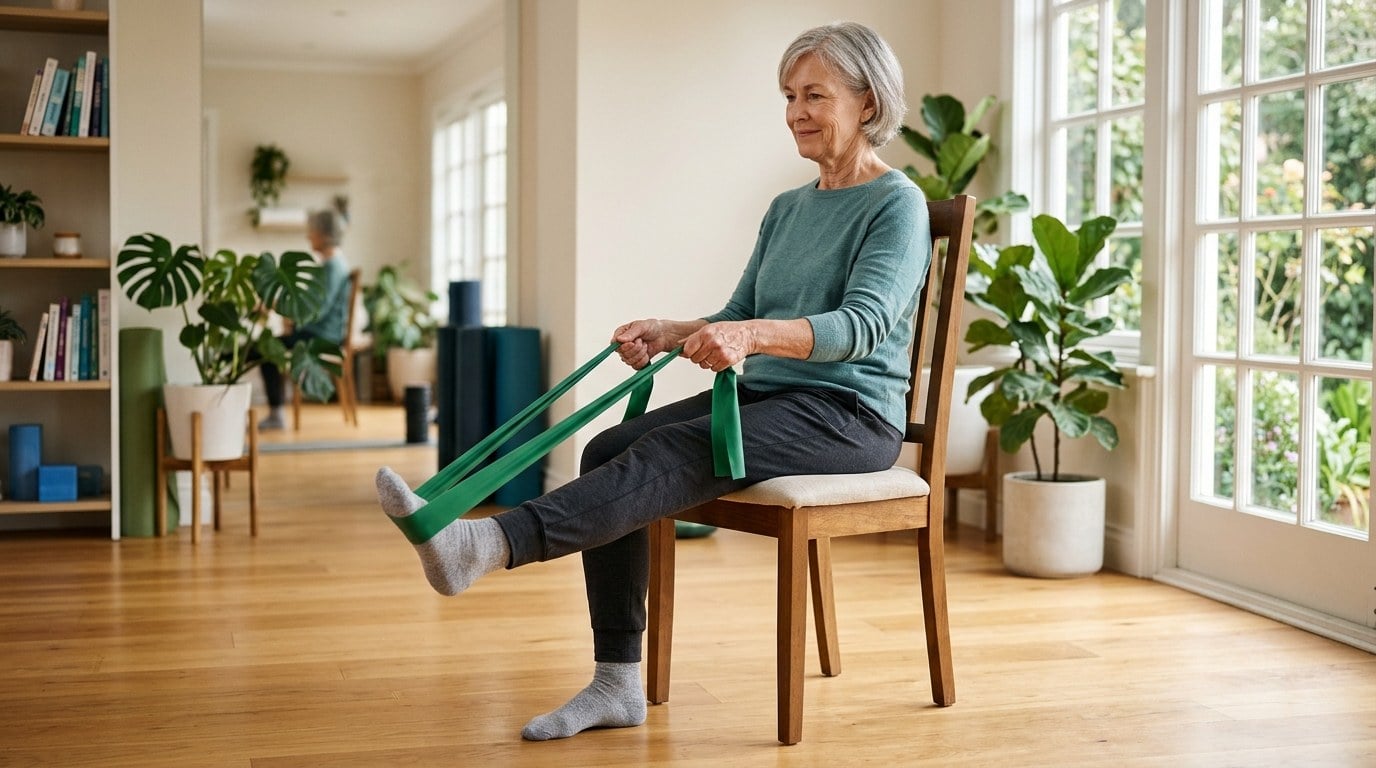
The AAOS describes ankle sprain rehabilitation in three phases. The table below pairs each phase with the evidence discussed in this article. Timing varies with severity, so no fixed calendar applies to every patient.
| Phase | Main goal | What it typically involves | Supporting evidence |
|---|---|---|---|
| 1. Protection | Settle pain and swelling | A short period of support, relative rest, ice, and elevation | AAOS; BJSM 2018 guideline on short immobilization |
| 2. Restoring motion and strength | Regain range of motion and load tolerance | Ending immobilization to avoid stiffness, then range-of-motion and strengthening exercises | AAOS; Bleakley 2010 early exercise trial |
| 3. Balance and return to activity | Rebuild control and prevent recurrence | Advanced strengthening, proprioception (joint position sense) and balance training, then a return to walking, stairs, and uneven ground | AAOS; Doherty 2017 overview; Hupperets 2009 trial |
Phase 3 is the one most often skipped. The AAOS states plainly: "Incomplete rehabilitation is the most common cause of chronic ankle instability after a sprain." That statement explains why the final phase matters as much as the first.
Why Sprains Recur: Chronic Ankle Instability
Chronic ankle instability means an ankle that keeps giving way or keeps spraining after the first injury has healed. Most people recover well from a first sprain. However, a real share do not, as the long-term studies above show.
The International Ankle Consortium, an international group of ankle researchers, reviewed this problem in 2016. Its evidence review states that "the recurrence rates of LASs are high" (LAS meaning lateral ankle sprain) and that a large percentage of patients go on to develop chronic ankle instability. It also links this chronic stage to lower physical activity, lower quality of life, and higher rates of post-traumatic ankle osteoarthritis.
That review describes the most active populations, where sprains are most studied. Its findings should be read with that population in mind.
Early Signs That Predict Instability
A prospective study of 82 people after a first-time sprain (Doherty and colleagues, American Journal of Sports Medicine, 2016) looked for early warning signs. People who could not complete two jumping and landing tasks within 2 weeks, and those with poorer dynamic balance and lower self-reported function at 6 months, were more likely to develop chronic instability.
These are associations, not proof of cause. However, they point to balance and controlled movement as the abilities worth measuring and rebuilding.
The American Family Physician review adds that the biggest risk factor for a sprain is a past sprain. It advises a recheck of serious sprains 4 to 6 weeks after injury for a loose ligament. As a result, the case for rehab is mostly a case for stopping the second sprain.
Prevention: What Balance Training Does and Does Not Prove
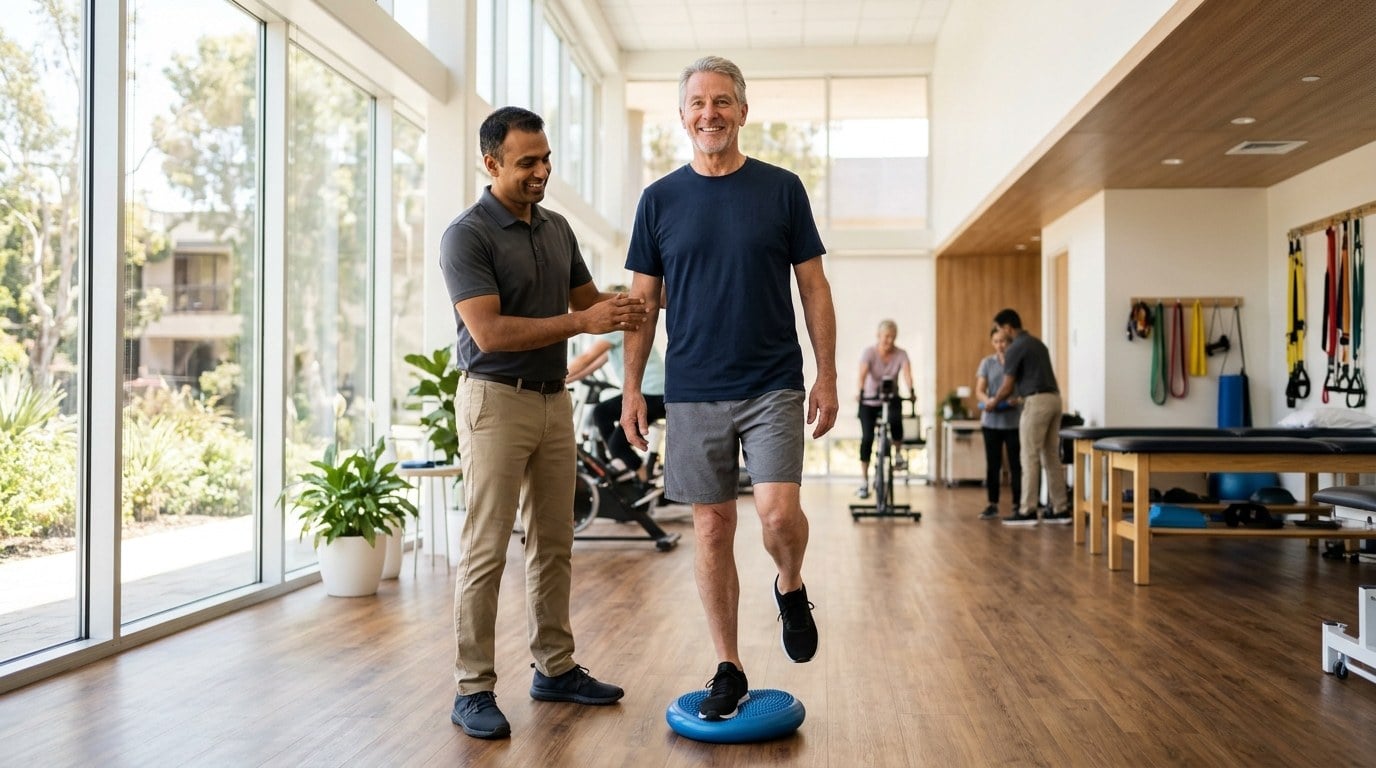
The strongest single trial on preventing recurrence was published in the BMJ in 2009 by Hupperets and colleagues. It enrolled 522 athletes aged 12 to 70 who had sprained an ankle within the previous two months.
The intervention group of 256 followed an eight-week unsupervised home proprioceptive training program; the control group of 266 did not. Self-reported recurrence was 22% in the training group and 33% in the control group, a relative risk of 0.63 (95% confidence interval 0.45 to 0.88). Nine people needed to complete the program to prevent one recurrence.
Two limits matter. First, the participants were athletes, and recurrence was self-reported. Second, among athletes whose original sprain had received medical treatment, the trial found no significant difference between groups.
Other reviews point the same way. The 2017 BJSM overview found moderate evidence for balance and control training, and strong evidence for bracing, to prevent a repeat sprain. The 2018 guideline also says braces "should be considered as an efficacious option" for this purpose.
For a 60-year-old, the honest reading is this: most prevention trials studied younger, active people. The principle, that balance and ankle control can be retrained, is consistent across the evidence, but the size of the benefit in older adults has not been measured directly.
Why It Matters More After 50
After 50, an unstable ankle is not only a sports concern. Balance, strength, and confidence in walking all feed into fall risk.
The CDC reports that "over 14 million, or 1 in 4 older adults report falling every year," and that falls are the leading cause of injury for adults aged 65 and older. A 2019 Cochrane review (Sherrington and colleagues) found high-certainty evidence that exercise programs reduce the rate of falls in community-dwelling older adults by about 23%.
No study reviewed for this article proves that a poorly rehabilitated sprain causes falls. Nevertheless, the abilities that sprain rehabilitation rebuilds, ankle strength, joint position sense, and balance on uneven ground, are the same abilities fall-prevention programs train. Readers who already feel unsteady when walking may find HWY's article on why people feel unsteady when walking useful alongside this one.
Two age-specific points are worth repeating. First, in the 2024 study of adults 65 and older presenting with ankle injuries, more than a third had a fracture. Second, the AAOS notes that elderly patients have a higher risk of complications after ankle fracture surgery. Both reinforce the value of a prompt, accurate diagnosis.
A note on scope: swelling that appears in both ankles without any injury is a different problem with different causes. That situation is covered in HWY's guide to why ankles swell after 50.
A Note for Families: Supporting a Parent After an Ankle Sprain
Adult children often learn about a parent's sprain after the fact, sometimes days later. The first priority is to confirm that the injury was examined, particularly if the parent is 65 or older or meets any item on the "See a Doctor Promptly If" list.
The second priority is to prevent a long period of inactivity. Prolonged rest can feel protective, yet the evidence favors early, guided movement. Limited movement is also one of the risk factors for blood clots the CDC lists.
Practical steps for families include:
- Asking whether an X-ray was considered, and why or why not.
- Clearing walkways and adding a stable handhold near stairs while the ankle is supported.
- Watching for the calf warning signs listed earlier.
- Encouraging a structured rehabilitation plan rather than an open-ended wait for the pain to stop.
A parent who completes rehabilitation is more likely to return to normal walking with confidence, which is the outcome families want most.
What Ankle Sprain Rehabilitation Looks Like at HWY Physical Therapy
HWY Physical Therapy specializes in adults over 50. Dr. Raj Pusuluri, PT, DPT, and the team build sprain rehabilitation around the phased approach described above, adjusted to each patient's health, activity level, and goals.
First, the evaluation reviews how the injury happened. It also screens for signs that need a doctor, including the Ottawa criteria. In Oregon, patients can see a physical therapist directly. The therapist refers to a doctor when the signs call for it.
Second, the therapist measures the abilities that matter most for recovery: ankle range of motion, strength, single-leg balance, walking pattern, and confidence on stairs and uneven ground.
Third, the plan progresses through protection, strength, and balance. Sessions in the clinic use supervised exercise and balance work. Home exercise is prescribed between visits and progressed as the ankle tolerates more load.
Fourth, the plan ends with a return to the activities the patient cares about, such as walking outdoors, gardening, or travel, rather than at the point when pain stops.
For patients who prefer to begin from home, HWY offers a virtual Wellness Video Call through its "Start From Home" telehealth option. A therapist can review the injury, check the warning signs, demonstrate early exercises on screen, and advise whether an in-clinic evaluation is the right next step.
HWY Physical Therapy also offers the Neubie, a direct-current stimulation device. It is FDA-cleared for uses that include pain management, range of motion, and retraining muscles. It is not cleared for ankle sprains, and it is not the core of sprain rehab. Exercise and balance training are.
Readers who want more detail on treatment techniques can see HWY's deeper guide to physical therapy for a sprained ankle.
Frequently Asked Questions
How long does a sprained ankle take to heal after 50?
Most ankle sprains resolve in two to six weeks, according to the American Family Physician review, and the AAOS gives a range of 2 weeks for minor sprains up to 6 to 12 weeks for severe injuries. A systematic review found that 5% to 33% of patients still had pain after a year, so full recovery depends heavily on completing rehabilitation.
How can someone tell whether an ankle is sprained or broken?
A sprain and a fracture can look very similar, so a clinician applies the Ottawa Ankle Rules. Tenderness over specific bony points, or an inability to take four steps both right after the injury and at the examination, indicates an X-ray. Walking does not rule out a fracture.
Should an older adult always get an X-ray after an ankle injury?
Not always, but the threshold should be low. The Ottawa Ankle Rules remained highly sensitive in two studies of older adults. However, one group of researchers proposed imaging everyone aged 65 or older, and another study found fractures in more than a third of adults 65 and older presenting with ankle injuries.
Is it better to rest a sprained ankle or move it?
The evidence favors early, guided movement over prolonged rest. A brief period of protection helps with pain and swelling, but early mobilization and exercise improve function. A trial of 101 patients found better ankle function at one and two weeks when therapeutic exercise started in the first week.
Why does the same ankle keep spraining?
A previous sprain is the greatest risk factor for another one. The AAOS identifies incomplete rehabilitation as the most common cause of chronic ankle instability. Balance and neuromuscular training reduced self-reported recurrence in a large trial of athletes.
Does a sprained ankle ever need surgery?
Rarely. The AAOS describes surgical treatment of ankle sprains as rare, and the 2018 BJSM guideline states: "Surgery should be reserved for cases that do not respond to thorough and comprehensive exercise-based treatment."
Steadier, Stronger Ankles at HWY Physical Therapy
A sprained ankle usually recovers well when it is diagnosed accurately, moved early, and rehabilitated through to balance training. For adults over 50, completing that last phase protects both the ankle and overall walking confidence.
To schedule a Wellness Video Call or an in-clinic evaluation, contact HWY Physical Therapy at (971) 202-1979 or book online. HWY Physical Therapy is direct-pay, no insurance required.
HWY Physical Therapy Serving adults 50 and over in Salem, Oregon.
North Salem: 2615 Portland Rd NE, Salem, OR 97301 (at Center 50+). Walk-ins welcome. South Salem: HWY Physical Therapy Clinic South Salem, 180 Ramsgate Square S, Salem, OR 97302. By appointment only.
Phone (both locations): (971) 202-1979 Hours: Monday to Friday, 8:00 AM to 5:00 PM
Sources
- Tiemstra JD. "Update on Acute Ankle Sprains." American Family Physician, 2012;85(12):1170-1176. https://www.aafp.org/pubs/afp/issues/2012/0615/p1170.html
- Stiell IG, et al. "Decision rules for the use of radiography in acute ankle injuries. Refinement and prospective validation." JAMA, 1993. PMID 8433468. https://pubmed.ncbi.nlm.nih.gov/8433468/
- Bachmann LM, Kolb E, Koller MT, Steurer J, ter Riet G. "Accuracy of Ottawa ankle rules to exclude fractures of the ankle and mid-foot: systematic review." BMJ, 2003;326(7386):417. https://pmc.ncbi.nlm.nih.gov/articles/PMC149439/
- Seyhan AU, et al. "The role of Ottawa ankle rules in geriatric emergency department visits." Ulusal Travma ve Acil Cerrahi Dergisi, 2024. PMID 38634845. https://pubmed.ncbi.nlm.nih.gov/38634845/
- Murphy J, et al. "Utility of Ottawa Ankle Rules in an Aging Population: Evidence for Addition of an Age Criterion." Journal of Foot and Ankle Surgery, 2020;59(2):286-290. PMID 32130992. https://pubmed.ncbi.nlm.nih.gov/32130992/
- American Academy of Orthopaedic Surgeons, OrthoInfo. "Sprained Ankle." https://www.orthoinfo.org/en/diseases--conditions/sprained-ankle/
- American Academy of Orthopaedic Surgeons, OrthoInfo. "Ankle Fractures (Broken Ankle)." https://www.orthoinfo.org/en/diseases--conditions/ankle-fractures-broken-ankle/
- Vuurberg G, et al. "Diagnosis, treatment and prevention of ankle sprains: update of an evidence-based clinical guideline." British Journal of Sports Medicine, 2018;52(15):956. PMID 29514819. https://pubmed.ncbi.nlm.nih.gov/29514819/
- van Rijn RM, et al. "What is the clinical course of acute ankle sprains? A systematic literature review." American Journal of Medicine, 2008;121(4):324-331. PMID 18374692. https://pubmed.ncbi.nlm.nih.gov/18374692/
- Doherty C, Bleakley C, Delahunt E, Holden S. "Treatment and prevention of acute and recurrent ankle sprain: an overview of systematic reviews with meta-analysis." British Journal of Sports Medicine, 2017;51(2):113-125. PMID 28053200. https://pubmed.ncbi.nlm.nih.gov/28053200/
- Lamb SE, et al. "Mechanical supports for acute, severe ankle sprain: a pragmatic, multicentre, randomised controlled trial." Lancet, 2009;373(9663):575-581. PMID 19217992. https://pubmed.ncbi.nlm.nih.gov/19217992/
- Bleakley CM, et al. "Effect of accelerated rehabilitation on function after ankle sprain: randomised controlled trial." BMJ, 2010;340:c1964. PMID 20457737. https://pubmed.ncbi.nlm.nih.gov/20457737/
- Gribble PA, et al. "Evidence review for the 2016 International Ankle Consortium consensus statement on the prevalence, impact and long-term consequences of lateral ankle sprains." British Journal of Sports Medicine, 2016. PMID 27259753. https://pubmed.ncbi.nlm.nih.gov/27259753/
- Doherty C, et al. "Recovery From a First-Time Lateral Ankle Sprain and the Predictors of Chronic Ankle Instability: A Prospective Cohort Analysis." American Journal of Sports Medicine, 2016;44(4):995-1003. PMID 26912285. https://pubmed.ncbi.nlm.nih.gov/26912285/
- Hupperets MD, Verhagen EA, van Mechelen W. "Effect of unsupervised home based proprioceptive training on recurrences of ankle sprain: randomised controlled trial." BMJ, 2009;339:b2684. https://pmc.ncbi.nlm.nih.gov/articles/PMC2714677/
- Centers for Disease Control and Prevention. "Older Adult Falls Data." https://www.cdc.gov/falls/data-research/index.html
- Sherrington C, et al. "Exercise for preventing falls in older people living in the community." Cochrane Database of Systematic Reviews, 2019. PMID 30703272. https://pubmed.ncbi.nlm.nih.gov/30703272/
- Centers for Disease Control and Prevention. "About Venous Thromboembolism (Blood Clots)." https://www.cdc.gov/blood-clots/about/index.html
