Your parent takes smaller steps or shuffles. Learn what gait changes after 75 mean, which signs need a doctor, and what physical therapy can rebuild.
You noticed it in a parking lot, or on the path from the car to the front door.
You slowed down. Not on purpose. You matched your mother's pace without thinking about it, the way you would with a small child. A second later you realized what you had just done.
That moment is usually what brings people to a page like this. Something about the way your parent walks has changed, and nobody in the family has said it out loud yet.
Maybe the steps are smaller. Maybe the feet are not really lifting, so the shoes scrape on the tile. Maybe the walk from the car now takes twice as long as it did two years ago, and you are both politely pretending it does not.
This guide is written for you, the adult child, not for your parent. It explains what a change in walking actually signals, which patterns belong in a doctor's office first, and what a physical therapist can genuinely rebuild.
Here is the short version. Some slowing is common with age. That does not make it meaningless, and it does not make it a sentence either. The pattern of the change tells you far more than the speed alone.
First: what needs a phone call, and when
Most gait changes build slowly. A few do not. Sort your parent into the right box before you read anything else.
Call 9-1-1 for one thing only
If the change in walking came on suddenly, over hours or a single day, treat it as a stroke until a doctor says otherwise. The CDC lists "sudden trouble walking, dizziness, loss of balance, or lack of coordination" among the warning signs of stroke, and says to call 9-1-1 right away.
Sudden means sudden. A walk that got worse over six months is a different conversation, and the rest of this article is about that conversation.
Book a doctor's appointment soon for any of these
- A shuffle that appeared over weeks, not years
- A new tremor in a hand, an arm, or the chin
- Handwriting that has become small or cramped
- A new problem with bladder control that started around the same time as the walking change
- New confusion or memory change alongside the walking change
- New numbness or clumsiness in the hands, such as dropping things or fumbling buttons
- A fall in the last six months, even one they laughed off
- A new lean to one side, or one foot that drags
- A new medicine started in the last few months
- Pain that makes them limp
None of those are emergencies. All of them are reasons to get on the calendar rather than wait for the next routine visit.
"Slower" and "shuffling" are two different signals
This is the most useful thing on this page, so it gets its own two sections.
A parent who walks slower and a parent who shuffles are usually telling you about two different problems. Families tend to lump them together as "getting old." Clinicians do not.
Slower usually points at the engine
Walking speed drops when the body has less to work with. Less leg strength. Less endurance. Less confidence. More pain in a hip, a knee, or a foot.
Some reduction is ordinary. Studies comparing healthy people in their 70s with healthy people in their 20s show roughly a 10 to 20 percent reduction in walking speed and stride length in the older group, according to the American Academy of Family Physicians.
Slowness on its own, with a normal-looking step, is the more reassuring pattern. It is also the pattern that responds best to training. That does not mean you ignore it. It means the first stop is usually a therapist, not a specialist.
Shuffling points somewhere else
A shuffle means the foot is not clearing the ground. Step height has dropped. The sole drags, scrapes, or barely leaves the floor.
That is a different list of causes, and several of them are neurological.
The family medicine literature describes a shuffling, short-stepped walk with a stooped posture and a reduced arm swing as the classic parkinsonian pattern. It describes a "magnetic" walk, with hesitation at the start and at turns, as a frontal gait disorder. It links that second pattern to normal-pressure hydrocephalus, among other causes.
A new shuffle deserves a doctor's eyes, not just a therapist's. That is not a scare line. It is about getting the right door first.
How to tell them apart without any training
You do not need a clinical eye for this. You need ten minutes and permission to watch.
- Watch the feet, not the face. Does the toe clear the floor on each step, or skim it?
- Listen. A shuffle is audible. You will hear a scrape on tile or a hiss on carpet.
- Watch the first step. Is starting to walk harder than walking? Hesitation at the start is a specific signal.
- Watch a turn. Does your parent turn smoothly, or pivot in one block with several tiny steps?
- Watch the arms. Has one arm stopped swinging?
- Watch the width. Are the feet unusually far apart, like someone bracing on a boat?
- Watch the posture. Is the trunk drifting forward, with hips and knees slightly bent?
Write down what you see. A short note that says "small steps, right arm not swinging, hard to start, turns in one block" is far more useful to a physician than "Mom is slower."
What the numbers actually mean
You will find walking speed statistics everywhere online. Most of them are reported badly. Here is the honest version.
The survival finding, and what it does not say
In 2011, researchers pooled nine long-term studies of 34,485 community-dwelling adults aged 65 and over and followed them for 6 to 21 years. Walking speed was associated with survival in all nine studies. Each additional 0.1 meters per second of usual walking speed carried a pooled hazard ratio of 0.88.
Now the part that matters more than the number.
This was observational research. It watched people over time. It did not change anything about them.
Walking speed works as a marker of how the whole body is doing, in the same way a resting heart rate is a marker. It is not a cause of how long someone lives.
So pushing your father to walk faster will not, by itself, add years to his life. What a slow walk does is flag that something is worth looking at. That is its real value, and it is a genuinely useful one.
The screening thresholds a clinician uses
A European expert group on age-related muscle loss uses two practical cut-offs. A usual walking speed of 0.8 meters per second or slower is one. Taking longer than 15 seconds to rise from a chair five times is the other.
Those numbers mark the point where a clinician looks closer. They are screening thresholds, not diagnoses, and not verdicts. Plenty of people cross one of them and are fine. Plenty of people sit just above one and still need help.
Timing a 4-meter walk at home
The same group notes that a 4-meter walk is a commonly used way to measure this. You can do a rough version at home, with your parent's agreement and never as a surprise test.
- Find a clear, level hallway with good light and nothing on the floor.
- Mark a start line and a finish line 4 meters apart. That is about 13 feet.
- Give your parent a few steps of run-up before the start line.
- Ask them to walk at their usual everyday pace, not their best pace.
- Let them use their cane or walker if that is what they normally use.
- Start timing when the lead foot crosses the start line, stop when it crosses the finish line.
- Divide 4 by the number of seconds. That is meters per second.
Stay beside them, not in front. Skip it entirely if they are unsteady on their feet without support, and read our guide on an aging parent who is unsteady instead.
Treat your result as a rough reading, not a measurement. One study of 1,177 older adults compared four different versions of the same 4-meter test and found the measured share of "slow" walkers moved substantially depending on which version was used. A stopwatch in a hallway is not a clinic sensor. The number is a conversation starter for the doctor's visit, and nothing more.
Three patterns that need a doctor first, not a therapist
We are a physical therapy clinic, and we are telling you plainly that these three belong to a physician. We do not diagnose them, and a therapist who lets you skip that step is doing you no favors.
Parkinsonism
The classic walking pattern is short, shuffling steps with the hips, knees, and spine slightly flexed, turns taken in one block, and a reduced arm swing. It usually comes with slowed movement, muscle stiffness, and often a tremor at rest.
Parkinson disease most often develops after age 60. Early signs can be easy to dismiss, including a mild tremor or a slight feeling that one leg is stiff and dragging. Trouble starting a movement, such as starting to walk or standing up from a chair, is another.
We are not going to write a Parkinson guide here, because that conversation belongs with a neurologist. If this description fits what you have been watching, that referral is the next step, and it is worth asking for by name.
Normal pressure hydrocephalus
This one gets missed, and it is the reason the bladder question is on our list above.
Normal pressure hydrocephalus involves a buildup of fluid around the brain. It classically presents as a combination of three things: a progressive walking problem, changes in thinking or memory, and urinary urgency or incontinence. Clinicians call that grouping the Hakim-Adams triad.
The walking change is usually the first of the three to show up. Reported patterns include shuffling, "magnetic," and wide-based walking, with slow speed, short steps, and a broad stance. Mean age at symptom onset is around 70.
It matters because it is described in the medical literature as a potentially reversible cause of dementia. A family that writes off the walking, the confusion, and the bladder trouble as three separate signs of aging can miss a treatable condition. If all three showed up together, say all three out loud at the appointment.
Cervical myelopathy
This is pressure on the spinal cord in the neck, usually from age-related changes to the spine.
The combination to watch for is a walking problem plus the hands. Family medicine describes a wide-based, unsteady walk together with decreased hand dexterity, including a change in handwriting and clumsiness.
A StatPearls review says patients typically present with hand or finger clumsiness and trouble walking. That review cites a summary of 61 studies in which gait disturbance appeared in roughly 72 percent of cases.
The average age at presentation is 64. Onset is usually gradual, and it tends to progress in steps rather than smoothly, though the rate varies a lot between people.
The tell is the hands. Neck arthritis alone does not make buttons hard. If your parent's walking changed and they have started dropping things, fumbling with zippers, or writing differently, that pairing belongs in front of a physician quickly.
Four everyday causes that get missed
Not everything on this page is neurological. In fact the most common story is a stack of small things, none of them dramatic.
One family medicine study found gait and balance disorders were multifactorial in 75 percent of older patients. The most common single problems identified in that group were arthritis, at 37 percent, and orthostatic hypotension, meaning a blood pressure drop on standing, at 9 percent.
Here are four worth checking before you assume the worst.
Medicines
The same source notes that taking four or more medicines, as well as certain specific classes, can lead to gait disorders and a higher rate of falls. The CDC puts it plainly: side effects from these drugs "can cause drowsiness, loss of balance, changes in vision, slower reaction time, and other effects that increase the risk of falling."
Ask your parent's pharmacist or physician for a medication review. It is a routine request, it is free of drama, and it is often the fastest win available.
Shoes
This one is almost embarrassing in how often it matters. In a study of 111 community-dwelling older adults attending a geriatric day hospital, 72 percent were wearing shoes that did not fit correctly on both feet, 90 percent had smooth or worn sole tread, and 67 percent reported wearing slippers at home.
The authors called their sample relatively small, did not measure shoe width, and did not assess home footwear directly. Even so, the picture is worth acting on. Go and look in the closet. A worn sole and a loose slipper both make a foot drag.
Foot and joint pain
A painful walk is a shortened, guarded walk. The classic pain pattern is limping with slow, short steps, limited motion, and reluctance to put full weight through one side.
Pain changes the walk before the person admits to the pain. If one hip or knee is the culprit, our guide on hip pain when walking covers how to sort out where it is coming from.
Fear
A frightened walk has its own signature. Family medicine describes it as careful and slow, wide-based, with the arms and legs held out, turning in one block, "like walking on ice." It is linked with deconditioning, with the period after a fall, and with poor vision.
Fear of falling is not rare. In a cross-sectional survey of 4,031 community-dwelling Dutch adults aged 70 and over, 54.3 percent reported fear of falling and 37.9 percent reported avoiding activity because of it. That is an association, not a cause, and the survey looked at one moment in time.
It matters because avoidance is a loop. Less walking means less strength, and less strength gives the fear a real basis.
What can genuinely be rebuilt, and what cannot
Now the useful part.
Walking speed responds to training. A 2015 meta-analysis pooled 25 studies and 2,389 older adults, with a mean age of 75.8.
Progressive resistance training improved usual walking speed by an average of 0.13 meters per second. The 95 percent confidence interval ran from 0.09 to 0.16. Interventions with a rhythmic component improved it by 0.07 meters per second.
The authors concluded that progressive resistance training at high intensities "seems the most effective exercise modality for improving preferred gait speed." They also noted real differences in health status between the study populations.
A large Cochrane review of resistance training in older adults reported a similar figure, a mean difference of 0.08 meters per second across 24 trials and 1,179 participants.
Is that actually enough to notice?
Fair question, and there is a reasonable answer. Researchers examining meaningful change in older adults described small meaningful change in gait speed as near 0.05 meters per second and substantial change as near 0.10 meters per second. They called these "best initial estimates," and they drew them from older adults with mobility problems, stroke survivors, and community-dwelling older people.
So the average training effect in those reviews sits in the range that people notice in daily life. Those are group averages, not a promise for any individual.
What improves
- Leg and hip strength. The most reliable gain, and the one that drives the others.
- Step length. Stronger legs and better hip motion produce a longer step, which raises speed without hurrying.
- Endurance. Walking to the mailbox and back without stopping is a trainable skill.
- Confidence. Practicing a difficult movement safely, repeatedly, under supervision is how fear loses its grip.
- Foot clearance, where the cause is mechanical. Weak hip flexors and stiff ankles are treatable.
What does not
Physical therapy does not treat the underlying disease in Parkinson disease, normal pressure hydrocephalus, or cervical myelopathy. It can help someone move better while their physician manages the condition. It is not a substitute for that care, and anyone who suggests otherwise is selling something.
Age itself does not reverse. The goal is not to give your mother the walk she had at 60. It is to widen the margin between what she can do and what her day demands.
Family medicine rates it fairly: "Exercise and physical therapy can help improve gait and balance disorders in older adults." That is a Grade B recommendation, which means good evidence, not certainty.
How to raise it with a parent who does not want to hear it
This is the part nobody writes about, and it is usually the actual obstacle.
Your parent has spent a lifetime being the capable one. A conversation that sounds like an assessment will be refused, and refusing it is a reasonable response to being managed.
The goal is their independence, not their compliance. Lead with that, and mean it.
Sentences that tend to work
- "I noticed I was walking slower next to you the other day. Has anything changed for you?"
- "What is harder now than it was last year?"
- "Is there anywhere you have stopped going because getting there is a hassle?"
- "I would like to come to your next appointment. Not to talk for you. Just to listen."
- "You know your body. I only see you once a month, so I notice the change more than you do. Tell me if I am wrong."
- "If we could get you steadier on the stairs, would that be worth six weeks of work?"
What to avoid saying
- "You are shuffling." Naming a deficit invites a denial.
- "You could have fallen." Prediction sounds like a threat.
- "Dad, you need to see someone about this." An instruction from a child to a parent lands badly.
- Anything said in front of grandchildren, or in a group.
- Anything that starts with "at your age."
If they say no
Accept the no, and keep the door open. Ask if you may bring it up again after the next appointment. Offer something small and concrete instead, such as a shoe check or a medication review with the pharmacist, because both are easy to agree to and both genuinely help.
If the situation is more advanced and your parent is struggling to get up at all, that is a different problem with a different starting point. Our guide on a parent who is too weak to get out of bed covers it.
What a physical therapy gait evaluation looks like
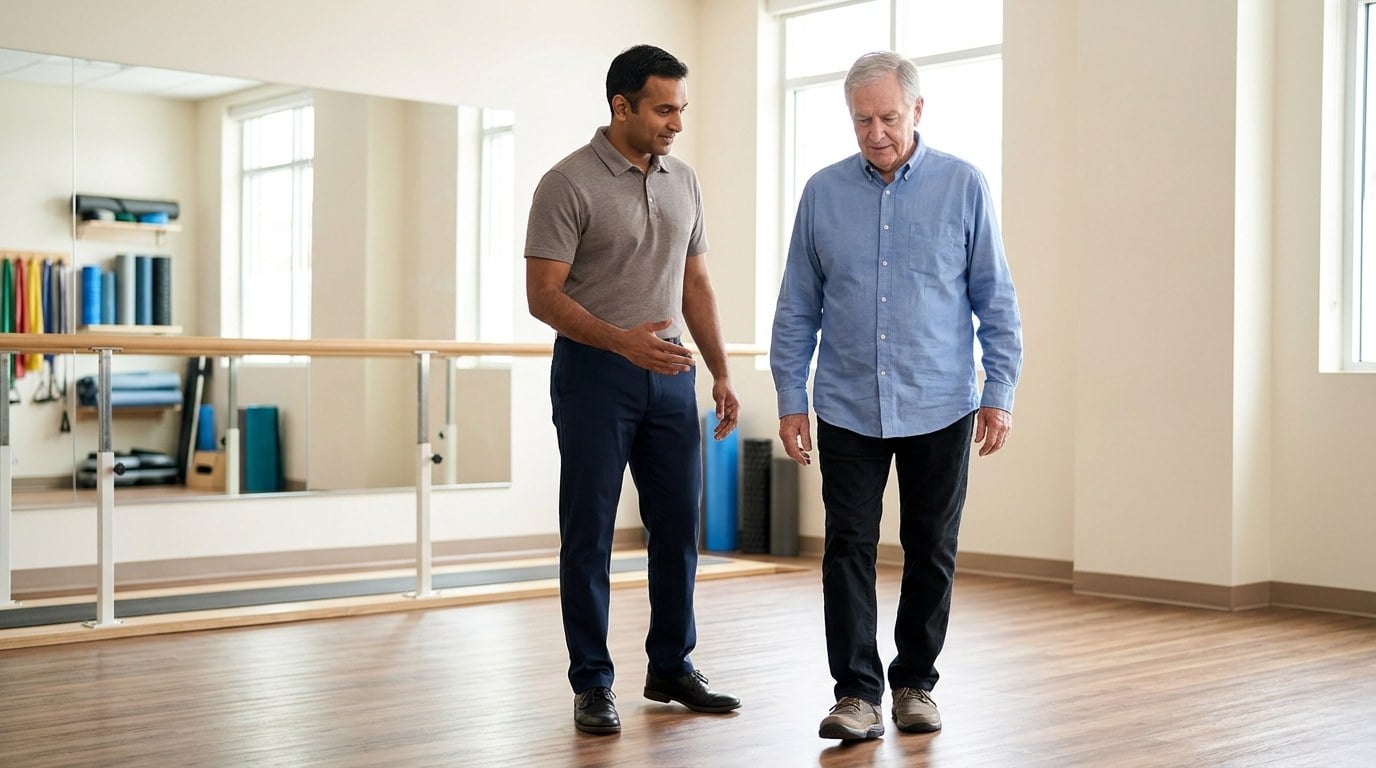
Knowing what happens removes most of the resistance. Here is the shape of it.
- History. What changed, when, and how fast. Falls. Medicines. Other conditions. What they have stopped doing.
- Watching them walk. Down a hallway, at usual pace. The therapist is looking at step length, step height, arm swing, width, turns, and how the walk starts.
- Timed measures. Usually a walking speed test and a chair-rise test, so there is a number to compare against later.
- Strength and range of motion. Hips, knees, ankles. Where the leverage is missing.
- Balance testing. Standing, turning, and reacting.
- Sensation and reflex screening. Enough to decide whether a physician needs to look before therapy goes further.
- A plan with a review date. Specific goals, and a stated point at which progress is measured again.
That last item is the one to insist on. Ask for the starting numbers in writing and ask when they will be re-checked.
Our guide to a first physical therapy visit after 50 walks through the practical details, including what to bring.
How we work with families
HWY Physical Therapy is a direct-pay clinic focused on adults over 50. Dr. Raj Pusuluri, PT, DPT, leads the care. Direct-pay means no insurance is required and no referral is needed to book.
We do not visit homes. If your parent cannot travel to a clinic, home health is arranged through their physician, and that is the right route.
What we do offer instead is a Wellness Video Call, a virtual visit you can sit in on. That matters when you live an hour away, or three states away. You can hold the tablet, describe what you have been seeing, and hear the answer at the same time your parent does. Many families start there.
One note on our equipment, because people ask.
We use a device called the Neubie, an FDA-cleared direct current stimulator that is different from a TENS unit, and we are the only clinic in the area using it. It is not the answer to a gait change. We use it in clinic only, and only where it fits the case.
Frequently asked questions
Is slow walking just a normal part of aging?
Some slowing is ordinary. Gait disorders were detected in roughly 25 percent of people aged 70 to 74 and nearly 60 percent of those aged 80 to 84 in one study, so being common is not the same as being harmless. A change in the pattern of the walk, rather than the pace, is what deserves attention.
My parent shuffles but seems fine otherwise. Do I still push for a doctor?
Yes. A shuffle means the foot is not clearing the ground, and several causes of that are neurological and worth identifying early. Having it checked takes one appointment. Leaving a treatable condition alone can take far more than that.
They refuse to see anyone. What do I do?
Start with the smallest door. A shoe check and a pharmacist medication review are both easy to accept and both address real causes. Success with something small often makes the bigger conversation possible.
Can physical therapy help if they already have Parkinson disease?
A therapist can work on strength, step length, balance, and confidence while a neurologist manages the condition. Therapy does not treat the disease itself, and we will always say so. Ask their physician what fits their case.
I live out of state. Is there anything useful I can do?
Yes. Write down what you observe on each visit, including the specifics of the pattern. Ask to join the next medical appointment by phone. A virtual visit is also an option you can attend with them.
How long before we would see a change?
The training studies above generally ran for weeks, not days, and reported average group improvements rather than individual promises. Ask for starting measurements and a defined review date, then judge the plan against those numbers.
Talk to someone about your parent's walking
If something about the way your parent walks has changed, the useful next step is a conversation with a clinician who works with older adults every day.
Book a Wellness Video Call here: https://meetings.hubspot.com/raj-pusuluri/virtual-pt-visit?uuid=29177845-1ade-43b0-87d2-1cba35e0a730
Or call (971) 202-1979. You are welcome to join the call with your parent.
HWY Physical Therapy 2615 Portland Rd NE, Salem, OR 97301 (at Center 50+) Walk-ins welcome
HWY Physical Therapy Clinic South Salem 180 Ramsgate Square S, Salem, OR 97302 By appointment only
Phone for both locations: (971) 202-1979 Hours: Monday to Friday, 8:00 AM to 5:00 PM Direct-pay, no insurance required.
Sources
- Studenski S, Perera S, Patel K, et al. Gait speed and survival in older adults. JAMA. 2011;305(1):50-58. https://pubmed.ncbi.nlm.nih.gov/21205966/
- Cruz-Jentoft AJ, Bahat G, Bauer J, et al. Sarcopenia: revised European consensus on definition and diagnosis (EWGSOP2). Age and Ageing. 2019. https://pmc.ncbi.nlm.nih.gov/articles/PMC6322506/
- Salzman B. Gait and balance disorders in older adults. Am Fam Physician. 2010;82(1):61-68. https://www.aafp.org/pubs/afp/issues/2010/0701/p61.html
- Degenerative cervical myelopathy: recognition and management. Am Fam Physician. 2020;102(12):740-750. https://www.aafp.org/pubs/afp/issues/2020/1215/p740.html
- Margetis K, Donnally CJ 3rd. Cervical myelopathy. StatPearls. https://www.ncbi.nlm.nih.gov/books/NBK482312/
- Margetis K, Das JM, Biagioni MC. Idiopathic normal pressure hydrocephalus. StatPearls. https://www.ncbi.nlm.nih.gov/books/NBK542247/
- MedlinePlus Medical Encyclopedia. Parkinson disease. https://medlineplus.gov/ency/article/000755.htm
- Centers for Disease Control and Prevention. Stroke signs and symptoms. https://www.cdc.gov/stroke/signs-symptoms/index.html
- Centers for Disease Control and Prevention. STEADI pharmacy care. https://www.cdc.gov/steadi/hcp/clinical-resources/pharmacy-care.html
- O'Rourke B, Walsh ME, Brophy R, et al. Does the shoe really fit? BMC Geriatrics. 2020. https://pmc.ncbi.nlm.nih.gov/articles/PMC7020372/
- Zijlstra GAR, van Haastregt JCM, van Eijk JTM, et al. Prevalence and correlates of fear of falling. Age and Ageing. 2007. https://pubmed.ncbi.nlm.nih.gov/17379605/
- Van Abbema R, De Greef M, Craje C, et al. What type, or combination of exercise can improve preferred gait speed in older adults? BMC Geriatrics. 2015. https://pmc.ncbi.nlm.nih.gov/articles/PMC4488060/
- Liu CJ, Latham NK. Progressive resistance strength training for improving physical function in older adults. Cochrane Database Syst Rev. 2009. https://pubmed.ncbi.nlm.nih.gov/19588334/
- Perera S, Mody SH, Woodman RC, Studenski SA. Meaningful change and responsiveness in common physical performance measures in older adults. J Am Geriatr Soc. 2006;54:743-749. https://pubmed.ncbi.nlm.nih.gov/16696738/
- Kim M, Won CW. Combinations of gait speed testing protocols (automatic vs manual timer, dynamic vs static start) can significantly influence the prevalence of slowness: results from the Korean Frailty and Aging Cohort Study. Arch Gerontol Geriatr. 2019. https://pubmed.ncbi.nlm.nih.gov/30623866/
- NeuFit. The Neubie. https://www.neu.fit/the-neubie
.png)