You are seventh in line at the grocery store. The person at the front is arguing about a coupon.
And you start doing the math. How many more minutes. Whether you can lean on the cart handle without looking like you need to. Whether anyone would notice if you shifted your weight again, and again, and again.
Then comes the part nobody talks about. You start scanning for a chair.
This happens at church. At the museum. At the pharmacy counter. Standing at the stove long enough to finish cooking dinner. It is a small thing that quietly removes large things from your life.
Most people over 50 file this under "getting older" and stop there. That is the wrong file.
Difficulty standing for long periods is not one problem. It is four different problems with four different fixes, plus a fifth thing that sits underneath all of them. The good news is that you can usually tell which one is yours from your own kitchen this week.
Is this you? Let us make sure you are in the right place
This article is about standing endurance. You can stand. You are not dizzy. You are not afraid of falling over. But you are unable to stand for long periods, and somewhere between two and fifteen minutes something makes you stop.
That "something" is the clue. It might be an ache in your low back. A heaviness in your calves. A burning down one leg. A deep pain in the groin or the front of the knee. Or a general sense that your legs are simply done.
If that is you, keep reading. If one of the following fits you better, we have written about it separately:
Still here? Good. Let us start with the part that matters most.
First: the signs that mean stop reading and get medical care
Almost everything in this article is a slow, fixable problem. A few things are not. Please read this section before anything else.
Get emergency care today, not an appointment next week, if you have any of these.
Loss of bowel or bladder control, with numbness between your legs. The American Academy of Orthopaedic Surgeons calls cauda equina syndrome "a medical emergency that requires prompt treatment." The warning signs they list are numbness in the saddle area, losing control of bowel or bladder function, and losing strength in your legs so that you cannot walk. Do not wait to see whether it passes.
Pain in your foot or toes while you are resting or lying in bed. Also a sore or ulcer on your foot or toes that will not heal, or a foot that looks pale, blue, mottled, or feels cold. Clinical guidance describes these as signs of critical limb-threatening ischemia, which means the blood supply to the foot is failing. That needs a vascular assessment quickly.
Swelling in one leg with pain, warmth, or redness. This can be a blood clot in a deep vein. The National Heart, Lung, and Blood Institute is blunt about it: call your provider right away if you think you have symptoms.
One honest caveat on that last one. Clinical sources state plainly that diagnosing a deep vein clot from symptoms alone is notoriously inaccurate, because the signs are non-specific. That cuts both ways. It means you cannot rule it in from this article, and you cannot rule it out either. It means a doctor looks at it.
Here is something worth knowing about physical therapists in Oregon. State law does not just permit us to refer you out. It requires it.
Under ORS 688.132, a physical therapist must refer you immediately if your symptoms need a medical provider. The same applies if the problem sits outside what physical therapy should handle. Walk into our clinic with something that belongs in a vascular lab, and sending you there is our legal duty, not a courtesy.
The four reasons you cannot stand for long
Here is the thing nobody tells you. Two people can both say "I can't stand for more than five minutes," and have completely different problems.
Read all four. Most people recognize themselves in one within a sentence or two. Some people have two of them at once, and that is normal too.
Cause 1: Your spinal canal narrows when you stand up straight
This one is called lumbar spinal stenosis, and the leg symptoms it produces are called neurogenic claudication.
The signature is unmistakable once you know it. Standing and walking upright bring the symptoms on. Sitting down or leaning forward makes them go away. Clinical texts describe symptoms that develop from extending the back while standing, then "promptly resolve by subsequently leaning forward 20 to 40 degrees at the waist."
There is a reason for that. Standing up straight and arching slightly narrows the space where the nerves travel. Leaning forward opens it back up. The nerves get room again.
Clinical texts treat this as the defining feature of the condition. Arching the low back increases the pain, and bending it forward decreases the pain. Position, not effort, is the switch.
This is why so many people push a grocery cart comfortably but cannot stand in the checkout line. Clinicians call it the shopping cart sign. The AAOS puts it in plain patient language: "People with spinal stenosis often feel better when they lean forward or sit down. Standing up straight or walking usually make the pain worse."
How you might describe it yourself: burning or aching in the buttocks and down the legs, often both legs, often above the knees. Numbness or tingling. Sometimes weakness. Better on a stationary bike than on a walk, because you are bent forward on the bike.
It shows up most often after age 60.
Cause 2: Your leg muscles are not getting enough blood
This one is peripheral artery disease, and the leg pain it causes is called vascular claudication. It is the cause most often mistaken for the first one, and telling them apart is genuinely useful.
Clinical texts define it as "cramping pain in the lower extremities that occurs with walking or exertion and resolves with rest." Narrowed arteries can supply the muscle at rest but not when it is working hard. Slow down or stop, and the blood supply catches up.
Here is the single most useful distinction in this whole article.
Vascular claudication is brought on by effort. It is relieved by stopping, in any position. You can stand still at the curb and it eases.
Neurogenic claudication is brought on by posture. Standing still does not fix it. You have to sit down or bend forward. A clinical review of lumbar spinal stenosis states it directly: patients with vascular claudication often improve with rest while standing, whereas those with neurogenic claudication need to sit down or lean over.
Researchers have actually put this to the test. In one crossover study, 55 people walked on a treadmill in two trunk positions, upright and leaned forward. The 23 with spinal stenosis lasted longer before symptoms changed when they walked leaned forward. The 14 with peripheral artery disease showed no difference between the two positions.
The authors put the everyday version of it plainly: in artery disease "patients need to stop their activity," while in spinal stenosis "patients need to adopt a bending forward posture or to sit down."
Hold that study loosely. Fifty-five people is a modest sample, and the authors said so themselves. They also could not access medical records to confirm each diagnosis, so some participants may have been misclassified or had both conditions at once.
So ask yourself one question. When the symptoms come, does simply standing still make them go away? Or do you have to sit?
Location helps too. Vascular symptoms tend to sit in the muscle below the narrowed artery, so calf pain is common. Nerve symptoms from the low back more often run through the buttocks and thighs.
Risk profile worth knowing: peripheral artery disease affects a large share of older adults, with incidence reported as high as 20% in people over 70. The main modifiable risk factors are smoking, diabetes, high blood pressure, and being sedentary. If two or three of those describe you and your calves cramp when you walk, get checked.
The test is simple and painless. It is called an ankle-brachial index, and the 2024 multi-society guideline recommends it as the way to establish the diagnosis. Ask your doctor for it by name.
Cause 3: A hip or knee joint that hurts under load
Arthritis behaves differently from both of the above, and it is usually easy to spot.
The pain is localized to a joint. Not a stripe down the leg, not a heaviness in the calf. It sits in the groin, or the front or side of the hip, or inside the knee. The AAOS describes hip arthritis pain in the groin or thigh that can spread to the buttocks or the knee.
It gets worse the longer you load it and eases when you take the weight off. Standing at the stove for twenty minutes does it. So does a long line. Sitting down helps, but not because of the position of your spine. It helps because you took your body weight off the joint.
Stiffness after sitting still is part of the same picture. AAOS notes that pain and stiffness "may be worse in the morning, or after sitting or resting awhile," and that vigorous activity can flare it up.
One thing to watch for: when arthritis pain starts showing up at rest or at night, that is a change worth mentioning to your doctor.
Cause 4: The veins in your legs are not moving blood back up
This one gets missed constantly, and it has the most distinctive daily rhythm of the four.
Chronic venous insufficiency means the veins struggle to return blood from your legs against gravity. Standing still is the worst thing you can ask of them, because you are not using your calf muscles to pump.
The American Academy of Family Physicians describes symptoms in this pattern: aching, heaviness, cramping, throbbing, restlessness, and swelling in the legs. Then the timing detail that gives it away. Symptoms "are often worse at the end of the day, especially after prolonged standing, and usually resolve when patients sit and elevate their legs."
How you might describe it yourself: your legs feel heavy and full, like they are made of wet sand. Your socks leave a deep mark by evening. Shoes feel tighter at 6pm than at 9am. Putting your feet up genuinely helps in a way that just sitting does not.
Prolonged standing and a sedentary lifestyle are both listed as risk factors, which sounds contradictory until you realize the common factor is a calf muscle that never pumps.
Reported estimates suggest 10% to 35% of US adults have some degree of chronic venous insufficiency, so this is not a rare curiosity.
And a fifth thing that sits underneath all four: deconditioning
Standing still is not passive. Your calves, hips, and trunk are working the whole time, quietly, to hold you upright.
When those muscles have less endurance, they fatigue sooner. And when they fatigue, performance degrades measurably. A systematic review in BMC Geriatrics found that fatiguing lower limb and trunk muscles in older adults induced postural instability during quiet standing, impaired functional reach, and reduced the speed and power of repeated sit-to-stands.
Be careful how much weight you put on that. It reviewed only seven studies out of 266 screened, and the authors were explicit that whether this fatigue actually raises fall risk is still an open question for future research.
Here is the part that matters practically. Strength declines faster than muscle size does with age. One quantitative review put the loss of strength at two to five times faster than the loss of mass, and concluded that loss of strength is a more consistent risk for disability than loss of muscle mass. Your legs can look completely normal and still run out of endurance in four minutes.
Deconditioning is also the cause that most often rides along with the other three. If standing hurts, you stand less. If you stand less, your standing endurance drops. Then standing hurts sooner.
The self-test: five minutes, a kitchen counter, and a clock

This test does not diagnose anything. Nothing you can do at home does. What it does is sort you toward the most likely cause, so that your next conversation with a clinician is a specific one rather than "my legs hurt."
You need a clock, a kitchen counter or a shopping cart, and a chair. Do it on a day when your symptoms are typical, not on your very best day or your very worst.
Step 1: Time your standing tolerance
Stand still at the counter without leaning. Note the time you start. Stand until you genuinely need to move, lean, or sit down.
Write down three things: how many minutes you lasted, what the symptom was, and exactly where in your body it was.
Be specific about the where. "Legs" is not enough. Buttocks, front of thigh, back of thigh, calf, groin, inside the knee, low back. That location does a lot of work in the next steps.
Step 2: The forward lean test
When the symptom arrives, stay standing but lean your forearms on the counter, the way you would lean on a shopping cart handle. Do not sit.
You are aiming for a real forward bend at the waist, not a slouch. Clinical descriptions of this position put it at roughly 20 to 40 degrees. Resting your forearms on a kitchen counter gets most people about there.
Give it two minutes. Does the symptom ease substantially while you are still on your feet?
Step 3: The sit test
Now sit down in the chair. Time how long until you feel meaningfully better.
Then note what happens when you stand back up. Does the clock reset and you get another few minutes, or does the symptom come straight back?
Step 4: The walk versus stand test
This one separates the two claudications, so it is worth doing carefully.
Walk on level ground until the symptom comes on. Then stop and just stand there. Do not lean, do not sit, do not bend.
Does standing still alone relieve it? Time how long that takes.
Step 5: The evening check
Over the next three days, compare morning and evening. Is standing noticeably harder at 6pm than at 9am?
Then, on one of those evenings, lie down and put your feet up above the level of your heart for fifteen minutes. Does the heaviness drain out of your legs?
Reading your results
Match your pattern to the column that fits best. Again, this sorts. It does not diagnose, and more than one row can be true for you.
| What you noticed |
What it points toward |
| Leaning forward on the counter helps a lot while still standing. Symptoms run through buttocks and thighs, often both sides. Bike is easier than walking. |
Nerve compression in the low back (spinal stenosis pattern) |
| Symptoms come on with walking, not with standing. Standing still alone relieves them within a few minutes. Often calf cramping. |
Circulation in the arteries (claudication pattern). Ask your doctor about an ankle-brachial index. |
| Pain sits inside one joint, groin, hip, or knee. Worse the longer you carry your weight. Better as soon as the weight comes off. Stiff after sitting. |
Hip or knee osteoarthritis |
| Heaviness, aching, and swelling that build through the day. Much worse by evening. Elevating your legs clearly helps. Sock marks. |
Venous circulation in the legs |
| No dominant pattern. Just a general fatigue and ache. Comes on later than it used to. Worse in weeks when you have been less active. |
Deconditioning of the postural muscles |
Read this part before you act on your result.
A clear match on one row does not rule out the other rows. These conditions coexist, and coexist often. Somebody in their seventies can have narrowing in the spine and narrowing in the leg arteries at the same time, both feeding into the same standing limit.
The treadmill study above ran into exactly this. Its authors flagged that they could not confirm each participant's diagnosis, so some may have had more than one condition contributing.
This matters most in one direction. If your result points neatly at the spine or at arthritis, that is not evidence your arteries are fine.
Arterial disease is the one on this list that can threaten a limb. So if walking brings on calf cramping that stops when you stand still, get the ankle-brachial index. Do that regardless of what else this test suggested.
What this test cannot tell you. It cannot rule out a serious problem. It cannot separate two causes happening at once.
There is also no published standard for how many minutes a healthy adult over 50 should stand still. So do not read your number as a grade. What matters is the pattern of relief, not the stopwatch.
What actually helps, cause by cause
Now for the part where the four causes stop looking alike. The treatment for one is close to useless for another, which is exactly why the sorting matters.
If the pattern points to circulation in the arteries
This is where the evidence is strongest, and the finding surprises most people.
The 2024 multi-society guideline on peripheral artery disease gives its highest recommendation to structured exercise. In patients with chronic symptomatic PAD, supervised exercise therapy or a structured community-based program is recommended to improve walking performance, functional status, and quality of life. Class 1, Level of Evidence A.
A Cochrane review of 32 trials and 1,835 participants backs it up with numbers. Exercise improved maximum walking distance by about 120 meters compared with control, and pain-free walking distance by about 82 meters, both rated high-quality evidence.
Two honest caveats. That same review found exercise did not improve the ankle-brachial index and showed no effect on amputation or death rates. And the guideline is much less confident about unstructured exercise, calling its usefulness uncertain. Walking more on your own is not the same intervention as a structured program.
This one needs a doctor first. Arterial disease is a cardiovascular condition, and the medical management of risk factors comes alongside the exercise, not after it.
If the pattern points to the low back
Be careful with the promises you hear here, including from physical therapists.
A clinical review of lumbar spinal stenosis gives the honest summary. A 2013 systematic review found insufficient evidence to recommend any specific type of non-surgical treatment. On exercise specifically, only low-quality evidence from a single trial showed short-term benefit for leg pain and function compared with no treatment.
That same review notes a 2015 randomized trial in which surgery and physical therapy produced no difference in results at one or two years. But it also reports that 57% of the physical therapy patients ended up crossing over to surgery. That number belongs in the open, not in a footnote. Physical therapy did not resolve the problem for everyone in that trial.
So what is worth doing? Clinical guidance for stenosis points to stretching, strengthening, and aerobic fitness to stabilize the muscles and posture, and to avoiding the positions that aggravate it, including walking downhill and excessive backward arching. The same source notes that people who stay sedentary tend to have disabling relapses.
If you already have a stenosis diagnosis, we have written about it in more depth on our spinal stenosis page.
If the pattern points to a hip or knee joint
Exercise therapy has solid evidence here, and modest effects. Both of those things are true at once.
Cochrane reviews of exercise for knee and hip osteoarthritis found real reductions in pain and improvements in function, on the order of 8 to 12 points on a 100-point pain scale right after treatment. The hip review rated the evidence high-quality but found no benefit for overall quality of life. The knee review flagged that only about a third of its included studies had adequate randomization procedures.
That is not a miracle. It is a meaningful, repeatable improvement in a condition where AAOS states plainly there is no cure.
Structured programs exist. GLA:D, an education and exercise program for hip and knee osteoarthritis, runs 12 supervised exercise sessions twice a week over six weeks plus two education sessions. That gives you a realistic sense of the commitment involved.
If the pattern points to venous circulation
The main conservative approach here is compression, elevation, and using your calf muscles.
Clinical guidance recommends leg elevation above the heart for at least 30 minutes, three times a day, to reduce venous pressure and swelling. Resistance exercise is recommended to improve the calf muscle pump, which is what normally pushes blood back up your legs and which is impaired in venous insufficiency.
The AAFP lists external compression as initial therapy, alongside avoiding prolonged standing and straining, exercise, non-restrictive clothing, and weight loss. Note the honest qualifier they attach: the evidence of effectiveness for compression remains limited.
Do not buy compression garments for a swollen leg that has not been assessed. Sizing and pressure matter, and a leg that is swelling for a reason nobody has identified needs a diagnosis first.
If the pattern points to deconditioning
This is the most fixable of the five, and it responds to plain old strength work.
A large Cochrane review of progressive resistance training in older adults, covering 121 trials and roughly 6,700 participants, found a large effect on strength. It also found a moderate to large improvement in getting out of a chair, though that particular finding came from only 11 trials with 384 participants between them, so hold it loosely.
The reviewers also noted that harms were not adequately reported, and that joint pain and muscle soreness came up in many of the studies. Which is to say: start at a level you can actually recover from.
The CDC target for adults 65 and over gives you a frame. At least 150 minutes a week of moderate aerobic activity, muscle-strengthening on two or more days a week, plus balance activity.
Encouragingly, early strength gains in older adults come largely from the nervous system learning to recruit muscle better, not from building new tissue. That is why people often notice a difference within about eight weeks at two sessions a week.
What to stop doing
Some of the most common coping habits make this worse. These are worth changing this week, whatever your cause turns out to be.
Stop standing frozen. Locking your knees and holding one position is the hardest version of standing.
In a small randomized crossover study, 12 older adults with type 2 diabetes stood in two ways. Dynamic standing, with periodic cues to shift weight, produced less discomfort than static standing. Twelve people proves nothing general, and the authors said so themselves. But shifting your weight and rocking heel to toe costs you nothing to try.
Stop avoiding standing altogether. This is the trap. Every week you spend sitting more, your standing endurance drops further, and the threshold gets lower. The stenosis literature notes that sedentary patients tend to have disabling relapses. Do less than the amount that wrecks you, but keep doing something.
Stop pushing through calf pain that comes on with walking. That specific pattern deserves an ankle-brachial index before you train through it.
Stop treating the shopping cart as the solution. Leaning forward is a fine coping strategy and a very informative clue. It is not a treatment. If you have been quietly reorganizing your life around things you can lean on, that is worth a conversation.
Stop assuming both legs mean it is your back and one leg means it is your joint. Neither rule holds reliably. Use the relief pattern instead, because that is what actually separates these conditions.
If you are the son or daughter reading this for a parent
You probably noticed this before they mentioned it. They stopped coming to the farmers market. They wait in the car. They pick the restaurant with the short line.
Most people do not describe this as a symptom. They describe it as a preference. "I'd rather just wait here." The loss is invisible until you count what has quietly dropped off the calendar.
Two things are genuinely useful for you to do.
Get the specifics, not the summary. "My legs hurt" is not actionable. Where exactly, what does it feel like, how many minutes, and what makes it stop. The five steps in the self-test above are a good script for a Sunday afternoon. Write the answers down and bring the paper.
Watch for the red flags in section one. Especially a foot that hurts at rest or at night, a sore on the foot that will not heal, or swelling in just one leg. Those do not wait for a physical therapy appointment.
One practical note. If you live in another city, you can join a virtual visit with your parent. Research on telerehabilitation in older adults notes that family involvement helps with adherence, home safety, and getting past technology frustrations.
What working with Dr. Raj looks like
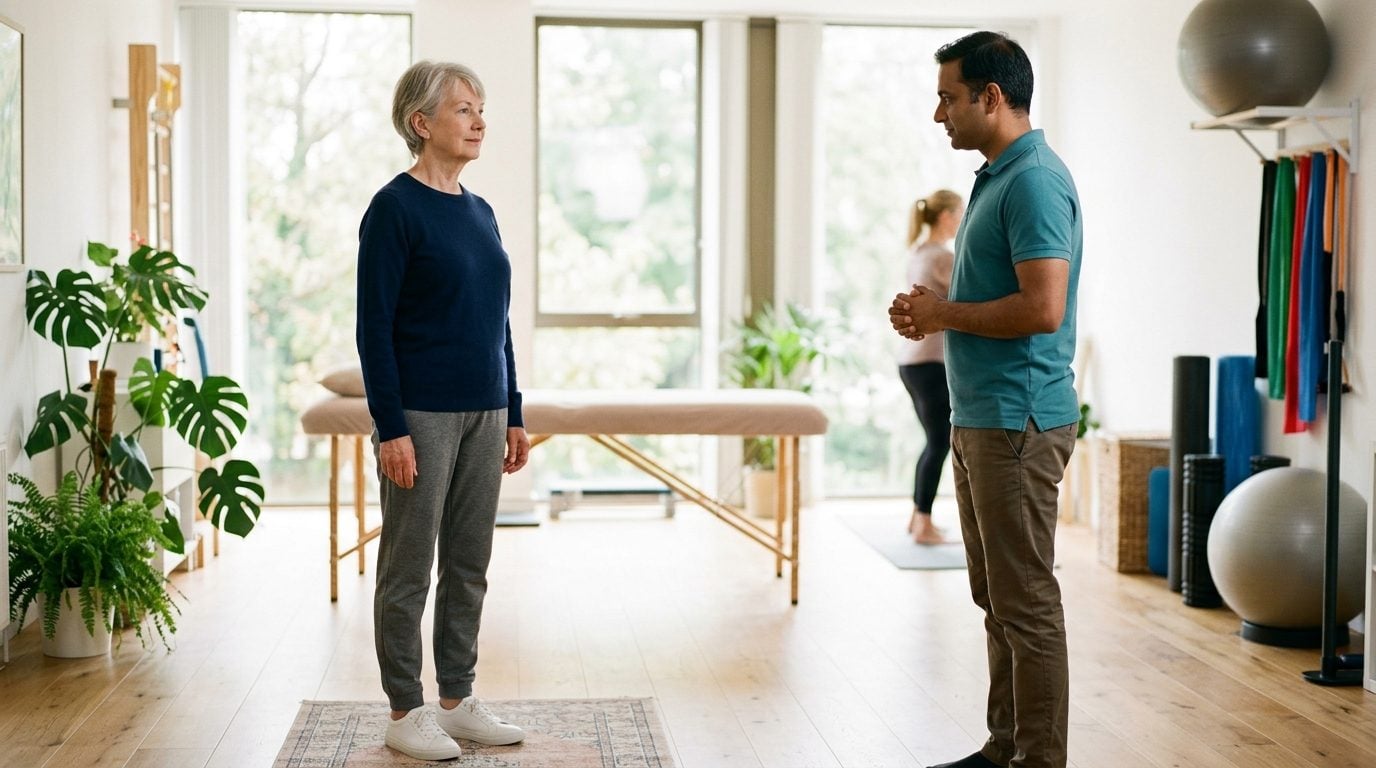
HWY Physical Therapy is a clinic for adults over 50. That is not a marketing line, it is what we do all day. Dr. Raj Pusuluri, PT, DPT, leads both of our Salem locations.
The first appointment is an evaluation, usually about 45 to 60 minutes. We take a history, look at how you move, test strength and range of motion, and, for this particular complaint, actually watch you stand and time it. We look for the relief pattern you documented at home.
You leave with a plan of care. Under APTA standards, that plan has to state goals in functional and measurable terms, and has to state the frequency and duration needed to reach them. For a standing-tolerance goal, that means something concrete: standing through a 25-minute church service, or cooking a full dinner without sitting down.
Realistic timeframes, in visits and weeks rather than promises. Structured osteoarthritis programs commonly run around 12 supervised sessions over six weeks. Meaningful strength change in older adults is typically noticeable within about eight weeks at two sessions per week. Nerve-related and circulation-related causes vary more, and they often involve your physician alongside us.
If the evaluation says this is not a physical therapy problem, we tell you and we refer you out. As noted earlier, Oregon law requires that.
Two practical notes. You do not need a doctor's referral to start. Oregon rules allow a physical therapist to evaluate and treat a self-referred patient. And we are direct-pay, no insurance required, so there is no authorization process to wait through.
If getting to the clinic is the hard part, our virtual "Start From Home" visits are a real option. A review of exercise-based telerehabilitation in around 1,400 older adults found it non-inferior to face-to-face care. That held for quality of life, six-minute walk distance, timed up and go, and quadriceps strength.
The same review described telerehab as safe, effective, and well adhered to. It also found pain outcomes slightly worse than in-person care, which is fair to know going in.
One more thing that is specific to us. We have the Neubie in our Salem clinics, and no other Salem physical therapy practice offers it. It is an FDA-cleared device that uses direct current, and it is not a TENS unit.
Its clearances include neuromuscular re-education, increasing local blood circulation, and management of chronic pain. It is a tool we use where it fits, not the reason to come in for this particular complaint.
Frequently asked questions
Is it normal to lose standing tolerance after 50?
Common is not the same as normal. Losing standing tolerance always has a mechanism behind it, and five of the most likely ones are described above. Every one of them has something you can do about it. "It's just age" is a description, not a diagnosis.
How long should I be able to stand still?
We looked for a published normal value and could not find one. That is why the self-test focuses on your relief pattern rather than your stopwatch reading. What is far more useful is tracking your own number over time and noticing which position makes the symptom go away.
Does leaning on a shopping cart mean I have spinal stenosis?
It is a meaningful clue, not an answer. Clinicians treat one combination as a strong pointer toward nerve compression in the low back. That combination is symptoms triggered by standing, relieved by sitting, felt above the knees, and eased by leaning forward.
But a pointer is not a diagnosis. Confirming it takes a clinical exam.
Why do my legs hurt when I stand but not when I walk?
That pattern leans away from arterial circulation, because artery-related leg pain is brought on by exertion and eases with rest. Symptoms that come on from standing still and need you to sit or bend forward point more toward the low back. Symptoms that build slowly across the day and drain away when you elevate your legs point more toward the veins.
Do I need a doctor's referral to see a physical therapist in Oregon?
No. Oregon rules allow a physical therapist to evaluate and treat a patient who refers themselves. If what we find belongs with a physician, we are required to send you there, and we will.
Can any of this be sorted out over video?
A lot of it can. We can take the history, watch you stand and move, run through your self-test results with you, and build the exercise plan. What we cannot do over video is hands-on strength and range-of-motion testing, and we cannot examine a foot or a swollen leg properly. For those, come in.
Find out which one is yours
If you ran the self-test and recognized yourself in one of those rows, the next step is short. Book a Wellness Screening Call. It is a virtual conversation with our team about what you found, what it likely means, and whether physical therapy is even the right answer for you.
Bring your notes: how many minutes, where the symptom sits, and what made it stop.
Book your Wellness Screening Call: https://meetings.hubspot.com/raj-pusuluri/hwy-pt-schedule
Or call us: (971) 202-1979
HWY Physical Therapy
Salem North HWY Physical Therapy 2615 Portland Rd NE, Salem, OR 97301 Located at Center 50+
Salem South HWY Physical Therapy Clinic South Salem 180 Ramsgate Square S, Salem, OR 97302
Phone (both locations): (971) 202-1979 Hours: Monday to Friday, 8:00 AM to 5:00 PM Walk-ins welcome. Book online: https://meetings.hubspot.com/raj-pusuluri/hwy-pt-schedule
Direct-pay clinic, no insurance required. Serving adults 50 and over across Salem, Keizer, and the Mid-Willamette Valley.
Sources
- StatPearls, Spinal Stenosis and Neurogenic Claudication: https://www.ncbi.nlm.nih.gov/books/NBK430872/
- StatPearls, Lumbar Spinal Stenosis: https://www.ncbi.nlm.nih.gov/books/NBK531493/
- AAOS OrthoInfo, Lumbar Spinal Stenosis: https://www.orthoinfo.org/en/diseases--conditions/lumbar-spinal-stenosis/
- Management of lumbar spinal stenosis (clinical review): https://pmc.ncbi.nlm.nih.gov/articles/PMC6887476/
- Comparison of walking variations during treadmill walking between neurogenic and vascular claudication (crossover study): https://pmc.ncbi.nlm.nih.gov/articles/PMC8280597/
- StatPearls, Peripheral Arterial Disease: https://www.ncbi.nlm.nih.gov/books/NBK430745/
- 2024 ACC/AHA/Multisociety Guideline for Lower Extremity PAD, key points: https://www.acc.org/latest-in-cardiology/ten-points-to-remember/2024/05/09/15/00/2024-guideline-for-lower-extremity-pad
- Cochrane, Exercise for intermittent claudication (2017): https://www.cochrane.org/evidence/CD000990_exercise-reducing-intermittent-claudication-symptoms
- AAOS OrthoInfo, Osteoarthritis of the Hip: https://www.orthoinfo.org/en/diseases--conditions/osteoarthritis-of-the-hip/
- AAOS OrthoInfo, Arthritis of the Knee: https://www.orthoinfo.org/en/diseases--conditions/arthritis-of-the-knee/
- Cochrane, Exercise for osteoarthritis of the knee (Fransen 2015): https://pubmed.ncbi.nlm.nih.gov/26405113/
- Cochrane, Exercise for osteoarthritis of the hip (Fransen 2014): https://pubmed.ncbi.nlm.nih.gov/24756895/
- AAFP, Varicose Veins: Diagnosis and Treatment: https://www.aafp.org/pubs/afp/issues/2019/0601/p682.html
- StatPearls, Venous Insufficiency: https://www.ncbi.nlm.nih.gov/books/NBK430975/
- StatPearls, Deep Venous Thrombosis: https://www.ncbi.nlm.nih.gov/books/NBK507708/
- NHLBI, Venous Thromboembolism Symptoms: https://www.nhlbi.nih.gov/health/venous-thromboembolism/symptoms
- Helbostad et al., Consequences of lower extremity and trunk muscle fatigue on balance and functional tasks in older people, BMC Geriatrics 2010: https://pubmed.ncbi.nlm.nih.gov/20716373/
- Static versus dynamic standing in older adults with type 2 diabetes: https://pmc.ncbi.nlm.nih.gov/articles/PMC7291508/
- Cochrane, Progressive resistance strength training for physical disability in older people: https://pubmed.ncbi.nlm.nih.gov/19588334/
- Muscle strength and mass loss with aging (quantitative review): https://pmc.ncbi.nlm.nih.gov/articles/PMC3429036/
- CDC, Physical Activity for Older Adults: https://www.cdc.gov/physical-activity-basics/adding-older-adults/index.html
- APTA, Elements of the initial examination and plan of care: https://www.apta.org/your-practice/documentation/defensible-documentation/elements-within-the-patientclient-management-model/initial-examination
- GLA:D hip and knee program structure: https://gladinternational.org/glad-hip-and-knee/
- Telerehabilitation in older adults (Age and Ageing systematic review): https://pmc.ncbi.nlm.nih.gov/articles/PMC10657214/
- Oregon Revised Statutes 688.132, physical therapist duty to refer: https://oregon.public.law/statutes/ors_688.132
- Oregon Administrative Rule 848-040-0117, self-referred patients: https://oregon.public.law/rules/oar_848-040-0117
- NeuFit, The Neubie device and FDA clearances: https://www.neu.fit/the-neubie
.png)