Swollen ankles after 50 have many causes, from harmless to urgent. Learn the one leg versus both legs rule and when to get help the same day.
Your socks leave a deep ring around your ankle, and the ring is still there at bedtime. Your shoes fit fine at breakfast and feel tight by four in the afternoon. You press a thumb into your shin and a dent stays behind.
Swollen ankles are one of the most common complaints we hear from adults over 50. Most of the time the cause is slow, dull and manageable. Some of the time it is a medical emergency.
The difference usually comes down to three simple things you can check at home. This guide walks through them, then explains what to do with the answer.
One thing first, because it matters more than anything else on this page.
Get medical help right now if you have these signs
Leg swelling that comes on fast deserves fast attention. The American Academy of Family Physicians is blunt about this in its 2022 review of peripheral edema:
Acute lower-extremity edema requires urgent evaluation because several potential causes require timely intervention.
In plain English, new swelling is not something to watch for a few weeks.
Call 911 or go to an emergency room now
Get emergency help if a swollen leg comes together with any of these:
- Sudden shortness of breath, or pain when you breathe in
- Chest pain or discomfort, especially when you cough or take a deep breath
- Coughing up blood
- A fast or irregular heartbeat
- Feeling faint, lightheaded, or actually passing out
That combination can mean a blood clot has traveled from the leg to the lungs. The CDC lists those exact signs for a lung clot and then says:
If you have any of these signs or symptoms, you should seek medical help immediately.
Do not drive yourself. Do not wait until morning.
Get medical care the same day
Call your doctor's office today, or use urgent care, if you have any of the following:
- Swelling in one leg that appeared over hours or a few days, especially with calf pain, warmth, redness, or tenderness
- Any leg swelling along with a fever
- Swelling with new or worse shortness of breath when you lie flat
- Swelling with a sudden weight gain over just a few days
- A break in the skin, a weeping patch, or an open sore anywhere on the swollen leg
For a possible clot in a leg vein, the CDC's instruction is: "If you have any of these signs or symptoms, you should see your doctor as soon as possible." The National Heart, Lung, and Blood Institute puts it the same way. Call your provider right away if you think you have symptoms.
None of that list is meant to frighten you. It is meant to make sure the small number of people reading this with something serious act today.
The three questions that sort out most leg swelling
Doctors sort leg swelling using a short set of questions before they order a single test. You can ask yourself the same ones. They will not give you a diagnosis, but they will tell you how urgently to act and who to call.
Question one: one leg, or both?
Look at both legs side by side, in good light, sitting down. Compare your ankles, then your calves.
This is the single most useful question on the page. One swollen leg points toward a local problem in that leg, such as a clot, an infection, or damaged veins on that side. Both legs swelling together points away from the leg itself and toward the whole body, which usually means the heart, the kidneys, the liver, or a medication.
If it is one leg and it is new, treat that as a same-day question. If it is both legs, it still needs a doctor, but the path is different.
Question two: how fast did it arrive?
The AAFP review splits swelling by time as well as by side. Its dividing line is three months. Anything shorter counts as new, and anything longer counts as long standing.
For practical purposes at home, ask a simpler version. Did this show up over hours or days, or has it crept up over months or years? New and fast is the version that gets moved to the front of the line.
Question three: does it pit?
Pitting simply means the swelling holds a dent. It is easy to check on yourself and it is gentle.
Press one thumb into the front of your shin, on the bony part a few inches above the ankle. Press with steady, moderate pressure for about ten seconds, then lift your thumb and look. If a visible dent stays behind for a few seconds, the swelling pits. If the skin springs right back, it does not.
That one detail narrows things down. The AAFP puts it this way: pitting swelling is linked with vein problems, with clots, and with early lymph swelling, while swelling that does not pit points more toward thyroid-related skin changes or later stage lymph swelling.
One honest caveat. You may have seen swelling graded on a scale from one to four. The AAFP says that scale "lacks reliability and reproducibility," so we are not going to print it. Pits or does not pit is all you need.
When only one leg is swollen
New swelling in one leg is the situation that most deserves a phone call today. Here is what usually sits behind it.
A clot in a deep vein
A clot in one of the deep leg veins is the reason one swollen leg is treated seriously. The CDC lists the usual signs in the affected limb as swelling, pain or tenderness, warmth, and redness or discoloration.
Two facts make this hard to judge for yourself. The CDC notes that about half of people with a deep vein clot have no symptoms at all. And the StatPearls chapter on deep venous thrombosis says plainly:
Obtaining the diagnosis of DVT only based on clinical signs and symptoms is notoriously inaccurate.
That is exactly why we send you to a clinician rather than giving you a checklist to rule it out. Risk goes up with immobility, recent surgery, cancer, obesity, and age over 60. An ultrasound settles it quickly.
An infection in the skin of the leg
A skin infection in the lower leg is another common cause of one swollen, angry looking limb. The AAFP describes it as spreading redness with warmth, swelling and tenderness, and one-sidedness is one of the features clinicians weigh.
Worth knowing: the AAFP reports that about 30 percent of people admitted to the hospital for a leg skin infection are misdiagnosed, because several harmless conditions look almost identical. Damaged vein skin changes, gout and lymph swelling are all on the list of look-alikes. Fever plus a red, hot, swollen leg is a same-day call either way.
Worn out vein valves on one side
Your leg veins carry blood uphill against gravity, and small one-way valves stop it falling back down. When those valves stop sealing, pressure builds in the leg and fluid leaks into the tissue. Clinicians call this chronic venous insufficiency.
It has a very recognizable daily rhythm. The AAFP describes symptoms as often worse at the end of the day, especially after long periods of standing, and usually settling when the person sits and raises the legs. People describe aching and heaviness rather than sharp pain. Over years it can bring brown staining around the ankle, thickened skin, and eventually an open sore near the inner ankle.
This can affect one leg or both. It builds over months and years, not overnight.
Lymph fluid buildup
Your body has a second drainage network alongside the veins, called the lymphatic system. When it is damaged or blocked, protein rich fluid collects in the limb. StatPearls calls lymphedema "a chronic, progressive condition caused by impaired lymphatic drainage."
The most common cause in adults is treatment for cancer, particularly surgery or radiation involving lymph nodes. One clue clinicians use is whether they can pinch up a fold of skin at the base of the second toe. When the skin has thickened enough that they cannot, that points strongly to lymph swelling.
Early on it pits and settles with elevation. Later it becomes firm and stops denting.
A knee cyst that burst
A fluid filled sac can form behind the knee, most often alongside knee arthritis. If it bursts, the fluid runs down into the calf.
StatPearls describes the result as sharp pain in the knee and calf, swelling or redness of the calf, and "a sensation that feels like water running down the calf." It can look so much like a clot that the chapter calls out how important it is to tell the two apart. That is a job for an ultrasound, not for you.
A recent knock, twist or fall
Swelling after an injury is the one cause with an obvious story attached. A sprained ankle, a torn calf muscle, or a fracture all swell on the injured side.
If you cannot put weight through the leg, if the swelling is severe, or if the pain is out of proportion to the injury, get it looked at. Ankle and foot problems that build over time rather than after a fall are a different conversation, and we cover those in our guide to foot arthritis that gets worse when you walk.
When both legs are swollen
Two swollen legs usually means the problem is not in the legs. Something body-wide is pushing fluid out into the tissue, and the ankles are just where gravity puts it.
This almost always belongs with a physician first, not a physical therapist.
The heart
When the right side of the heart cannot keep up, fluid backs up into the body. The National Heart, Lung, and Blood Institute lists swelling in the ankles, feet, legs, abdomen and neck veins as a sign, along with weight gain.
The clue that raises the stakes is breathing. The AAFP says that shortness of breath, or breathlessness on lying flat, should prompt consideration of heart failure. If you have started propping yourself on extra pillows to sleep, tell your doctor about that specifically.
The kidneys and the liver
Both organs sit behind the scenes of fluid balance. Kidney disease and liver disease both appear on the AAFP list of causes of swelling in both legs, in acute and long standing forms.
These are not conditions you can sort out at home, and they do not announce themselves clearly. Blood tests and a urine test are usually the starting point.
Low protein in the blood
Protein in your blood helps hold fluid inside the blood vessels. When it drops too low, fluid seeps out into the tissue. Poor nutrition, kidney loss, and liver disease can all drive it down.
This is one reason a doctor will often check bloodwork before anything else.
Medications
This is the cause most often missed, and it is the easiest one to check. The AAFP lists several classes that commonly cause leg swelling:
- Blood pressure medications, including amlodipine, nifedipine, diltiazem and beta blockers
- Anti-inflammatory drugs, including NSAIDs and corticosteroids
- Gabapentin and pregabalin
- Hormones, including estrogen, progesterone and testosterone
- Pioglitazone, used in diabetes
- Some antipsychotics, some chemotherapy drugs, and acyclovir
Bring your full medication list to the appointment, including anything over the counter. Do not stop or change a dose on your own. Deciding whether a medication is worth its side effect is a prescriber's call, not a blog's.
Long periods of stillness
Sitting or standing still for hours lets fluid pool in the lowest part of the body. StatPearls describes this pattern directly: dependent swelling often improves with elevation and worsens with long periods of standing or sitting.
Long flights, long car rides, desk work and long shifts on your feet all do it. It is usually mild, affects both legs, and clears overnight. If it does not clear overnight, that is worth mentioning to your doctor.
Vein valve problems in both legs
The worn valve problem described earlier is very common and often affects both legs at once. The end of day pattern is the giveaway. If your legs are fine in the morning and heavy by evening, and this has been true for years, damaged vein valves are a leading candidate.
Long days on your feet can also become hard for other reasons that have nothing to do with swelling. If standing is the thing that has changed for you, our guide to why standing for long periods gets harder after 50 covers that separately.
A quick comparison
| Which leg | How fast | Pits? | What else is there | Who to see first |
|---|---|---|---|---|
| One | Hours to days | Usually yes | Calf pain, warmth, tenderness | Doctor or urgent care TODAY |
| One | Hours to days | Usually yes | Spreading redness, heat, fever | Doctor or urgent care TODAY |
| One | Sudden, after knee pain | Usually yes | Calf pain, a water running feeling | Doctor, to rule out a clot |
| One or both | Months to years | Yes early on | Aching, heaviness, worse by evening | Doctor, then physical therapy |
| One | Months to years | Firm, hard to dent | Thick skin, past cancer treatment | Doctor, then a lymphedema therapist |
| Both | Days to weeks | Usually yes | Breathlessness, weight gain, flat-lying trouble | Doctor, promptly |
| Both | Weeks to months | Usually yes | Started after a new prescription | Prescriber, do not self-adjust |
| Both | Same day, clears overnight | Mild | Long trip, long shift, long drive | Usually no one, mention at next visit |
Use this to decide who to call. Do not use it to decide that you are fine.
What physical therapy actually does here, and what it does not
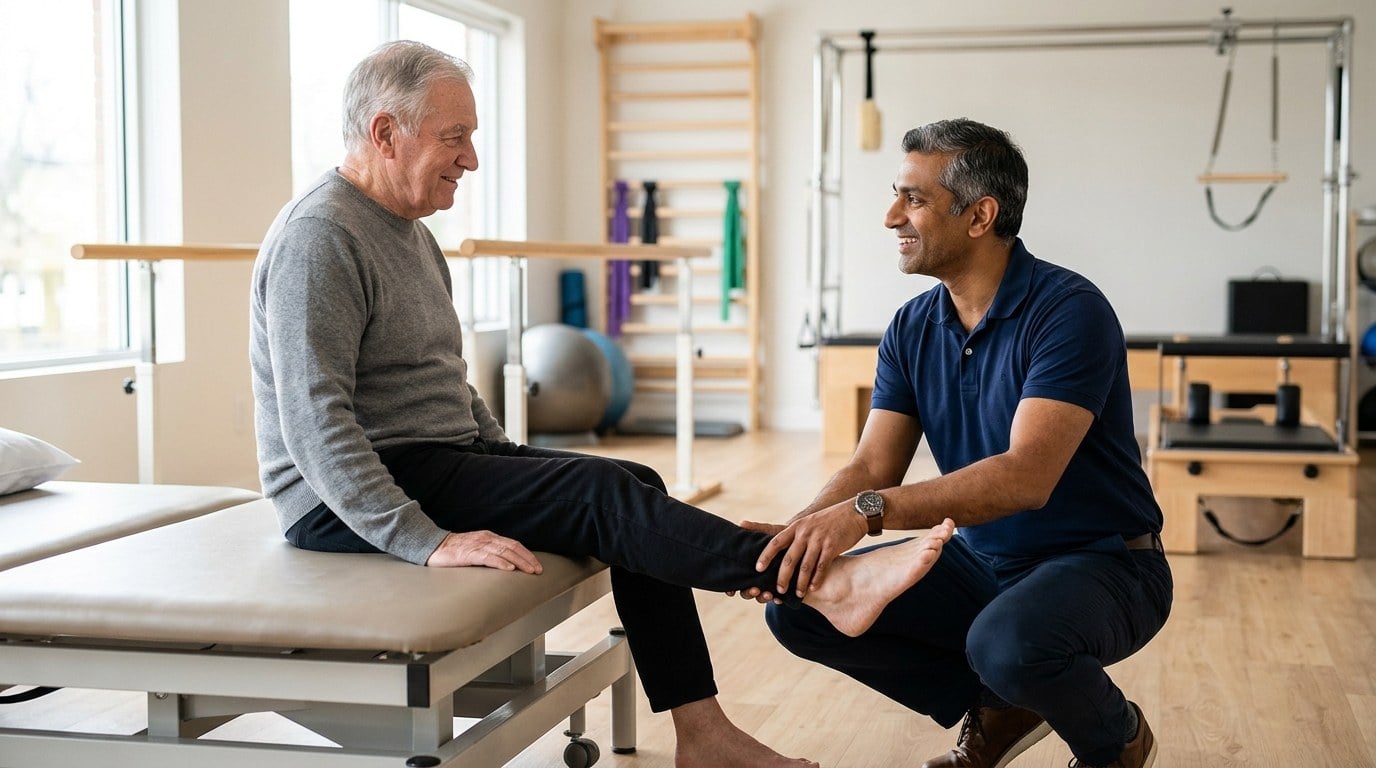
We want to be straight with you, because this is the part where clinics often oversell.
Most causes of leg swelling are medical, not musculoskeletal. Your heart, your kidneys, your liver, your veins, your lymphatic system and your medication list are not physical therapy problems. We do not treat a clot, and we do not treat heart, kidney or liver disease. If your swelling has never been looked at by a physician, that is the first appointment to make, not this one.
Our role is real, but it is narrow. Here is what it actually covers.
The calf pump. Your calf muscles squeeze the deep veins every time you push off, which helps drive blood back up the leg. The StatPearls chapter on venous insufficiency describes it directly:
resistance exercises help improve the calf muscle pump, which normally aids venous blood return from the lower extremities in healthy individuals and is impaired in those with CVI.
In other words, strong calves and a freely moving ankle help the leg move blood.
Ankle motion. The same chapter notes that movements involving the ankle and toes, such as walking and cycling, are the most effective at increasing blood speed in the leg veins. A stiff ankle is a weak pump. Restoring ankle range is squarely a physical therapy job.
Walking capacity and safe strengthening. Many people with long standing swelling have quietly stopped walking as far as they used to. We rebuild that, and we keep the program safe for whatever else is going on.
What the evidence actually shows
A 2017 systematic review and meta-analysis by Orr and colleagues in Ostomy/Wound Management pooled 14 studies and 519 participants, with the meta-analysis itself resting on just 83 people. Exercise improved calf pump ejection fraction significantly. Ankle range of motion was higher in the exercise groups, but that difference was not statistically significant, and the authors said larger studies are needed.
A 2021 systematic review by Silva and colleagues in J Vasc Bras pulled together 11 studies. In milder disease, exercise improved reflux, strength, ankle range and quality of life. In advanced disease, pump measures and ankle range improved but reflux and quality of life did not. The authors were candid: "Many studies had low quality scores, mainly due to absence of control groups."
For lymph swelling the picture is thinner still. A 2025 review in Acta Oncologica covering 12 trials and 367 people found exercise looked safe, with three adverse events reported, and concluded:
Based on a small number of studies with large clinical heterogeneity, poor methodological quality, hence low level of certainty of evidence, it was not possible to provide evidence-based recommendations on exercise for patients with LLL.
So here is the honest summary. Exercise appears to help the mechanics of the calf pump and the movement of the ankle. Nobody has shown that it makes a swollen leg reliably smaller. We will not promise you that, and you should be skeptical of anyone who does.
People do ask about our equipment, so here is the short version. We use a device called the Neubie, an FDA cleared machine that delivers a direct current and is not a TENS unit, available in Salem only at our clinic. Its cleared uses do include increasing local blood circulation and preventing venous thrombosis after surgery. It is not a treatment for leg swelling, and we will not offer it to you as one.
Safe things anyone can do while waiting for an appointment

None of these replace a medical opinion. All of them are gentle and low risk for most people.
- Move your ankles often. Point and flex your feet, then circle them, for a minute or two every half hour while you are sitting.
- Take walking breaks. Short and frequent beats one long walk for this purpose. Getting up every hour is a reasonable goal.
- Put your legs up. Lying down with your legs raised on cushions, higher than your hips, lets gravity work for you instead of against you.
- Do not sit with your legs crossed for long stretches. Uncross and move every so often.
- Wear shoes that fit the foot you have today. A shoe that fits at breakfast may be too tight by evening, and a tight shoe on a swollen foot risks a skin break.
- Check your skin daily. Look at the ankle and the shin, including the back of the leg with a mirror. Report any break, weeping patch or sore.
We are deliberately not telling you what compression stockings to buy, whether to take a water pill, or what salt limit to follow. Those are decisions for the person who can examine you and see your blood work.
If you are reading this for a parent
A lot of people find this page while worrying about a mother or father. A few things will help you be useful.
Look at both of their legs yourself, in good light, with the socks off. Photograph them, so that next week you have something to compare against. Check their skin for any break or sore, because an older adult with damaged leg skin can develop an infection quickly.
Do not wait if you see any of these: one leg newly bigger than the other, redness and heat, a fever, breathlessness, new trouble lying flat, or a rapid weight gain over days.
Also watch how they move. Swollen, heavy legs change how somebody walks, and that has knock-on effects. Our guide to spotting unsteadiness in an aging parent covers what to look for.
Frequently asked questions
Is swelling in both ankles by evening just part of getting older? It is common, but common is not the same as normal. Mild swelling that clears overnight after a long day on your feet is usually harmless. Swelling that is still there in the morning, that is growing, or that comes with breathlessness, needs a doctor.
Should I see a doctor or a physical therapist first? A doctor, unless your swelling has already been investigated and you have a diagnosis. Physical therapy is the right next step once the cause is known and something serious has been ruled out.
Can I still exercise with swollen legs? Usually yes, and moving is generally good for the circulation in the legs. The exception is new swelling in one leg that has not been checked. Get that assessed before you push through a workout.
Why is my swelling worse in the evening? The end-of-day pattern is the signature of vein valve trouble. The AAFP describes symptoms as worse at the end of the day, especially after long periods of standing, and easing when the legs are raised. It is worth mentioning to your doctor.
My ankles only swell on long journeys. Is that a clot risk? Long stretches of stillness cause mild swelling in both legs that clears overnight, and that is usually nothing. A clot is different: one leg, persistent, often with calf pain or warmth. Move your ankles and stand up regularly on long trips, and take one-sided swelling seriously.
What will happen at the physical therapy appointment? We look at ankle range, calf strength, walking, and balance, and we build a plan around what we find. If anything suggests your swelling has not been fully worked up, we will say so and send you back to your physician. You can read more in our guide to what to expect at your first physical therapy visit after 50.
Talk to us once your swelling has been checked out
If a doctor has already looked at your legs and you are ready to work on ankle motion, calf strength and walking again, we can help with that part.
Start with a Wellness Video Call. It is a virtual visit, so you can do it from your kitchen table with your feet up, and we will tell you honestly whether physical therapy is the right next step for you or whether you need a different door.
Book a Wellness Video Call or call (971) 202-1979.
Direct-pay, no insurance required.
This article is general information, not medical advice. It cannot diagnose your swelling, and it is not a substitute for being examined. If anything in the urgent section above describes you, act on it today.
HWY Physical Therapy Serving adults 50 and over in Salem, Oregon.
North Salem: 2615 Portland Rd NE, Salem, OR 97301 (at Center 50+). Walk-ins welcome. South Salem: HWY Physical Therapy Clinic South Salem, 180 Ramsgate Square S, Salem, OR 97302. By appointment only.
Phone (both locations): (971) 202-1979 Hours: Monday to Friday, 8:00 AM to 5:00 PM
Sources
- American Academy of Family Physicians. "Peripheral Edema: Evaluation and Management in Primary Care." American Family Physician, 2022. https://www.aafp.org/pubs/afp/issues/2022/1100/peripheral-edema.html
- Centers for Disease Control and Prevention. "About Blood Clots." https://www.cdc.gov/blood-clots/about/index.html
- National Heart, Lung, and Blood Institute. "Venous Thromboembolism: Symptoms." https://www.nhlbi.nih.gov/health/venous-thromboembolism/symptoms
- National Heart, Lung, and Blood Institute. "Heart Failure: Symptoms." https://www.nhlbi.nih.gov/health/heart-failure/symptoms
- StatPearls. "Deep Venous Thrombosis." https://www.ncbi.nlm.nih.gov/books/NBK507708/
- StatPearls. "Venous Insufficiency." https://www.ncbi.nlm.nih.gov/books/NBK430975/
- StatPearls. "Lymphedema." https://www.ncbi.nlm.nih.gov/books/NBK537239/
- StatPearls. "Baker's Cyst." https://www.ncbi.nlm.nih.gov/books/NBK430774/
- StatPearls. "Peripheral Edema." https://www.ncbi.nlm.nih.gov/books/NBK554452/
- American Academy of Family Physicians. "Applying a Clinical Prediction Rule to Distinguish Lower Extremity Cellulitis from Its Mimics." American Family Physician, 2021. https://www.aafp.org/pubs/afp/issues/2021/0900/p309.html
- American Academy of Family Physicians. "Varicose Veins: Diagnosis and Treatment." American Family Physician, 2019. https://www.aafp.org/pubs/afp/issues/2019/0601/p682.html
- Orr L, et al. "A Systematic Review and Meta-analysis of Exercise Intervention for the Treatment of Calf Muscle Pump Impairment in Individuals with Chronic Venous Insufficiency." Ostomy/Wound Management, 2017. PMID 28873064. https://europepmc.org/article/MED/28873064
- Silva KLS, et al. "The impact of exercise training on calf pump function, muscle strength, ankle range of motion, and health-related quality of life in patients with chronic venous insufficiency at different stages of severity: a systematic review." Jornal Vascular Brasileiro, 2021. https://pmc.ncbi.nlm.nih.gov/articles/PMC8147883/
- Wittenkamp MC, Christensen J, Vinther A, Juhl CB. "The effect of exercise in patients with lower limb lymphedema: a systematic review." Acta Oncologica, 2025. https://pmc.ncbi.nlm.nih.gov/articles/PMC11977414/
.png)