Feeling unsteady while walking can be unsettling.
For many people with neuropathy, that feeling shows up without warning.
You might notice your feet feel numb or disconnected.
Or you may feel unsure when stepping on uneven ground or turning quickly.
Simple movements start to feel risky.
Walking in dim light or getting up at night can suddenly feel unsafe.
This is where fall risk becomes a real concern.
And falls are one of the biggest threats to independence as we age.
Neuropathy affects how your body senses the ground and responds to movement.
That makes balance harder, even if your muscles are still strong.
The good news is that there are ways to improve stability and reduce risk.
With the right exercises, habits, and guidance, you can move more confidently again.
In this guide, you’ll learn:
- Why neuropathy increases fall risk
- Signs your balance may be affected
- Simple tests to check your stability
- Exercises that improve safety
- When to seek help in Salem, Oregon
Small changes can go a long way.
And it starts with understanding what’s happening in your body.
Why Does Neuropathy Increase Fall Risk?
Neuropathy increases fall risk because it affects how your nerves communicate with your brain.
This makes it harder to feel the ground, react quickly, and stay balanced.
When nerves in your feet are damaged, you may not sense where your foot is placed.
This reduces your ability to adjust your steps or catch yourself if you trip.
At the same time, nerve signals travel more slowly.
Your body takes longer to respond to changes like slipping or losing balance.
Many people also lose proprioception, which is your body’s sense of position.
Without it, walking can feel uncertain and less controlled.
The combination of numbness, delayed reactions, and poor awareness increases instability.
That’s why even simple movements can feel risky with neuropathy.
The good news is that balance and stability can improve with the right approach.
Targeted exercises and training can help your body adapt.
What Is Neuropathy and How It Affects Balance and Walking
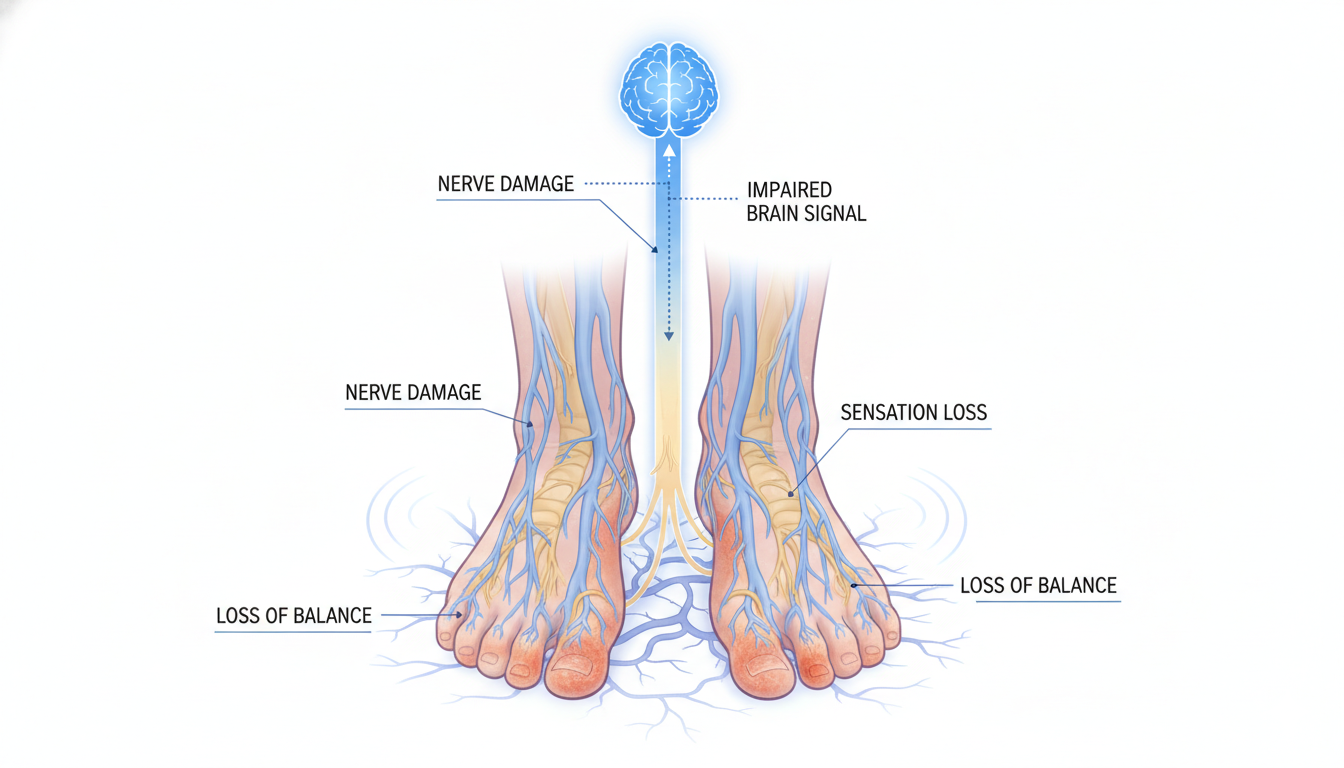
Neuropathy is a condition where nerves are damaged, often in the feet and legs.
These nerves play a key role in helping you feel, move, and stay balanced.
When they don’t work properly, simple movements become harder to control.
That’s where balance problems begin.
Loss of Sensation in Feet and Poor Balance
Healthy nerves send constant feedback from your feet to your brain.
This helps you feel the ground and adjust your steps.
With neuropathy, that feedback is reduced or lost.
Your feet may feel numb, like you’re walking on a soft or uneven surface.
Without clear sensation, your body has to guess where your feet are.
That makes each step less stable.
Delayed Nerve Signals and Slower Reactions
Nerves also control how quickly your body reacts.
When something changes, like slipping slightly, your brain sends signals to correct it.
With neuropathy, these signals are slower.
Your body reacts later than it should.
This delay can make small missteps harder to recover from.
It increases the chance of losing balance.
Proprioception Loss in Peripheral Neuropathy
Proprioception is your body’s awareness of position and movement.
It helps you know where your legs and feet are without looking.
Neuropathy affects this system.
You may feel unsure when walking or turning.
This lack of awareness makes movements less precise.
Over time, it can lead to instability and increased fall risk.
Real-Life Situations Where Neuropathy Increases Fall Risk

Neuropathy doesn’t just affect balance in theory.
It shows up in everyday moments when you least expect it.
Walking on Uneven Surfaces or Stairs
Uneven ground requires quick adjustments from your feet and ankles.
With reduced sensation, it’s harder to feel changes in surface.
You may misjudge a step or not notice small shifts in terrain.
This increases the chance of tripping or losing balance.
Stairs can be even more challenging.
Without clear foot placement, each step feels less certain.
Getting Up at Night or in Low Light
Vision helps compensate for balance issues.
In low light, that support is reduced.
If your feet already lack sensation, this makes movement riskier.
Even walking to the bathroom can feel unsteady.
Small obstacles become harder to detect.
That’s when many falls happen.
Turning, Pivoting, or Changing Direction
Changing direction requires coordination and control.
Neuropathy makes these movements slower and less precise.
You may feel off balance when turning quickly.
Or unsure when shifting your weight from one foot to the other.
These moments often lead to near-falls.
And over time, they can increase your fear of moving confidently.
Signs Your Neuropathy Is Increasing Your Fall Risk
Neuropathy often worsens gradually.
But your body gives clear signs when balance is becoming a concern.
Numbness, Tingling, or Burning in Feet
Changes in sensation are one of the earliest signs.
Your feet may feel numb, tingly, or even burning.
This reduces your ability to feel the ground properly.
Without that feedback, balance becomes less reliable.
Feeling Unsteady While Walking
You may feel like you’re not fully in control when walking.
Steps can feel uncertain or uneven.
Some people describe it as walking on cushions or soft ground.
This makes it harder to stay steady, especially on unfamiliar surfaces.
Frequent Near-Falls or Loss of Balance
If you often catch yourself before falling, pay attention.
These near-falls are warning signs.
You might grab onto walls, furniture, or nearby support.
This shows your body is struggling to stay balanced.
Over time, these moments can become more frequent.
Addressing them early can help prevent an actual fall.
Quick Safety Checklist for Neuropathy Fall Risk at Home
This quick checklist can help you spot risk factors early.
It gives you a simple way to assess your safety at home.
Ask yourself these questions:
- Do you feel the floor clearly when you walk?
- Do you feel unsteady when turning or changing direction?
- Do you rely on walls or furniture for support?
- Do you avoid walking in low light?
- Have you had any near-falls recently?
If you answered “yes” to even a few of these, your fall risk may be higher.
That doesn’t mean something bad will happen, but it does mean you should take action.
Small adjustments can improve safety right away.
And targeted exercises can help reduce these risks over time.
Awareness is the first step.
Once you know where the risks are, you can start fixing them.
Simple Balance Test to Check Fall Risk at Home
This simple test can help you understand how stable you are right now.
It gives you a quick idea of your fall risk.
How to Do the Test
- Stand near a wall or sturdy surface for safety
- Place your feet together
- Try to stand still without holding on
- Hold this position for up to 10 seconds
If that feels easy, try this next step:
- Stand on one foot while holding support if needed
- Try to hold for 5 to 10 seconds
Take your time and stay safe.
Stop if you feel unsteady.
What Your Results Mean
- Steady and confident → Your balance is in a good range
- Slight wobbling → Mild balance issues
- Need support quickly → Higher fall risk
- Unable to hold position → Balance needs improvement
This test is not about perfection.
It helps you understand where you are starting from.
If you feel unsafe during the test, don’t push through it.
That’s a sign your body needs support and training.
Best Exercises for Neuropathy Balance and Fall Prevention at Home
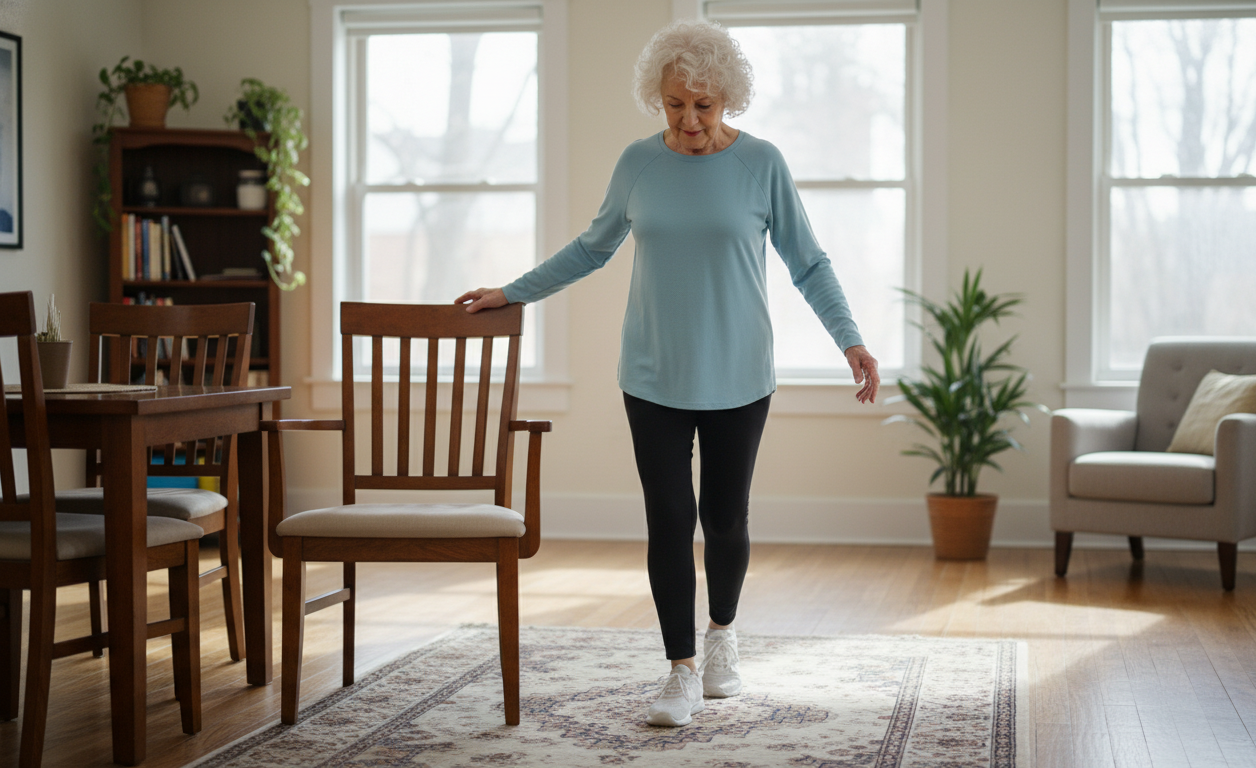
The right exercises can improve your balance and reduce fall risk.
Focus on slow, controlled movements that train your body to feel and respond better.
Balance Exercises for Neuropathy Patients
These help your body adjust to changes in position.
- Heel-to-Toe Walk
- Walk in a straight line placing one foot directly in front of the other
- Keep your eyes forward and move slowly
- Single-Leg Stand (with support)
- Hold onto a chair or wall
- Lift one foot slightly off the ground
- Hold for a few seconds, then switch sides
- Side-to-Side Weight Shifts
- Stand with feet shoulder-width apart
- Slowly shift your weight from one foot to the other
These improve stability and confidence.
Practice near support for safety.
Strength Exercises to Improve Stability
Stronger muscles help you stay steady during movement.
- Sit-to-Stand
- Sit in a chair and stand up slowly
- Use your hands if needed
- Lower yourself back down with control
- Heel Raises
- Stand and lift your heels off the ground
- Hold briefly, then lower
- Mini Squats
- Bend your knees slightly while holding support
- Keep the movement small and controlled
These exercises reduce strain on your joints.
They also improve your ability to recover from small balance shifts.
Coordination and Proprioception Training
These help your body relearn position awareness.
- Step Taps
- Tap one foot onto a step or low surface
- Alternate sides slowly
- Controlled Stepping
- Take slow, deliberate steps forward and backward
- Eyes-Closed Standing (with support)
- Stand still and gently close your eyes
- This challenges your internal balance system
These exercises train your body to adapt.
Over time, your movements feel more stable and controlled.
How Physical Therapy Helps Reduce Fall Risk With Neuropathy
Physical therapy focuses on improving how your body moves in real-life situations.
It helps you build strength, improve balance, and regain confidence step by step.
Improving Strength and Balance Through Therapy
A structured program targets the muscles that support your stability.
This includes your legs, hips, and core.
Therapists guide you through exercises that match your ability level.
As you improve, the difficulty increases gradually.
This steady progression helps reduce fall risk.
It also makes daily movements feel more controlled.
Retraining Nerve-Muscle Communication
Neuropathy affects how your nerves send signals.
Physical therapy works on improving how your body responds to those signals.
You practice controlled movements and balance drills.
These help your brain and muscles work together more effectively.
Over time, your reactions become quicker and more accurate.
That makes it easier to recover from small slips or missteps.
Advanced Neuromuscular Approaches for Neuropathy
Some modern approaches focus on stimulating the connection between nerves and muscles.
These methods aim to improve how signals are sent and received.
For example, certain neuromuscular therapies are designed to retrain movement patterns and improve control.
You can learn more about these approaches here: https://www.neu.fit/neuropathy/
These techniques are often used alongside traditional therapy.
Together, they can help improve stability and reduce fall risk more effectively.
Daily Tips to Prevent Falls With Neuropathy
Small daily habits can make a big difference in reducing fall risk.
These changes help you stay safe without feeling restricted.
Safe Footwear and Home Modifications
What you wear and how your home is set up matters.
Both can affect your stability more than you think.
- Wear shoes with good grip and support
- Avoid walking barefoot or in loose slippers
- Remove loose rugs and clutter from walkways
- Use non-slip mats in bathrooms and kitchens
These changes reduce unexpected slips.
They also make movement more predictable.
Improving Lighting and Visibility
Good lighting helps your brain compensate for reduced sensation.
It allows you to see where your feet are going.
- Keep hallways and rooms well lit
- Use night lights for evening movement
- Turn on lights before walking in dark areas
Better visibility gives you more control.
It reduces hesitation and uncertainty.
Using Support and Assistive Devices
Using support is a smart safety step.
It does not mean you are losing independence.
- Hold railings when using stairs
- Use a cane or walker if recommended
- Keep stable furniture nearby when needed
Support gives your body extra stability.
It helps prevent sudden loss of balance.
Why You Still Feel Unsteady With Neuropathy (Even With Treatment)
It can feel frustrating when you’re doing everything right but still feel unsteady.
There are a few reasons why this happens.
One common reason is that nerve healing takes time.
Unlike muscles, nerves recover slowly, so progress may feel gradual.
Another issue is inconsistency with exercises.
Missing sessions or not practicing regularly can slow improvement.
Sometimes the exercises may not be challenging enough.
Your body needs the right level of difficulty to improve balance and control.
Balance itself is complex.
It depends on strength, coordination, vision, and nerve signals working together.
If one of these areas is still weak, you may continue to feel unstable.
For example, good strength alone does not guarantee good balance.
Fear can also play a role.
If you feel worried about falling, your body may become stiff and cautious.
This can actually make movement less natural.
And that increases the feeling of instability.
Progress often comes from small adjustments.
The right guidance can help you move forward more confidently.
When to Seek Help for Neuropathy and Balance Problems in Salem, Oregon
Sometimes balance issues don’t improve with home strategies alone.
That’s when getting the right help can make a real difference.
Signs You Need Professional Fall Prevention Therapy
If you feel unsteady often, don’t ignore it.
Your body may need guided support.
Watch for signs like:
- Frequent near-falls or actual falls
- Difficulty walking without support
- Feeling unsafe on stairs or uneven ground
- No improvement despite regular exercise
- Increased numbness or loss of control
These are signs your fall risk is higher.
Early support can prevent more serious problems.
How HWY Physical Therapy Helps With Neuropathy
Physical therapy focuses on improving how you move in daily life.
It targets strength, balance, and coordination together.
At HWY Physical Therapy, the approach is practical and personalized.
You work on movements that directly improve your safety.
This includes balance training, strength work, and movement retraining.
Each plan is adjusted based on your progress.
Personalized Fall Risk Reduction Programs
Every person’s condition is different.
That’s why a one-size approach doesn’t work well.
A personalized plan focuses on your specific challenges.
It helps you improve safely and steadily.
With the right guidance, you can regain confidence in your movement.
And reduce your risk of falling over time.
Preventing Falls Long-Term With Neuropathy
Reducing fall risk is not just about short-term fixes.
It’s about building habits that support safe movement every day.
Staying Active Without Increasing Risk
Avoiding movement can actually make balance worse.
Your body needs regular activity to stay strong and responsive.
Choose safe activities like walking, light exercises, or guided routines.
Keep movements controlled and avoid sudden changes.
Consistency helps your body adapt.
Even small daily activity makes a difference over time.
Building Strength and Confidence Over Time
Strength and balance improve gradually.
The more you practice, the more confident you feel.
Focus on steady progress instead of quick results.
Each small improvement adds up.
Confidence plays a big role in movement.
When you trust your body, you move more naturally and safely.
Creating a Safe Daily Routine
Your routine should support stability and reduce risk.
Simple adjustments can make everyday life easier.
- Keep frequently used items within easy reach
- Avoid rushing, especially when standing or turning
- Use proper lighting and supportive footwear
- Practice balance and strength exercises regularly
These habits help protect you from unexpected falls.
They also help you stay independent longer.
FAQs About Neuropathy and Fall Risk
Can neuropathy cause frequent falls?
Yes, neuropathy can increase the risk of frequent falls.
It affects sensation, balance, and reaction time.
When your feet don’t feel the ground properly, your steps become less stable.
This makes it harder to recover from small slips or missteps.
How can I improve balance with neuropathy?
Balance improves with consistent practice.
Exercises that focus on strength, coordination, and stability are most effective.
Simple movements like weight shifting, heel-to-toe walking, and sit-to-stand can help.
Doing them regularly builds better control over time.
What exercises are safe for neuropathy?
Safe exercises include low-impact, controlled movements.
Examples include seated exercises, supported standing, and gentle balance training.
Always use support when needed.
Safety should come first, especially if you feel unsteady.
Is fall risk reversible with therapy?
Fall risk can be reduced significantly with the right approach.
While nerve damage may not fully reverse, your body can adapt.
Physical therapy helps improve strength, coordination, and confidence.
This makes daily movement safer and more controlled.
Topics to Read Further
- balance exercises for seniors at home
- how to prevent falls in elderly
- causes of nerve damage in feet
Contact HWY PT for Expert Advice and Support
If neuropathy is making you feel unsteady, it’s important to take action early.
You don’t have to wait for a fall to happen.
At HWY Physical Therapy in Salem, Oregon, Dr. Raj helps patients improve balance and move safely in daily life.
The focus is on practical training that builds confidence step by step.
With the right support, you can feel more stable and in control again.
And that can make a big difference in your independence.
Call 971-202-1979 or visit Center 50+, Salem City Building to get started.
.png)