Neuropathy
Fall Prevention for Neuropathy Patients
Learn why neuropathy causes falls and balance problems. Discover exercises, gait therapy, and Neubie rehabilitation at HWY Physical Therapy Clinic.
Learn what causes foot drop from neuropathy, the best exercises to improve walking, and treatment options available at HWY Physical Therapy Clinic in Salem, Oregon.
If you've noticed that you're catching your toes on the floor, tripping more often, or having difficulty lifting the front of your foot while walking, you may be experiencing a condition known as foot drop. For many people, foot drop develops as a result of peripheral neuropathy, a condition that damages the nerves responsible for controlling movement and sensation in the legs and feet.
Foot drop doesn't just affect your foot. It can change the way you walk, reduce your balance, and increase your risk of falls. Everyday activities such as climbing stairs, walking on uneven ground, or simply moving around your home can become more challenging and frustrating.
The good news is that many people can improve their walking and mobility with the right treatment plan. Physical therapy, targeted strengthening exercises, gait training, balance training, and advanced rehabilitation techniques can all play an important role in helping you move more safely and confidently.
In this guide, you'll learn what causes foot drop from neuropathy, the symptoms to watch for, the best exercises to strengthen your foot and leg, available treatment options, and when it's time to seek professional help. We'll also discuss practical strategies to reduce your risk of falls and improve your confidence with every step.
Foot drop is a condition that makes it difficult or impossible to lift the front part of your foot while walking. Instead of clearing the ground with each step, your toes may drag across the floor, increasing your risk of tripping and falling.
Foot drop is not a disease by itself. It's a symptom of an underlying problem affecting the nerves or muscles that control the movement of your foot and ankle. One of the most common causes is peripheral neuropathy.
Peripheral neuropathy occurs when the peripheral nerves become damaged. These nerves carry signals between your brain, spinal cord, muscles, and skin. When they're damaged, communication slows down or becomes disrupted.
Depending on which nerves are affected, neuropathy can cause:
When the nerves responsible for lifting the foot become weak, foot drop can develop.
Lifting your foot while walking is called dorsiflexion. This movement is primarily performed by the tibialis anterior muscle, located along the front of your lower leg.
The tibialis anterior receives signals through the deep peroneal nerve, which branches from the common peroneal nerve. If these nerves are affected by neuropathy, the muscle may no longer receive strong enough signals to lift your foot properly.
As a result, the front of your foot may drop downward during the swing phase of walking, causing your toes to catch the ground.
Many people assume that dragging their foot is simply part of getting older. In reality, foot drop is a sign that something is affecting the way your nerves and muscles work together.
Without treatment, foot drop can lead to:
The sooner foot drop is evaluated, the sooner you can begin treatment to improve strength, walking mechanics, and overall mobility. Physical therapy can help address muscle weakness, improve balance, retrain your walking pattern, and teach strategies that make moving around safer and more efficient.
Even when nerve damage cannot be completely reversed, early rehabilitation can often improve function, reduce fall risk, and help you maintain your independence.
Foot drop often develops gradually, making it easy to dismiss the early signs. You may notice subtle changes in the way you walk before you realize there's a problem with lifting your foot.
Recognizing these symptoms early can help you seek treatment before they lead to falls or further mobility problems.
One of the most common signs of foot drop is dragging your toes across the floor while walking. Since the muscles responsible for lifting the front of your foot are weak, your toes may catch on carpets, uneven sidewalks, or stairs.
Many people first notice this symptom because they begin tripping more often than usual.
You may find it difficult to pull your toes upward toward your shin. This movement, known as dorsiflexion, is essential for clearing your foot during each step.
Weakness in this movement can make walking feel awkward and less controlled.
To prevent the toes from dragging, many people begin lifting their knee much higher than normal while walking. This exaggerated movement is called a steppage gait.
Although it helps clear the foot, it requires more energy and can make walking feel tiring, especially over longer distances.
Some people notice that their foot slaps against the ground immediately after the heel touches the floor. This happens because the muscles aren't able to lower the foot in a slow, controlled manner.
Foot slap can make your walking sound louder and less smooth than it used to.
As foot clearance decreases, the risk of catching your toes on everyday objects increases.
You may trip over:
Even if you haven't fallen, repeated near falls should never be ignored.
Foot drop affects more than just your foot. It changes your entire walking pattern, making it harder to stay balanced while walking, turning, or climbing stairs.
You may notice that you:
Over time, your body naturally begins to compensate for foot drop. While these changes may help you keep moving, they can place extra stress on your hips, knees, and lower back.
You may notice:
If you've noticed one or more of these symptoms, don't assume they're simply part of aging. An evaluation by a physical therapist can identify the cause of your walking difficulties and help you begin treatment before the problem worsens.
To understand why foot drop develops, it helps to know how your nerves control movement. Every time you take a step, your brain sends signals through the spinal cord and peripheral nerves to the muscles in your lower leg. These signals tell the muscles when to lift your foot, stabilize your ankle, and place your foot safely on the ground.
When peripheral neuropathy damages these nerves, those messages become weaker, slower, or may not reach the muscles at all. As a result, lifting your foot becomes more difficult and your walking pattern begins to change.
Peripheral neuropathy damages the nerves responsible for movement and sensation. When the nerves that control the muscles at the front of your lower leg are affected, those muscles can't contract with enough strength to lift your foot.
This weakness usually develops gradually. You may first notice that your toes occasionally catch the floor before walking becomes noticeably more difficult.
As nerve damage progresses, muscle weakness may become more pronounced, making everyday activities such as climbing stairs or walking on uneven ground more challenging.
The muscle most responsible for lifting your foot is the tibialis anterior. When it doesn't receive strong nerve signals, your foot remains pointed downward instead of lifting normally during the swing phase of walking.
To compensate, many people begin lifting their knees higher than usual or swinging their leg outward to avoid dragging their toes. While these movements help prevent tripping, they require more energy and place extra stress on other joints.
Neuropathy doesn't only weaken muscles. It often reduces feeling in your feet as well.
Your feet constantly send information to your brain about the surface you're walking on and the position of your body. This feedback helps you make small balance adjustments without thinking about them.
When sensation is reduced, it becomes harder to judge where your foot is during each step. This can lead to:
Foot drop changes the way your entire body moves.
Instead of taking smooth, efficient steps, your body begins to compensate for the weakness in your foot. Over time, these compensations can become habits that affect your posture, balance, and overall mobility.
Common changes include:
These changes may seem minor at first, but they can make walking more tiring and increase your risk of stumbling.
While peripheral nerves may heal slowly or, in some cases, not fully recover, the body is still capable of improving the way it moves.
Physical therapy focuses on strengthening the muscles that remain functional, improving balance, retraining walking patterns, and teaching strategies to compensate safely for weakness. With a personalized rehabilitation program, many people with foot drop from neuropathy can improve their mobility, reduce their risk of falls, and become more confident during everyday activities.
Understanding why foot drop develops also helps explain why treatment usually includes more than strengthening exercises alone. Addressing muscle weakness, balance, walking mechanics, and functional movement together often leads to the best results.
Foot drop can have several underlying causes, which is why a thorough evaluation is an important first step. A physical therapist doesn't just look at your foot. They assess how your entire body moves to determine what's contributing to your walking difficulties and how those problems can be improved.
The information gathered during your evaluation helps create a treatment plan that is specific to your symptoms, goals, and level of mobility.
Your evaluation usually begins with a discussion about your symptoms and overall health.
Your physical therapist may ask questions such as:
Understanding your medical history helps identify possible causes of foot drop and guides the rest of the evaluation.
Next, your physical therapist will assess the strength of the muscles involved in walking.
Special attention is given to the muscles that lift your foot, stabilize your ankle, and support your hips and legs. Weakness in any of these areas can contribute to changes in your gait.
The therapist will also compare both legs to determine whether the weakness affects one side more than the other.
Watching you walk provides valuable information about how foot drop affects your movement.
Your physical therapist will observe:
These observations help identify movement patterns that increase your risk of tripping or falling.
Since foot drop often affects stability, your therapist will evaluate how safely you perform everyday activities.
This may include:
These functional tests provide a clear picture of your current mobility and help establish a starting point for treatment.
After completing the evaluation, your physical therapist will explain the findings and recommend a rehabilitation program based on your individual needs.
Your treatment plan may include strengthening exercises, gait training, balance exercises, flexibility work, neuromuscular re-education, and recommendations for supportive devices if needed. As your strength and walking improve, your program will be adjusted to help you continue making steady progress toward your goals.
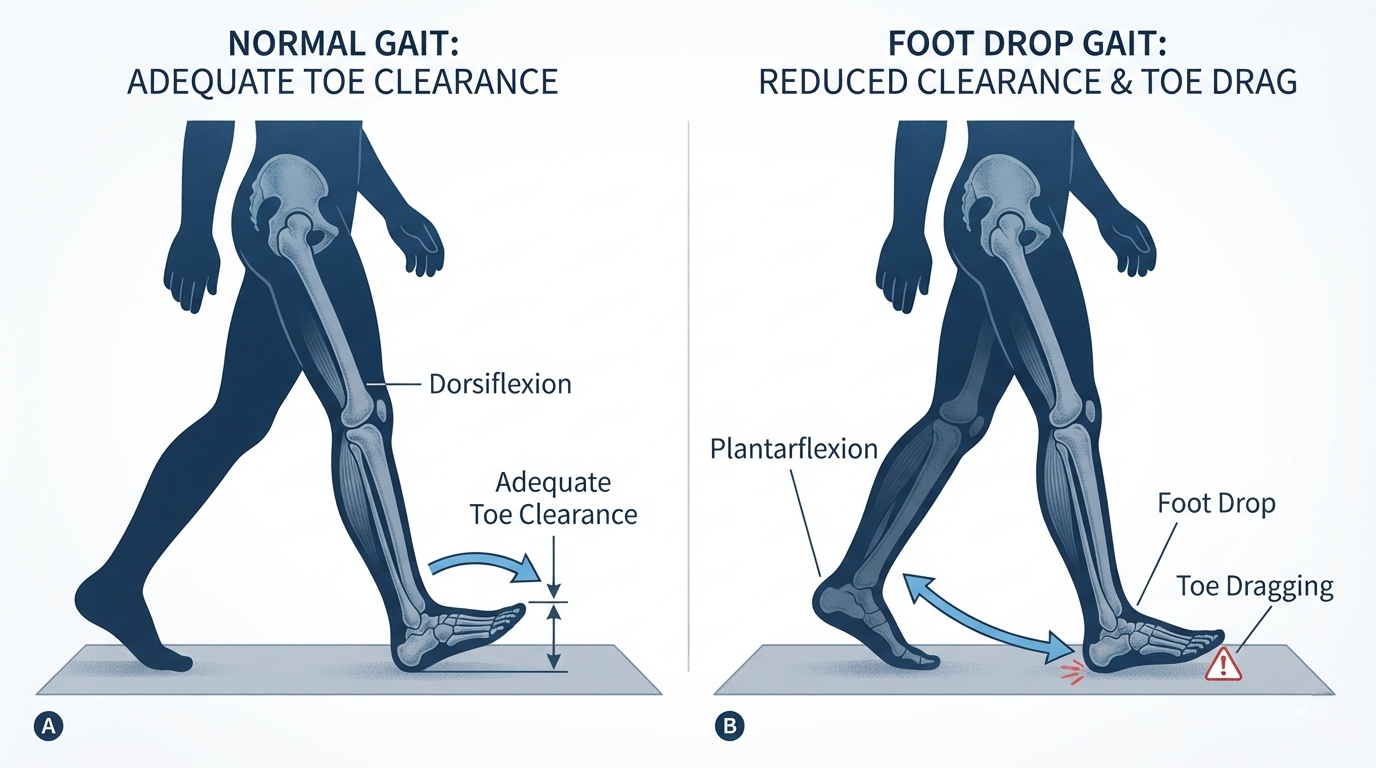
Walking is a coordinated movement that depends on your muscles, nerves, joints, and balance working together. When foot drop develops, that coordination is disrupted. Instead of moving through a smooth walking pattern, your body begins making adjustments to compensate for the weakness in your foot.
While these compensations may help you keep moving, they can make walking less efficient and increase your risk of falling.
One of the first changes people notice is difficulty lifting the front of the foot during the swing phase of walking. As a result, the toes may drag across the floor instead of clearing it.
Reduced toe clearance increases the chance of catching your foot on:
Even a small obstacle can become a tripping hazard when your foot doesn't lift properly.
To avoid dragging the toes, many people naturally begin lifting their knee much higher than normal. This walking pattern is known as a steppage gait.
Although this compensation helps the foot clear the ground, it requires more effort and can become tiring over time. It also places extra stress on your hips and lower back.
People with foot drop often take shorter steps because they don't feel confident placing their affected foot forward.
A shorter stride can reduce walking efficiency and make it more difficult to keep up with others. It may also contribute to stiffness and fatigue during longer walks.
Walking more slowly is another common adaptation.
Many people instinctively reduce their speed because they worry about tripping or losing their balance. While slowing down may feel safer, it can also reduce your confidence and limit your ability to participate in everyday activities.
Foot drop doesn't only affect the foot. It changes the way your entire body moves.
You may notice that you:
Over time, these changes can place additional strain on your knees, hips, and lower back.
One of the biggest concerns with foot drop is the increased risk of falls.
When your toes catch the ground unexpectedly, it's harder to recover your balance. This risk becomes even greater when walking on uneven surfaces, climbing stairs, or moving through crowded areas.
Falls can lead to fractures, loss of confidence, and reduced independence, making early treatment especially important.
The good news is that you don't have to accept an altered walking pattern as your new normal.
Gait training helps you develop safer, more efficient walking mechanics by improving muscle strength, balance, coordination, and foot clearance. Combined with strengthening exercises and appropriate treatment for neuropathy, gait training can reduce compensatory movements and help you walk with greater confidence.
The sooner these walking changes are addressed, the better your chances of improving mobility and maintaining an active, independent lifestyle.
Exercise is an important part of recovering from foot drop, but safety should always come first. Since foot drop affects balance and foot clearance, taking a few precautions before you begin can reduce your risk of falling and help you exercise with confidence.
If you've recently fallen or your symptoms have worsened, speak with your healthcare provider or physical therapist before starting a new exercise program.
The shoes you wear can make a significant difference in your stability.
Choose shoes that:
Avoid flip-flops, loose slippers, worn-out shoes, or walking in socks on smooth floors, as these can increase your risk of tripping.
Practice your exercises in an area that gives you plenty of room to move safely.
Before you begin:
A clean, uncluttered area allows you to focus on your movements instead of worrying about obstacles.
When learning new exercises, keep a sturdy countertop, handrail, or heavy chair within reach.
Using support while you build strength and balance is a smart safety strategy. As your confidence improves, your physical therapist may recommend gradually reducing the amount of support you use.
There's no need to rush through your exercises.
Perform each movement slowly and with control. Pay attention to lifting your foot, maintaining good posture, and keeping your movements smooth rather than trying to complete as many repetitions as possible.
Quality of movement is more important than speed.
Stop exercising immediately if you experience:
If these symptoms occur, stop exercising and seek medical advice before continuing your program.
Taking a few minutes to prepare before each session creates a safer environment for recovery. When you combine good safety habits with consistent practice, you'll be better positioned to improve your strength, walking ability, and confidence while reducing your risk of injury.
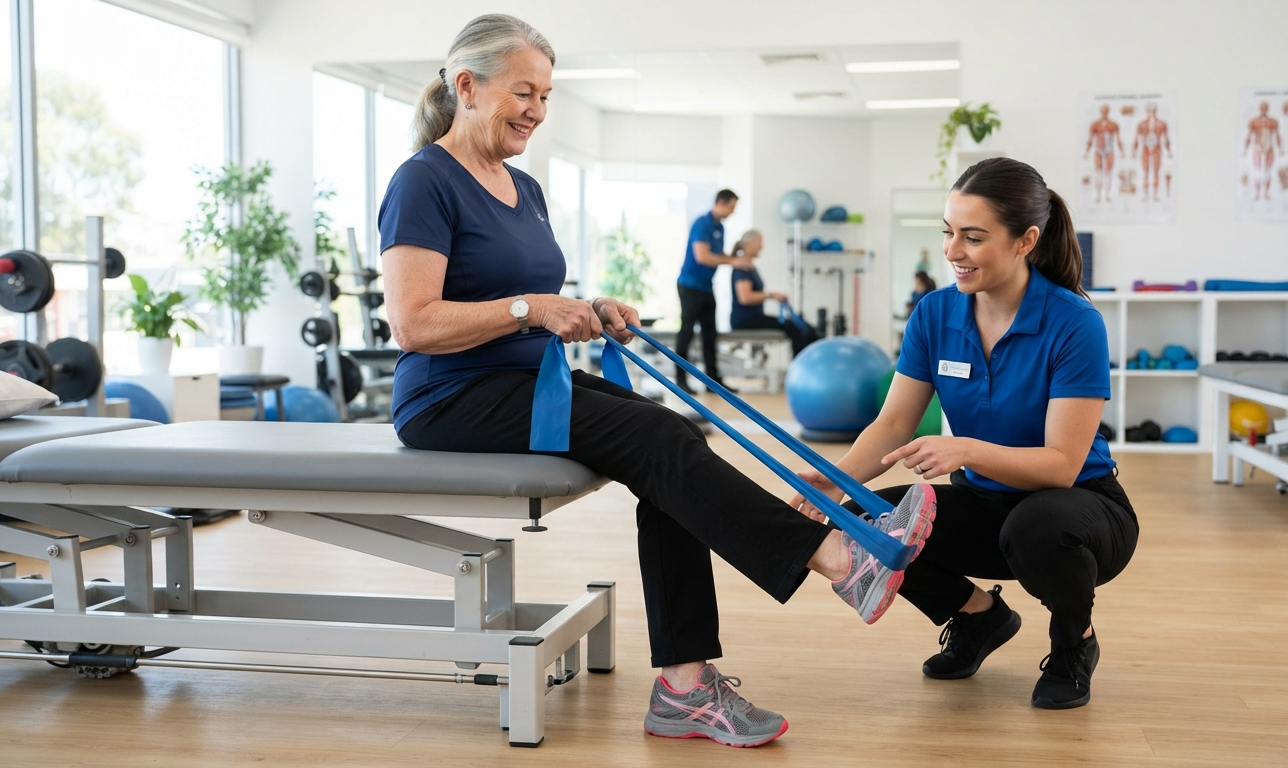
Exercise is one of the most effective ways to manage foot drop caused by neuropathy. While exercises can't repair damaged nerves, they can strengthen the muscles that still function, improve balance, retrain your walking pattern, and reduce your risk of falls.
Before starting these exercises, make sure you're in a safe environment with a sturdy chair, countertop, or handrail nearby for support. Move slowly and stop if you experience severe pain, dizziness, or feel unsafe.
This exercise strengthens the muscles responsible for lifting the front of your foot, which is one of the primary movements affected by foot drop.
How to perform the exercise:
Common mistakes:
Make it easier: Reduce the lifting height.
Make it more challenging: Hold the lifted position for five seconds.
Adding gentle resistance helps strengthen the muscles that lift your foot during walking.
How to perform the exercise:
Common mistakes:
Make it easier: Use a lighter resistance band.
Make it more challenging: Increase the resistance slightly while maintaining good control.
Toe raises strengthen the muscles at the front of your lower leg and improve foot clearance while walking.
How to perform the exercise:
Common mistakes:
Make it easier: Perform the exercise while sitting.
Make it more challenging: Pause for three to five seconds before lowering your toes.
Heel walking improves ankle control and strengthens the muscles that lift your foot.
How to perform the exercise:
Common mistakes:
Make it easier: Walk a shorter distance.
Make it more challenging: Increase the number of steps.
Marching improves hip strength, coordination, and foot clearance during walking.
How to perform the exercise:
Common mistakes:
Make it easier: Lift your knees only a few inches.
Make it more challenging: Pause briefly each time your knee reaches its highest point.
Step-ups improve lower-body strength while preparing you for everyday tasks like climbing stairs and stepping onto curbs.
How to perform the exercise:
Common mistakes:
Make it easier: Use a lower step.
Make it more challenging: Increase the repetitions gradually.
This gentle exercise is ideal for people with significant weakness or those beginning rehabilitation.
How to perform the exercise:
Common mistakes:
Make it easier: Lift your foot only slightly.
Make it more challenging: Increase the hold time.
This exercise improves ankle mobility and control while encouraging movement in multiple directions.
How to perform the exercise:
Common mistakes:
Make it easier: Complete only the first half of the alphabet.
Make it more challenging: Complete the full alphabet twice.
Walking requires smooth weight transfer from one leg to the other. This exercise helps improve balance and stability.
How to perform the exercise:
Common mistakes:
Make it easier: Keep both hands on the support.
Make it more challenging: Briefly lift the opposite foot from the floor.
Heel-to-toe walking improves coordination, balance, and foot placement while encouraging a smoother walking pattern.
How to perform the exercise:
Common mistakes:
Make it easier: Leave a small gap between your heel and toes.
Make it more challenging: Reduce your hand support as your balance improves.
To get the most from these exercises:
Remember that foot drop recovery looks different for everyone. Some people notice better muscle control within a few weeks, while others require longer rehabilitation depending on the severity of their neuropathy. The goal is steady progress that improves your safety, confidence, and ability to move through daily life.
Foot drop affects much more than the muscles that lift your foot. Walking also depends on strong hips, thighs, glutes, calves, and core muscles working together to keep you stable and moving efficiently.
Strengthening these muscle groups can improve your balance, increase your walking endurance, and help reduce the compensations that often develop with foot drop.
Aim to perform these exercises two to three times each week in addition to your gait training routine.
The sit-to-stand exercise strengthens your thighs, hips, and core while improving one of the most common daily movements.
How to perform the exercise:
Common mistakes:
Make it easier: Use the chair's armrests for support.
Make it more challenging: Pause for three seconds before sitting down.
Strong glute muscles help stabilize your pelvis and support a smoother walking pattern.
How to perform the exercise:
Common mistakes:
Make it easier: Lift only as high as comfortable.
Make it more challenging: Hold the bridge for five to ten seconds.
The muscles on the outside of your hips help stabilize your body while walking. Weakness in these muscles often causes excessive side-to-side movement.
How to perform the exercise:
Common mistakes:
Make it easier: Lift your leg only a few inches.
Make it more challenging: Pause for three seconds before lowering.
Although foot drop mainly affects lifting the foot, strong calf muscles are still essential for a normal walking pattern because they provide the push needed to move you forward.
How to perform the exercise:
Common mistakes:
Make it easier: Lift your heels only partway.
Make it more challenging: Use one hand for support instead of both.
Mini squats strengthen several muscle groups at the same time, making them an excellent functional exercise for improving walking and balance.
How to perform the exercise:
Common mistakes:
Make it easier: Perform a smaller squat.
Make it more challenging: Hold the lowered position for three to five seconds.
Strong thigh muscles help control your knee during walking and improve stability when standing from a chair or climbing stairs.
How to perform the exercise:
Common mistakes:
Make it easier: Extend your leg only partway.
Make it more challenging: Add a light ankle weight if recommended by your physical therapist.
Strength training works best when combined with gait training, balance exercises, and regular walking practice. As your muscles become stronger, you'll often notice that everyday activities require less effort and your walking becomes smoother and more controlled.
Remember that improvements happen gradually. Focus on performing each exercise with good technique rather than completing as many repetitions as possible. Small gains in strength can lead to meaningful improvements in mobility, confidence, and overall quality of life.
Strengthening your muscles is an important part of recovering from foot drop, but strength alone won't automatically improve the way you walk. Your brain and muscles also need to relearn how to work together during each step. This process is known as gait training.
Balance and gait training help improve coordination, increase confidence, and reduce the compensatory movements that often develop with foot drop. Practicing these drills regularly can make everyday activities feel safer and more natural.
Walking requires smooth weight transfer from one leg to the other. Weight shifting improves stability and prepares you for taking confident steps.
How to perform the exercise:
Common mistakes:
Make it easier: Keep both hands on the support.
Make it more challenging: Briefly lift the opposite foot off the floor.
Heel-to-toe walking improves balance, foot placement, and coordination while encouraging a smoother walking pattern.
How to perform the exercise:
Common mistakes:
Make it easier: Leave a small space between your heel and toes.
Make it more challenging: Reduce your hand support when it is safe to do so.
Daily life involves stepping over door thresholds, curbs, toys, and other obstacles. This drill improves foot clearance and teaches you to lift your foot more effectively during walking.
How to perform the exercise:
Common mistakes:
Make it easier: Use lower obstacles and increase the spacing.
Make it more challenging: Create a course with gentle turns.
Many falls occur while changing direction rather than walking straight ahead. Practicing turns helps improve balance and control.
How to perform the exercise:
Common mistakes:
Make it easier: Practice beside a countertop.
Make it more challenging: Walk a figure-eight pattern around two objects.
As your confidence improves indoors, gradually begin practicing in environments that better reflect everyday life.
Examples include:
Begin with short distances and choose locations with even surfaces. If you feel unsteady, have someone walk with you or use an assistive device recommended by your physical therapist.
It's normal for your walking pattern to feel different at first. Many people have spent weeks or months compensating for foot drop, and those movement habits don't change overnight.
Consistent gait training helps your body develop safer walking patterns while improving confidence and reducing unnecessary compensations. When combined with strengthening exercises, balance training, and a personalized rehabilitation program, these drills can help you walk more efficiently and lower your risk of falls.
Exercise and physical therapy are the foundation of foot drop rehabilitation, but some people benefit from additional support while improving their strength and walking pattern. Braces, assistive devices, and proper footwear can increase safety, reduce the risk of falls, and make everyday activities easier.
The right option depends on the severity of your foot drop, your balance, and your overall mobility. A physical therapist can help determine which type of support is most appropriate for your needs.
An ankle-foot orthosis, commonly called an AFO, is a brace that helps hold your foot in a more neutral position while walking. This improves toe clearance during the swing phase of gait and reduces the likelihood of tripping.
An AFO may be recommended if you:
An AFO can improve walking efficiency, but it should be viewed as part of a comprehensive rehabilitation program rather than a replacement for exercise. Continuing to strengthen your muscles and improve your walking mechanics remains important.
Some people with foot drop benefit from using a cane or walker, particularly during the early stages of rehabilitation or when balance is significantly affected.
These devices can:
A physical therapist can recommend the most appropriate device and teach you how to use it safely. Using equipment that is the wrong height or technique can actually make walking more difficult.
Supportive shoes provide a stable foundation for walking and can improve both comfort and safety.
Look for shoes that:
Avoid flip-flops, backless slippers, worn-out athletic shoes, and high heels. These types of footwear can make foot drop more difficult to manage and increase your risk of tripping.
Not everyone with foot drop needs a brace. Some people regain enough strength and control through physical therapy that an AFO is unnecessary, while others may benefit from wearing one during certain activities, such as walking outdoors or covering longer distances.
Your treatment plan may also change over time. As your strength, balance, and walking pattern improve, your physical therapist will reassess whether your brace or assistive device is still needed or whether it can be adjusted or discontinued.
The goal is always the same: to help you walk as safely, efficiently, and independently as possible while supporting your long-term mobility.
Exercise is one of the most important parts of treating foot drop, but it isn't the only tool available. Modern physical therapy often combines strengthening exercises with specialized rehabilitation techniques that help improve muscle activation, movement patterns, and walking ability.
Your treatment plan should always be based on the cause of your foot drop, the severity of your symptoms, and your rehabilitation goals.
Neuromuscular re-education is a physical therapy approach that helps retrain communication between your brain, nerves, and muscles.
When neuropathy affects the muscles that lift your foot, your body often develops compensatory movement patterns. Neuromuscular re-education focuses on improving movement quality rather than simply increasing muscle strength.
Treatment may include:
The goal is to help your muscles work together more efficiently during everyday activities.
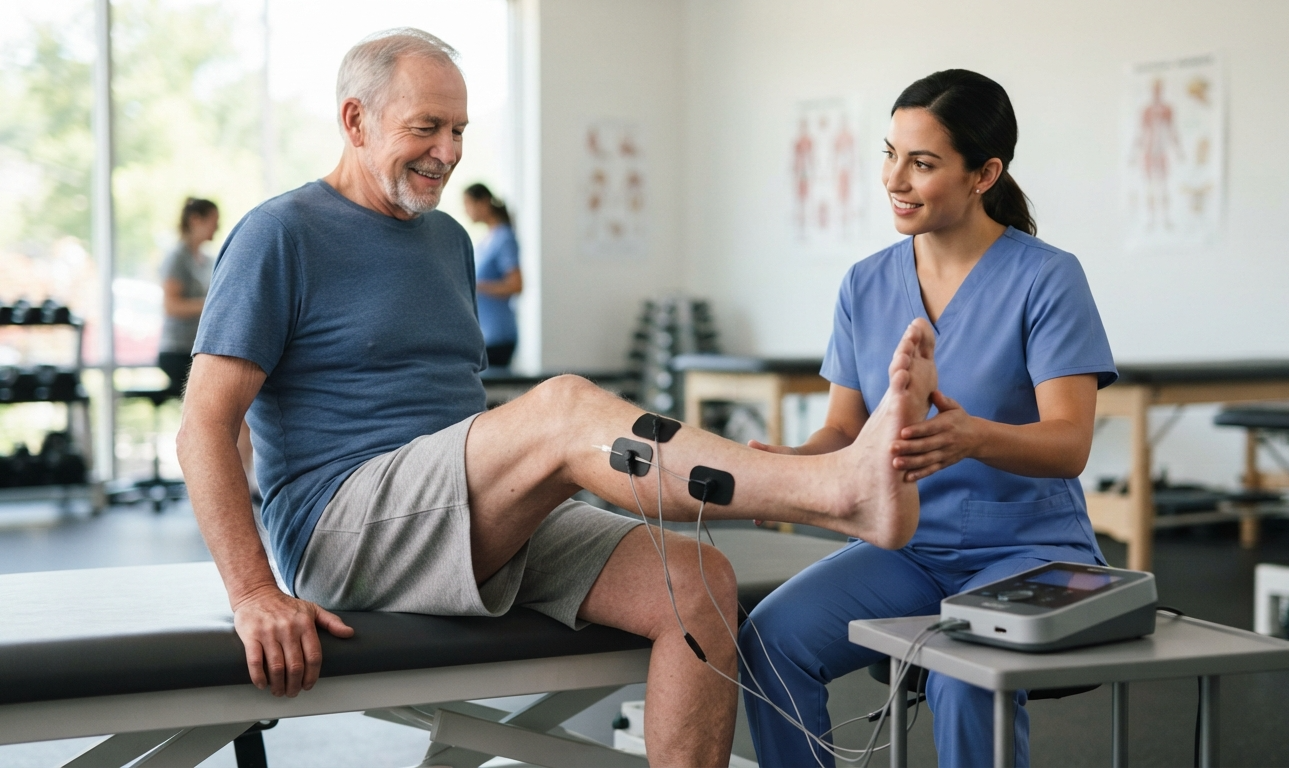
Electrical stimulation is another technique that may be incorporated into a rehabilitation program for some people with foot drop.
Small electrical impulses are delivered through surface electrodes placed on the skin. These impulses stimulate specific muscles to contract, helping improve muscle activation during exercise and functional activities.
Electrical stimulation may be used alongside strengthening exercises and gait training to encourage more effective movement patterns.
Not everyone is a candidate for electrical stimulation, so your physical therapist will determine whether it's appropriate based on your medical history and examination.
One advanced form of neuromuscular electrical stimulation is the NEUBIE® (Neuro-Bio-Electric Stimulator). Unlike many traditional electrical stimulation devices, the NEUBIE is designed to be used while performing guided movement and therapeutic exercises.
For some individuals with neuropathy, this approach may help improve muscle activation, movement awareness, and functional training as part of a comprehensive rehabilitation program. The exact benefits vary from person to person, which is why a thorough evaluation is important before deciding whether this type of treatment is appropriate.
If you'd like to learn more about how advanced neuromuscular stimulation is being used in neuropathy rehabilitation, NEUFit provides additional educational information here: https://www.neu.fit/neuropathy/.
At HWY Physical Therapy, we have the NEUBIE machine available as part of our rehabilitation services for appropriate patients.
When clinically indicated, Dr. Raj may incorporate the NEUBIE into a personalized treatment program alongside:
Rather than relying on a single treatment method, your rehabilitation program is designed around your specific condition, functional limitations, and personal goals.
There is no single treatment that works for everyone with foot drop caused by neuropathy. The most successful rehabilitation programs typically combine several evidence-based strategies to improve strength, walking mechanics, balance, and overall mobility.
By combining therapeutic exercise, gait retraining, patient education, and advanced rehabilitation technology when appropriate, many people are able to improve their walking, reduce their risk of falls, and regain confidence in their daily activities.
One of the first questions people ask after being diagnosed with foot drop is whether it will get better. The answer depends on the cause of the nerve damage, how severe it is, and how soon treatment begins.
While some people experience significant improvement, others may continue to have some weakness. Even when nerve recovery is limited, physical therapy can often improve walking, balance, and overall function.
Peripheral neuropathy can develop for many reasons, including diabetes, chemotherapy, vitamin deficiencies, autoimmune conditions, and nerve compression. The extent of nerve damage and whether the underlying cause can be treated play a major role in recovery.
If the nerve is able to heal or its function improves, muscle strength may gradually return. If nerve damage is permanent, rehabilitation focuses on maximizing the strength of the muscles that are still working and teaching safer, more efficient movement strategies.
Starting treatment as soon as symptoms appear can help prevent secondary problems such as muscle weakness, poor walking habits, joint stiffness, and repeated falls.
A comprehensive rehabilitation program may include:
Building good movement habits early can improve long-term mobility and help you stay independent.
Recovery isn't always measured by completely eliminating foot drop. For many people, success means:
Even small improvements can have a meaningful impact on your quality of life.
Improving foot drop takes patience and regular practice. Following your home exercise program, attending physical therapy sessions, and staying as active as your condition allows can all contribute to better outcomes.
Your physical therapist will monitor your progress and adjust your treatment plan as your strength, mobility, and walking pattern improve. With consistent effort and the right support, many people are able to move more safely, reduce their risk of falls, and regain confidence in their daily lives.
Living with foot drop doesn't mean you have to stop doing the activities you enjoy. Making a few practical changes at home and developing safer movement habits can significantly reduce your risk of falling while helping you stay active and independent.
Combining these strategies with your exercise program can make everyday movement safer and more comfortable.
Many falls happen at home because of hazards that are easy to overlook.
Walk through your home and look for areas that could increase your risk of tripping.
Simple changes include:
A safer home allows you to move with greater confidence.
Stairs require good balance, strength, and foot control.
To improve safety:
If stairs have become difficult, discuss the problem with your physical therapist. They can teach techniques that make stair climbing safer.
Uneven ground increases the chance of catching your toes.
When walking outdoors:
Taking a few extra seconds to scan your path can help prevent unexpected trips.
Peripheral neuropathy can reduce sensation in your feet, making it harder to notice cuts, blisters, or pressure areas.
Take a few minutes each day to:
If you have diabetes, daily foot care is especially important to help prevent complications.
It may be tempting to avoid walking because you're worried about falling, but becoming less active can lead to weaker muscles and poorer balance.
Instead, stay active within your comfort level by:
Regular movement helps maintain strength, flexibility, and confidence.
If you notice that you're tripping more often, your foot is becoming weaker, or you're losing confidence while walking, don't wait for a fall to happen.
Seeking treatment early can help address the underlying problem before it leads to more serious mobility limitations.
Small daily habits can make a big difference. By creating a safer environment, protecting your feet, staying active, and paying attention to changes in your walking, you can reduce your risk of falls and continue living as independently as possible.
Managing foot drop takes more than performing a few exercises. Daily habits, walking techniques, and treatment decisions all influence your progress. Some common mistakes can slow recovery, increase the risk of falls, or make walking more difficult than it needs to be.
Recognizing these habits early can help you stay safer and get better results from your rehabilitation program.
Many people dismiss occasional toe dragging or frequent tripping as a normal part of aging. Unfortunately, waiting too long to seek help can allow muscle weakness, poor walking habits, and balance problems to become more pronounced.
If you notice changes in the way you walk, schedule an evaluation as early as possible. Early treatment often leads to better functional outcomes.
Unsupportive shoes can make foot drop more difficult to manage.
Avoid:
Instead, choose supportive shoes with a secure fit, good traction, and adequate arch support to improve stability while walking.
Progress depends on consistency. Performing exercises only during physical therapy appointments is usually not enough to build strength and improve walking mechanics.
Set aside time several days each week to complete your prescribed exercises. Even short sessions performed consistently are more effective than occasional long workouts.
An ankle-foot orthosis (AFO) can improve safety and reduce toe dragging, but it shouldn't replace rehabilitation whenever exercise is appropriate.
Strengthening exercises, gait training, and balance activities help improve the muscles and movement patterns that support long-term mobility. For many people, the best results come from combining these approaches rather than depending on a brace alone.
It's natural to watch your feet if you're worried about tripping, but constantly looking down changes your posture and can affect your balance.
Practice looking several feet ahead while remaining aware of your surroundings. This encourages a more natural walking pattern and helps you identify obstacles before you reach them.
After a trip or fall, many people become afraid to walk. While that reaction is understandable, avoiding activity often leads to weaker muscles, poorer balance, and even greater difficulty walking.
Stay active within your comfort level and follow the guidance of your physical therapist. Gradually increasing your activity can help rebuild both strength and confidence.
It's important to challenge yourself, but advancing to more difficult exercises before you're ready can increase your risk of injury or falls.
Focus on mastering each exercise with good form before increasing the difficulty. Slow, steady progress is more effective than rushing through your rehabilitation.
If your foot drop is getting worse, you're falling more often, or home exercises aren't improving your walking, it's time to seek professional care.
A physical therapist can identify the cause of your movement difficulties, monitor your progress, and adjust your treatment plan as your needs change. Getting expert guidance early can help you avoid unnecessary setbacks and improve your long-term mobility.
Home exercises can be very effective, especially during the early stages of foot drop. However, there are times when professional evaluation and treatment are the safest and most effective way to improve your mobility.
If your walking continues to become more difficult despite exercising regularly, a physical therapist can identify the underlying problems and develop a treatment plan tailored to your needs.
Consider seeing a physical therapist if you:
The earlier these problems are addressed, the easier they are often to manage.
Your first visit begins with a comprehensive evaluation to understand how foot drop is affecting your movement.
Your physical therapist will assess:
Based on your findings, a personalized rehabilitation plan will be created to address your specific goals and challenges.
Treatment may include:
Your program will be adjusted as you progress to help you continue improving safely.
If you're looking for foot drop treatment in Salem, Oregon, Dr. Raj at HWY Physical Therapy provides individualized care designed to help you move with greater confidence and independence.
Every rehabilitation program begins with a thorough evaluation and is tailored to your symptoms, diagnosis, lifestyle, and goals. Depending on your needs, treatment may include gait training, balance therapy, strengthening exercises, neuromuscular re-education, and advanced rehabilitation techniques.
For appropriate patients, HWY Physical Therapy also offers treatment using the NEUBIE machine, which may be incorporated into a comprehensive rehabilitation program to support muscle activation and functional movement alongside therapeutic exercise.
The goal is not simply to strengthen your foot. It's to improve the way you walk, reduce your risk of falls, and help you return to the activities that matter most.
HWY Physical Therapy
Center 50+, Salem City Building
2615 Portland Rd NE
Salem, OR 97301
Call 971-202-1979 to schedule your personalized evaluation and learn how a customized rehabilitation program can help you improve your walking and regain confidence.
It depends on the underlying cause and the extent of the nerve damage. If the neuropathy can be treated or managed effectively, some people experience improved nerve function and muscle strength over time.
Even if nerve recovery is limited, physical therapy can help improve walking, increase strength, reduce the risk of falls, and maximize your independence. The goal is to help you move as safely and efficiently as possible.
There isn't one exercise that's best for everyone.
A successful rehabilitation program usually combines several exercises that target different aspects of walking, including:
Your physical therapist will recommend the exercises that best match your level of strength, balance, and mobility.
Walking is beneficial because it helps maintain mobility, endurance, and cardiovascular health. However, walking alone usually isn't enough to correct the muscle weakness and movement patterns associated with foot drop.
The best results typically come from combining regular walking with strengthening exercises, gait training, and balance training.
An AFO can be very helpful for people with significant foot weakness or frequent tripping. By keeping the foot in a better position during walking, it improves toe clearance and helps reduce the risk of falls.
Not everyone with foot drop needs a brace. Some people improve enough with rehabilitation that they no longer require one, while others may benefit from wearing an AFO only during certain activities. Your physical therapist can help determine whether a brace is appropriate for your situation.
Electrical stimulation may benefit some people by improving muscle activation during rehabilitation. It is often used alongside strengthening exercises, gait training, and balance training rather than as a stand-alone treatment.
Advanced technologies, including the NEUBIE machine, may also be incorporated into rehabilitation programs for appropriate patients to support muscle activation and functional movement. Your physical therapist will determine whether this type of treatment is suitable based on your condition and goals.
It depends on which foot is affected, the severity of your weakness, and your ability to safely control the vehicle.
If your right foot is affected, operating the accelerator and brake may become more difficult. Before continuing to drive, discuss your symptoms with your physician or physical therapist. They can advise you on whether additional evaluation or vehicle modifications are appropriate.
Most people with foot drop from peripheral neuropathy are treated without surgery.
However, surgery may be considered if foot drop is caused by certain conditions, such as severe nerve compression, a traumatic nerve injury, or another problem that can be corrected surgically. Your physician will determine whether surgical treatment is appropriate based on the underlying cause.
Recovery varies from person to person.
Some individuals notice improvements within several weeks, while others require several months of rehabilitation. The length of treatment depends on factors such as:
Your physical therapist will regularly evaluate your progress and adjust your treatment plan as your mobility improves.
Yes. Foot drop makes it more difficult to lift your toes while walking, increasing the chance of catching your foot on everyday obstacles.
The risk becomes even greater when walking on uneven ground, climbing stairs, or moving through unfamiliar environments. Strengthening exercises, gait training, balance therapy, supportive footwear, and assistive devices can all help reduce this risk.
Don't wait until you've experienced a serious fall.
You should schedule an evaluation if you notice:
Early intervention often leads to better outcomes and can help prevent small mobility problems from becoming larger safety concerns.
If you'd like to learn more about foot drop, neuropathy, and improving your mobility, these trusted resources provide additional evidence-based information:
Foot drop caused by neuropathy can make everyday activities more challenging, but it doesn't have to define your mobility. The right rehabilitation program can help you improve your walking, reduce your risk of falls, and regain confidence in your daily activities.
At HWY Physical Therapy, Dr. Raj provides comprehensive evaluations and personalized treatment plans for people experiencing foot drop and walking difficulties related to peripheral neuropathy. Every rehabilitation program is tailored to your specific condition, goals, and lifestyle.
Treatment may include:
Our goal is to help you move more safely, improve your independence, and return to the activities you enjoy with greater confidence.
HWY Physical Therapy
Center 50+, Salem City Building
2615 Portland Rd NE
Salem, OR 97301
Call 971-202-1979 today to schedule your personalized evaluation and learn how a customized treatment program can help you improve your walking and quality of life.
Learn why neuropathy causes falls and balance problems. Discover exercises, gait therapy, and Neubie rehabilitation at HWY Physical Therapy Clinic.
Neuropathy symptoms in seniors can increase fall risk. Learn early signs and treatment options at HWY Physical Therapy Clinic in Salem, Oregon.
Non-surgical neuropathy treatment in Salem Oregon using Neubie therapy. Get expert care at HWY Physical Therapy Clinic for nerve pain relief.
.png)
Whether you have questions about enhancing strength, increasing mobility, ensuring home safety, managing pain effectively, or preventing falls, I am here to provide expert guidance.
Limited Time Offer - $25 - Learn More