Which stroke physical therapy treatments have strong evidence, which add-ons are weaker, and what research shows about recovery months or years later.
After a stroke, the choice of physical therapy shapes how much movement a person regains and how well that movement holds up in daily life. Stroke survivors and their families often face a long list of options, from walking practice and arm training to robots, mirrors, and electrical stimulation.
Two concerns come up again and again. The first is which of these treatments actually work. The second is a widely repeated belief that recovery stops after six months, so later therapy is pointless. This article explains what current guidelines and clinical trials show on both questions, including where the evidence is strong and where it is thin.
Before Starting: New Stroke Signs Need 911, Not Therapy
Stroke survivors carry a risk of another stroke, so new symptoms are an emergency, not a reason to book therapy. The CDC uses the B.E. F.A.S.T. checklist:
- Balance: "Ask the person if they are feeling off-balance or dizzy."
- Eyes: "Ask the person if they have trouble seeing normally."
- Face: "Ask the person to smile. Does one side of the face droop?"
- Arms: "Ask the person to raise both arms. Does one arm drift downward?"
- Speech: "Ask the person to repeat a simple phrase. Is the speech slurred or strange?"
- Time: "If you see any of these signs, call 9-1-1 right away."
The CDC adds: "Do not drive to the hospital or let someone else drive you."
The Short Answer: What the Best Stroke Rehabilitation Has in Common
The best physical therapy after a stroke is repetitive, task-specific practice of real activities, progressed steadily, at a high enough dose to matter. That pattern runs through the strongest guideline recommendations and the largest reviews of trials.
Task-specific practice means rehearsing the actual skill a person wants back. Walking practice builds walking. Reaching and grasping practice builds reaching and grasping. Exercises that only loosely resemble the goal tend to help less.
The largest review in this field makes the point plainly. Veerbeek and colleagues analyzed 467 randomized trials with more than 25,000 participants in 2014. They concluded:
"There is strong evidence for PT interventions favoring intensive high repetitive task-oriented and task-specific training in all phases poststroke. Effects are mostly restricted to the actually trained functions and activities."
In plain terms, practice works, more practice works better, and the gains show up mainly in the tasks that were practiced. As a result, a good program is built around the activities each person needs most.
The 2026 Guideline: A New Standard
In August 2026, the American Heart Association and the American Stroke Association published a new stroke rehabilitation guideline in the journal Stroke. It replaces the 2016 version that many websites still quote. The grades below come from that guideline, as listed in the Guideline Central summary.
Two grading terms appear throughout. The Class of Recommendation describes strength: Class 1 is strong, Class 2a is moderate, Class 2b is weak, and Class 3 means no benefit or harm. The Level of Evidence describes quality: Level A rests on multiple high-quality randomized trials, Level B-R on moderate-quality randomized trials, and Level B-NR on nonrandomized studies.
These grades matter because they separate well-tested treatments from promising ones. The next sections apply them treatment by treatment.
The Treatments With the Strongest Evidence
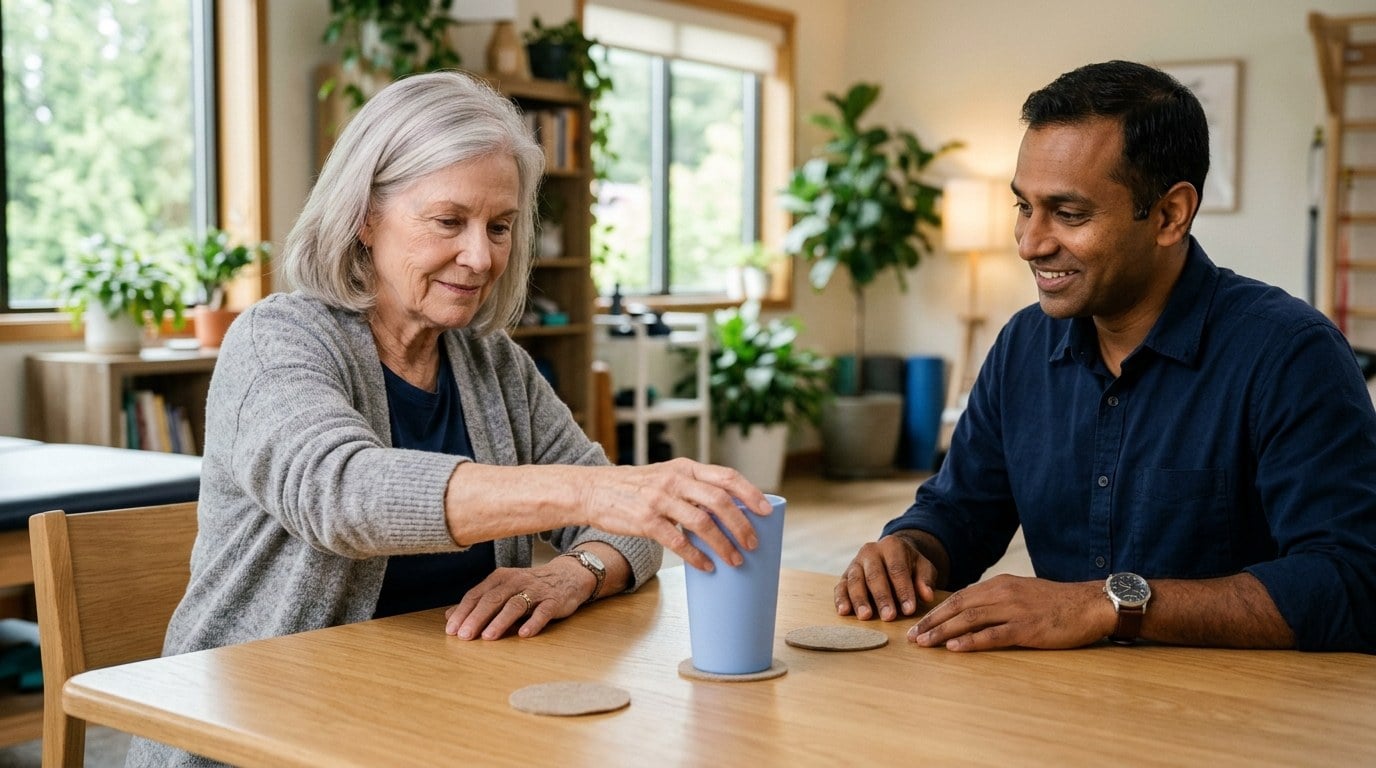
Four approaches carry the strongest support. Each one follows the same core pattern of focused, repeated, progressively harder practice.
Task-Specific Practice: The Foundation for Arm and Leg Recovery
The 2026 guideline recommends repetitive, progressively graded practice of functional tasks for arm and hand recovery (Class 1, Level A). For walking, it recommends task-specific training focused on overground walking, stepping, and balance (Class 1, Level A). These are the guideline's strongest grades.
The Cochrane review of repetitive task training supports this, with honest limits. French and colleagues pooled 33 trials with 1,853 participants in 2016. They found improvements in arm function, hand function, walking distance, and functional walking ability.
However, the effects were small to moderate. The quality of evidence ranged from low for arm function to moderate for walking. Benefits were measurable for up to six months after treatment ended but not beyond, which suggests that practice needs to continue to hold its gains.
Walking Practice at Higher Intensity: Effort Matters
Walking training works better when it is challenging. The 2026 guideline states that moderate to high intensity stepping practice, or high intensity interval training focused on walking speed, can be effective (Class 2a, Level B-R).
The guideline also gives a dose for walking therapy. It suggests at least 4 to 8 weeks of high-dose gait therapy, in sessions of 1 to 2 hours, 5 times per week (Class 2a, Level B-R). That is a research benchmark, not a fixed rule, but it shows the scale of practice that trials used.
Importantly, the same guideline advises against low-effort treadmill walking. Light to moderate intensity treadmill training, with or without body weight support, is graded Class 3: No Benefit (Level A). In other words, the treadmill is a tool, and the intensity of the work on it decides whether it helps.
Constraint-Induced Movement Therapy: For the Weaker Arm
Constraint-induced movement therapy, often shortened to CIMT, limits use of the stronger arm, usually with a mitt. This forces intensive practice with the weaker arm. The 2026 guideline names CIMT as one of the task-specific approaches within its Class 1, Level A recommendation for arm recovery.
The best-known trial is EXCITE, published in JAMA in 2006. This single-blind randomized trial at seven US academic centers enrolled 222 people whose first stroke had occurred 3 to 9 months earlier. After a two-week CIMT program, the treated group showed a 34 percent greater improvement than the usual-care group in the time needed to complete a standard set of arm tasks. The gains lasted at least one year.
The broader evidence is more modest. The 2015 Cochrane review of CIMT, covering 42 studies and 1,453 participants, found a significant improvement in arm motor function. However, it did not find a convincing reduction in disability, and the authors noted that "The majority of studies were underpowered."
CIMT also does not suit everyone. The EXCITE authors described earlier CIMT studies as involving people "who maintain some hand and wrist movement." A therapist needs to assess whether the weaker arm has enough active movement to benefit.
Strength, Fitness, and Bracing: The Supporting Pillars
Stroke rehabilitation is not only about relearning movement. The 2026 guideline recommends strength and balance training 2 to 3 days per week (Class 1, Level A). It also supports strength training as an add-on to functional task practice (Class 2a, Level B-R).
Foot drop, where the toes catch on the ground, is common after stroke. The guideline recommends an ankle-foot orthosis (a lightweight brace) or functional electrical stimulation, called FES, to improve balance and mobility (Class 1, Level A). FES uses small electrical pulses to make a muscle contract at the right moment in each step.
Together, these supports make the core practice safer and more productive. They do not replace it.
Treatments With Weaker or Mixed Evidence
Several popular treatments are useful in the right setting but carry weaker or mixed evidence. Some are best understood as ways to add more practice, rather than as treatments in their own right.
Robotic and Electromechanical Walking Devices: Helpful Add-On, Not a Replacement
The evidence on walking robots points two ways, and both matter. A 2025 Cochrane review by Mehrholz and colleagues pooled 101 trials with 4,224 people. It found that adding robot gait training to physical therapy probably makes walking alone more likely. The review rated this evidence as moderate certainty.
However, the gains in walking speed and distance were probably not sustained after the studies ended. The 2026 guideline also states that robot-assisted gait training is not recommended over task-specific overground walking training (Class 3: No Benefit, Level A). As a result, a robot may add practice for some patients, but it does not outperform skilled walking practice on the ground.
Treadmill Training: Small Gains in Speed
The 2017 Cochrane review of treadmill training pooled 56 trials with 3,105 participants. The authors found that people who received treadmill training were "not more likely to improve their ability to walk independently." They also reported that "walking speed and walking endurance may improve slightly in the short term."
This fits the guideline's position. Treadmill work can be useful when it is intense and progressed, but light treadmill walking alone adds little.
Mirror Therapy: Moderate Evidence as an Adjunct
Mirror therapy places a mirror so the reflection of the stronger arm appears to be the weaker arm moving. The 2018 Cochrane review, with 62 studies and 1,982 participants, found moderate-certainty evidence of improved arm motor function and daily activities.
The 2026 guideline grades mirror therapy as reasonable for motor function and daily activities (Class 2a, Level B-R). The 2024 Veterans Affairs and Department of Defense guideline also moved toward endorsing it, according to Guideline Central's summary. Its best use is as an addition to active practice, not a substitute for it.
Electrical Stimulation and Robotic Arm Devices: Tools for More Practice
Neuromuscular electrical stimulation, or NMES, uses pulses to contract weak muscles. The 2026 guideline grades NMES for arm motor recovery as Class 2b, Level B-R, which means it may be reasonable but the case is weak. Robotic arm devices added to standard therapy, mainly to increase the amount of practice for moderate to severe arm weakness, carry a Class 2a, Level A grade.
One Exercise to Avoid: Overhead Pulleys
The 2026 guideline gives overhead pulley exercises a Class 3: Harm grade for increasing shoulder range of motion or reducing shoulder pain after stroke. This is an expert-consensus recommendation rather than a trial result. Nonetheless, families should know that a common piece of home equipment is advised against.
Comparing the Main Approaches
The table summarizes the evidence above. Grades refer to the 2026 AHA/ASA guideline.
| Treatment | What it involves | Strength of evidence | Best suited for |
|---|---|---|---|
| Task-specific practice | Repeated practice of real activities, steadily progressed | Class 1, Level A | Nearly all stroke survivors |
| Higher intensity walking practice | Challenging stepping and walking work | Class 2a, Level B-R | People working on walking speed and distance |
| Constraint-induced movement therapy | Limiting the stronger arm to force use of the weaker one | Included in Class 1, Level A arm practice | People with some active hand and wrist movement |
| Strength and balance training | Resistance and balance work, 2 to 3 days per week | Class 1, Level A | Most survivors, alongside task practice |
| Brace or FES for foot drop | Ankle brace or timed electrical stimulation | Class 1, Level A | People whose toes catch when walking |
| Mirror therapy | Watching the mirrored stronger arm move | Class 2a, Level B-R | An adjunct for arm recovery |
| Robot-assisted walking | Device-guided stepping | Not recommended over overground practice (Class 3: No Benefit) | An add-on in some programs |
| Light treadmill walking | Low-effort treadmill sessions | Class 3: No Benefit | Not recommended on its own |
| NMES for arm recovery | Pulses that contract weak muscles | Class 2b, Level B-R | A possible adjunct |
The pattern is consistent. The more a treatment involves intense, active, task-focused practice, the stronger its evidence tends to be.
The Recovery Timeline: Is It Ever Too Late?
It is not too late for meaningful improvement months or years after a stroke, but later gains are usually slower and smaller than early ones. Both halves of that answer are supported by research.
Where the Six-Month Idea Comes From
The six-month belief traces partly to older observational studies. The Copenhagen Stroke Study, published in 1995, followed patients in one Danish city. It found that 80 percent reached their best level of daily function within 6 weeks, and 95 percent within 12.5 weeks.
However, that study measured when people stopped improving under the care available at the time. It did not test whether more or better therapy could push recovery further. Early recovery is often fastest, but that is different from recovery ending.
What the Newer Evidence Shows
Several lines of evidence show that improvement remains possible later on. Each has limits worth stating.
First, the 2014 Lohse meta-analysis in Stroke examined 30 trials with 1,750 participants in which one group received more therapy than the other. More scheduled therapy predicted more improvement. Importantly, time since stroke, which ranged up to more than five years, did not change that benefit. The authors cautioned that scheduled time may not reflect actual practice.
Second, the Cochrane review of repetitive task training found that time since stroke did not alter its effects. Third, the 2014 Veerbeek review found strong evidence for intensive task practice "in all phases poststroke."
Fourth, the Queen Square program in London reported results for 224 people a median of 18 months after stroke. After 90 hours of arm-focused therapy over three weeks, their median arm impairment score rose from 26 to 37 out of 54 by six months. The authors wrote:
"chronic stroke patients can change by clinically important differences in measures of impairment and activity."
That program had no control group and offered a very high dose, so it shows what is possible, not what is typical. In addition, a 2019 reanalysis of 219 people with mild to moderate arm weakness found that responsiveness to treatment extended beyond 12 months. That finding applies to the arm only.
The LEAPS Trial: An Honest Comparison
The LEAPS trial, published in the New England Journal of Medicine in 2011, adds an important nuance. It randomized 408 people about two months after stroke into three groups. One received body weight supported treadmill training starting at 2 months, one received the same training starting at 6 months, and one received a progressive exercise program at home managed by a physical therapist.
At one year, 52 percent of all participants had improved their walking ability. Neither treadmill group did better than the therapist-managed exercise group. People who started at six months ended up in a similar place to those who started at two months.
In other words, a later start did not close the door, and the specific equipment mattered less than structured, progressive, supervised work. The treadmill groups also reported more dizziness, and people with severe walking problems in the early treadmill group had more repeated falls.
What the 2026 Guideline Says About the Chronic Phase
Clinicians usually call the period after six months the chronic stage. The 2026 guideline still calls for an individual assessment and treatment plan in this stage. A summary by Guideline Central describes rehabilitation in the guideline as "a longitudinal process with no defined endpoint." In plain terms, there is no set date when therapy stops being useful.
So the honest answer for a survivor one, two, or five years out is clear. Gains are possible. They usually take focused, hard practice. The goals should be specific and measured.
How to Judge a Stroke Rehabilitation Program
Families and survivors can assess a program by asking direct questions. The following questions reflect the evidence above.
- How much active practice happens in each session? A 2009 observational study of seven clinics counted an average of 32 arm repetitions and 357 steps per session. The authors suggested those doses may be too low. Ask how practice volume is tracked.
- Is the practice built around my goals? Gains are mostly specific to what is practiced, so the plan should target the activities that matter most.
- How is progress measured? The 2026 guideline supports monitoring functional recovery and reassessing rehabilitation needs over time (Class 2a, Level B-NR). Expect standard tests, repeated at set points.
- How is difficulty increased? Effective programs make tasks harder as the person improves.
- What happens between visits? Visits alone rarely provide enough practice. A clear, supervised practice plan between sessions extends the dose.
- How are strength, fitness, and balance addressed? These are core recommendations, not extras.
For a broader framework on which therapy methods carry evidence across conditions, see which physical therapy treatments have evidence. For advice on comparing clinicians, see how to choose a physical therapist. If therapy has started but progress seems slow, how to tell if physical therapy is working explains what to look for at each stage.
A Note for Families
Adult children often lead the search for therapy and help with practice between visits. The early weeks at home bring their own decisions about safety, routines, and support. Those are covered in our guide for families whose parent is home after a stroke.
For the longer phase, families can help most by keeping practice consistent and by asking the questions above. However, family members should not create their own exercise program for a survivor who has not been assessed. Balance, blood pressure, swallowing, and fall risk vary widely after stroke, and an unsuitable exercise can cause harm.
What Stroke Rehabilitation Looks Like at HWY Physical Therapy
HWY Physical Therapy is an outpatient clinic for adults over 50, led by Dr. Raj Pusuluri, PT, DPT. Stroke rehabilitation follows the evidence-based pattern described above, delivered in clinic and through virtual visits.
The process works in four steps:
- Evaluation. Dr. Raj assesses strength, balance, walking, arm and hand function, and fall risk, and records baseline scores with standard tests.
- Goal setting. The patient and family name specific activities to work toward, such as walking to the mailbox or using the weaker hand to eat.
- Practice-based sessions. Sessions focus on repeated, progressively harder practice of those activities, with strength and balance work built in.
- Practice between visits and reassessment. Each patient receives a practice plan for home, and progress is re-measured on a set schedule so the plan can change.
Virtual visits help when travel is difficult, which is common after a stroke. The 2026 guideline supports telerehabilitation in some situations, such as when in-person care is hard to reach.
HWY also uses the Neubie, a direct-current stimulation device. It is FDA-cleared for uses that include neuromuscular re-education, which means retraining muscles to respond to the nerves. At HWY it is only an add-on to active task practice, never a substitute for it. No high-quality trial has shown that the Neubie outperforms standard stroke rehabilitation.
Frequently Asked Questions
Is It Too Late for Physical Therapy Two Years After a Stroke?
Not necessarily. Trials and reviews show measurable gains well after the first year, especially with intensive, task-specific practice. Later gains are usually slower and smaller than early ones, so clear goals and regular measurement matter.
How Long Does Stroke Rehabilitation Take?
It varies with severity, goals, and time since the stroke. In the 2026 guideline, walking programs used at least 4 to 8 weeks of frequent sessions. The LEAPS trial delivered 36 sessions over 12 to 16 weeks. A therapist should state a plan length and a review date after the evaluation.
Is Robotic or Treadmill Therapy Better Than Regular Physical Therapy?
Not according to the current evidence. The 2026 guideline does not recommend robot-assisted walking over overground task practice, and it advises against light treadmill training. Both tools can add practice within a broader program.
Can Virtual Physical Therapy Help After a Stroke?
Yes, for suitable patients. The 2026 guideline supports telerehabilitation in some situations, such as when in-person care is hard to reach. Virtual visits work best for people who can practice safely at home, often with a family member present.
Should a Stroke Survivor Exercise at Home Without a Therapist?
General activity is valuable, but a specific program should follow an assessment. Balance, blood pressure, and fall risk differ widely after stroke. A therapist can set exercises that are both safe and hard enough to drive progress.
Evidence-Based Stroke Recovery at HWY Physical Therapy
The best physical therapy after a stroke is focused, repeated, progressively challenging practice of the activities that matter most. Improvement remains possible months and years later, and a clear plan with measured goals gives the best chance of reaching it.
To schedule a Wellness Video Call or an in-clinic evaluation, contact HWY Physical Therapy at (971) 202-1979 or book online. HWY is direct-pay, no insurance required, and no physician referral is needed to start.
HWY Physical Therapy 2615 Portland Rd NE, Salem, OR 97301 (at Center 50+) Phone: (971) 202-1979 Walk-ins welcome
HWY Physical Therapy Clinic South Salem 180 Ramsgate Square S, Salem, OR 97302 Phone: (971) 202-1979 By appointment only
Hours at both locations: Monday to Friday, 8:00 AM to 5:00 PM.
Sources
- Richards LG, Ifejika NL, Stein J, et al. 2026 Guideline for Adult Stroke Rehabilitation and Recovery: A Guideline From the American Heart Association and American Stroke Association. Stroke. 2026;57(10):e514-e658. PMID 42657476. https://doi.org/10.1161/STR.0000000000000536
- Guideline Central. AHA/ASA Adult Stroke Rehabilitation and Recovery Guideline Summary (2026). https://www.guidelinecentral.com/guideline/7080/
- Guideline Central. August 2026 AHA/ASA Adult Stroke Rehabilitation and Recovery Guideline Spotlight. https://www.guidelinecentral.com/insights/aug-2026-ahaasa-adultstrokerehabrecovery-guideline-spotlight/
- NeurologyLive. New Stroke Rehabilitation and Recovery: An FAQ on the AHA/ASA Guideline. https://www.neurologylive.com/view/new-stroke-rehabilitation-recovery-an-faq-on-aha-asa-guideline
- Guideline Central. Stroke Rehabilitation Guidelines Timeline (VA/DoD 2024). https://www.guidelinecentral.com/insights/stroke-rehabilitation-guidelines-timeline-october-2024/
- CDC. Signs and Symptoms of Stroke. https://www.cdc.gov/stroke/signs-symptoms/index.html
- Veerbeek JM, et al. What is the evidence for physical therapy poststroke? A systematic review and meta-analysis. PLoS One. 2014. PMID 24505342. https://pubmed.ncbi.nlm.nih.gov/24505342/
- French B, et al. Repetitive task training for improving functional ability after stroke. Cochrane Database Syst Rev. 2016;11:CD006073. PMID 27841442. https://pubmed.ncbi.nlm.nih.gov/27841442/
- Corbetta D, et al. Constraint-induced movement therapy for upper extremities in people with stroke. Cochrane Database Syst Rev. 2015;10:CD004433. PMID 26446577. https://pubmed.ncbi.nlm.nih.gov/26446577/
- Wolf SL, et al. Effect of constraint-induced movement therapy on upper extremity function 3 to 9 months after stroke: the EXCITE randomized clinical trial. JAMA. 2006;296(17):2095-2104. PMID 17077374. https://pubmed.ncbi.nlm.nih.gov/17077374/
- Mehrholz J, Thomas S, Elsner B. Treadmill training and body weight support for walking after stroke. Cochrane Database Syst Rev. 2017;8:CD002840. PMID 28815562. https://pubmed.ncbi.nlm.nih.gov/28815562/
- Mehrholz J, Kugler J, Pohl M, Elsner B. Electromechanical-assisted training for walking after stroke. Cochrane Database Syst Rev. 2025;5:CD006185. PMID 40365867. https://pubmed.ncbi.nlm.nih.gov/40365867/
- Thieme H, et al. Mirror therapy for improving motor function after stroke. Cochrane Database Syst Rev. 2018;7:CD008449. PMID 29993119. https://pubmed.ncbi.nlm.nih.gov/29993119/
- Lohse KR, Lang CE, Boyd LA. Is more better? Using metadata to explore dose-response relationships in stroke rehabilitation. Stroke. 2014;45(7):2053-2058. PMID 24867924. https://pubmed.ncbi.nlm.nih.gov/24867924/
- Duncan PW, et al. Body-weight-supported treadmill rehabilitation after stroke. N Engl J Med. 2011;364(21):2026-2036. PMID 21612471. https://pubmed.ncbi.nlm.nih.gov/21612471/
- Ward NS, Brander F, Kelly K. Intensive upper limb neurorehabilitation in chronic stroke: outcomes from the Queen Square programme. J Neurol Neurosurg Psychiatry. 2019;90(5):498-506. PMID 30770457. https://pubmed.ncbi.nlm.nih.gov/30770457/
- Ballester BR, et al. A critical time window for recovery extends beyond one-year post-stroke. J Neurophysiol. 2019;122(1):350-357. PMID 31141442. https://pubmed.ncbi.nlm.nih.gov/31141442/
- Jorgensen HS, et al. Outcome and time course of recovery in stroke. Part II: Time course of recovery. The Copenhagen Stroke Study. Arch Phys Med Rehabil. 1995. PMID 7741609. https://pubmed.ncbi.nlm.nih.gov/7741609/
- Lang CE, et al. Observation of amounts of movement practice provided during stroke rehabilitation. Arch Phys Med Rehabil. 2009. PMID 19801058. https://pubmed.ncbi.nlm.nih.gov/19801058/
- NeuFit. The Neubie and FAQ. https://www.neu.fit/faq
