You reach for your keys and they slip through your fingers. You step off a curb and your foot lands half a beat late. You walk on gravel and notice, for the first time in your life, that you are thinking about your feet.
Nothing hurts. Nothing is weak. Something is just a little less automatic than it used to be.
That something is coordination. And here is the good news buried in this whole article: coordination is a skill, not a muscle. Skills respond to practice at any age. Below are ten exercises that train it, how to make each one easier or harder, and how often to do them.
Read this before you start
These exercises are meant to be a little bit hard. That is the point. But a little bit hard should never mean unsafe.
Stand next to a kitchen counter, a heavy table or a wall. Not a chair with wheels. Not a chair at all if you can help it, because chairs slide.
Clear the floor. Move the rug, the cord, the cat bowl. Wear shoes with a flat sole or go barefoot on a non-slip floor. Have someone else in the house the first few times if you are not sure of yourself.
Stop immediately if you feel dizzy, lightheaded, short of breath, or any chest pain. Stop if a movement causes sharp pain. Feeling wobbly is fine. Feeling like the room is moving is not.
What coordination actually is
Coordination is your nervous system doing three things at once. It senses where your body is, it decides what to do, and it fires the right muscles in the right order at the right moment.
Strength is how much force a muscle can make. Coordination is the timing and the sequencing of that force. You can be strong and clumsy. You can also be quite ordinary in strength and beautifully coordinated. Ask any 70-year-old who still dances.
This distinction matters because it tells you how to train. Muscles grow when you load them. Skills improve when you practise them under conditions that are slightly harder than you can comfortably manage.
Motor learning researchers Mark Guadagnoli and Timothy Lee described this as the challenge point. For every person and every task there is a level of difficulty that produces the most learning. Too easy and there is nothing to learn from. Too hard and you just fail repeatedly without useful information.
Their key insight is that difficulty is relative. A tandem stand is not inherently hard or easy. It is hard or easy for you, today, on this surface. That is why every exercise below comes with a way to make it easier and a way to make it harder.
Why coordination gets harder with age
Four things change, and they stack.
Your position sense fades. Proprioception is the sense that tells you where your foot is without looking at it. A review of the ageing literature by Goble and colleagues found consistent age-related decline in proprioceptive acuity, with real consequences for postural control. The mechanisms include reduced sensitivity of the muscle spindles, thinning of nerve fibres, and changes in how the brain processes the signal.
Encouragingly, the same review reported that physical activity is linked to better proprioceptive ability in older adults. That is an association rather than proof of cause, but it points the right way.
Your processing gets slower. Reaction time and processing speed decline with age. A review of the processing speed literature notes something important, though. Cross-sectional studies, which compare different people of different ages, show a steady lifelong decline. Longitudinal studies, which follow the same people over time, show much smaller change before 60 and clearer change after it.
So the picture is less grim than the headlines. Still, when your foot catches a lip in the sidewalk, the recovery step has to happen fast. A slower system has less margin.
Your eyes change. Vision is a huge input to balance. The National Institute on Aging lists vision problems among the common contributors to unsteadiness in older adults, alongside inner ear changes, nerve problems in the feet, medication side effects and blood pressure drops on standing.
Your movement gets less varied. This is the one nobody talks about. Adult life quietly narrows down to a small set of movements: sit, stand, walk forward on flat ground, repeat.
A national US survey found that only about 1 in 7 adults aged 65 and over met both the aerobic and the muscle strengthening guidelines in 2022. That is a description of how people live, not a cause of anything by itself. But coordination is specific to what you practise. If you never step sideways, never turn quickly, never catch anything, the nervous system has no reason to keep those patterns sharp.
A two-minute self-check
Two tests used in clinical fall-risk screening will tell you roughly where you stand. Do them near a counter.
The tandem stand. Put one foot directly in front of the other, heel touching toe. Try to hold it for 10 seconds. In the CDC's 4-Stage Balance Test, not being able to hold a tandem stance for 10 seconds indicates increased fall risk.
Timed Up and Go. Sit in a firm chair. Stand up without using your arms, walk 10 feet, turn around, walk back and sit down. Time it. In CDC guidance, 12 seconds or more flags increased fall risk.
These are screening tools, not diagnoses. A slow time means it is worth a conversation, not that something is wrong with you.
Add one informal check of your own. Stand at the counter, close your eyes, and stand with your feet together for 10 seconds. If closing your eyes turns a stable stand into a struggle, you are leaning heavily on vision to do a job your position sense should be sharing.
The ten best exercises for coordination after 50
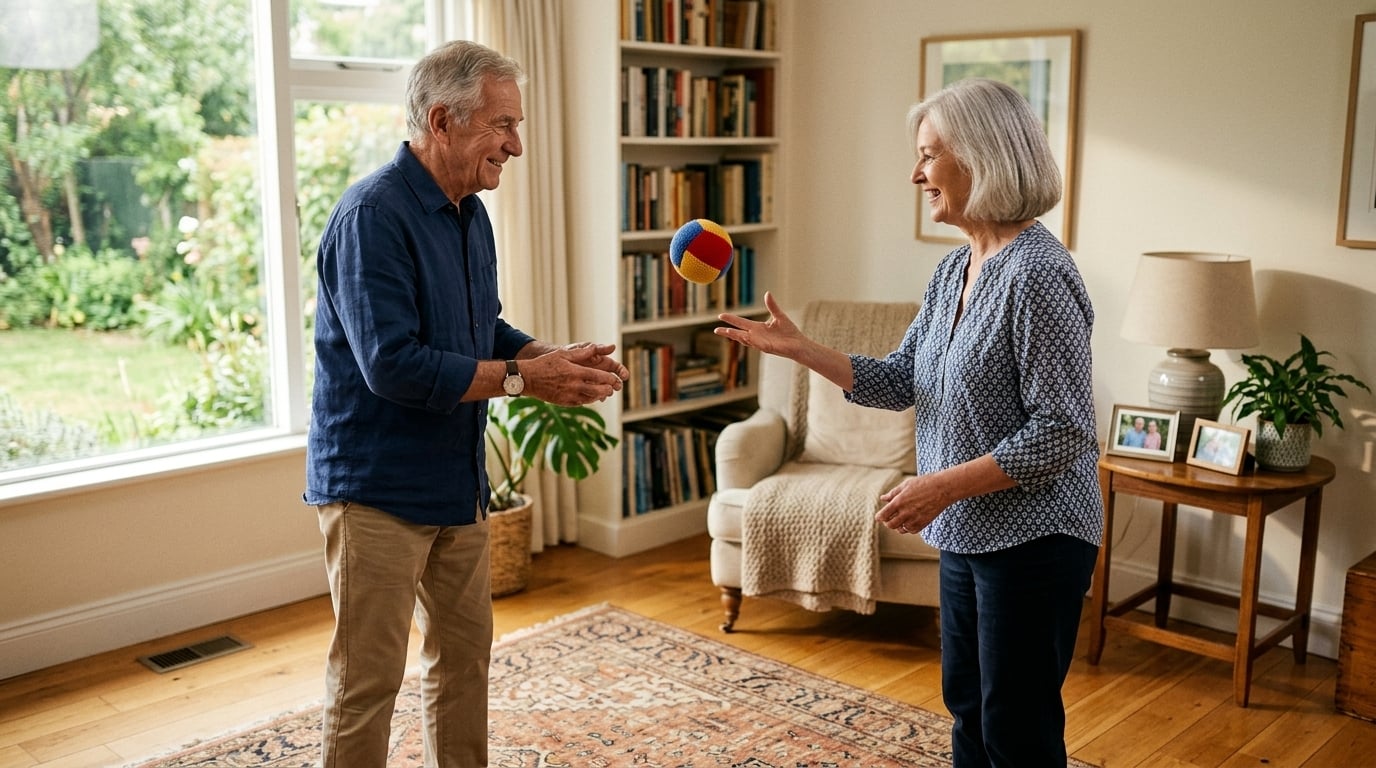
Start with the first three. Add the rest as you get comfortable. You do not need equipment beyond a tennis ball, a broomstick and a bit of floor.
1. The Counter Stance Ladder
Trains: static balance, position sense in the ankles and hips.
- Stand facing a counter with fingertips resting on it.
- Put your feet together, touching. Hold 10 seconds.
- Slide one foot half a step forward so the instep touches the other big toe. Hold 10 seconds.
- Move to full tandem, heel directly against toe. Hold 10 seconds.
- Lift one foot and stand on one leg. Hold 10 seconds. Repeat on the other side.
Easier: keep a full hand on the counter, or hold each stance for 5 seconds. Harder: use one fingertip, then no hands. Then close your eyes at whichever stance you can hold steadily with hands off. Safety: stay within arm's reach of the counter at every stage. Never close your eyes on one leg.
2. Heel-to-Toe Line Walk
Trains: foot placement, dynamic balance, hip control.
- Find a line. A floorboard seam, a hallway edge, or a strip of tape.
- Walk along it placing the heel of each step directly against the toe of the other foot.
- Take 10 steps forward. Turn slowly. Walk 10 steps back.
- Look ahead at a fixed point, not down at your feet.
Easier: walk beside a wall with one hand trailing it. Widen the line to shoulder width. Harder: walk backwards along the line. Then try turning your head slowly left and right as you walk. Safety: do this in a hallway where both walls are within reach. Stop if the head turns make you dizzy.
3. The Obstacle Path
Trains: stepping accuracy, clearance, planning your feet ahead of time.
- Lay four or five small objects on the floor in a line, roughly two feet apart. Rolled towels or empty shoeboxes work well.
- Walk the line, stepping over each object.
- Walk it again, this time weaving around the objects instead.
- Do three passes each way.
Easier: use flat objects like sheets of paper and simply step on them as targets. Harder: raise the objects, vary the spacing so no two gaps are the same, or carry a light laundry basket while you do it. Safety: use soft, light objects that will not hurt or roll if you catch one. Nothing made of glass. Keep a wall on one side.
4. The Four Corner Reach
Trains: reactive balance, controlled weight shift, recovery.
- Stand with feet hip width apart, counter to one side.
- Reach one hand forward as far as you comfortably can, then return to upright.
- Reach to the side, then diagonally back, then across your body.
- Do five reaches in each direction, then swap hands.
Easier: reduce how far you reach and keep the other hand on the counter. Harder: reach with the opposite foot instead of the hand, tapping the floor lightly at each corner without shifting your weight onto it. Safety: move slowly. This is a control drill, not a stretch. If you feel yourself falling into the reach rather than steering it, make it smaller.
5. Quick Step Response
Trains: reaction speed and the recovery step that actually catches you in real life.
- Stand facing the counter, hands lightly resting on it.
- Have someone call out a direction: front, back, left or right.
- Take one quick, deliberate step in that direction, then step back to centre.
- Do 10 steps. If you are alone, write the four directions on slips of paper and draw one at a time.
Easier: step slowly and only forward and back. Harder: speed up the calls, add diagonals, or have the caller point instead of speaking so you have to read the cue. Safety: this is the most demanding drill here. Do it in a corner with the counter in front and a wall behind you until it feels routine.
6. Wall Ball Toss
Trains: hand-eye coordination, visual tracking, timing.
- Stand about four feet from a bare wall with a tennis ball.
- Throw underhand at the wall and catch the rebound with the same hand. Do 20.
- Switch hands. Do 20.
- Then throw with one hand and catch with the other. Do 20.
Easier: stand closer, use a larger and softer ball, and let it bounce on the floor once before you catch it. Harder: stand further back, use a smaller ball, or call out a colour or a number to yourself on each catch. Safety: stand on a stable surface with nothing underfoot. Do not chase a missed ball. Let it go and pick it up when it stops.
7. The Two-Object Pass
Trains: bilateral coordination, the two hands learning to do different things at once.
- Hold a tennis ball in one hand and a rolled sock in the other.
- Pass both across your body at the same time, so each object ends up in the opposite hand.
- Do it 20 times slowly, then 20 times a little faster.
- Then try passing one over the top and one underneath.
Easier: use two identical objects and pass them one at a time. Harder: do it standing on one leg beside the counter, or add a third object and rotate them in a circle. Safety: sit down for this one if standing balance is still shaky. It works just as well seated.
8. The Coin and Button Drill
Trains: fine motor control in the fingers. This is the one that fixes fumbled keys.
- Put 15 coins on the table. Pick them up one at a time and drop them in a cup. Time it.
- Now do it with your other hand.
- Take a shirt with buttons. Button and unbutton it three times.
- Finish by picking up each coin and moving it to your fingertips without your other hand helping.
Easier: use larger coins or poker chips and a wide-mouthed bowl. Harder: do it with your eyes closed, or time yourself and try to beat it. Safety: the only risk here is frustration. Slow down before you get annoyed. Sloppy fast practice teaches sloppiness.
9. Walk and Count
Trains: dual-tasking, the ability to move well while your mind is elsewhere.
- Walk down a clear hallway at a normal pace.
- As you walk, count backwards out loud from 100 by threes. 100, 97, 94.
- Walk 20 steps, turn, and walk back still counting.
- Do three passes.
Easier: count backwards by ones, or name animals instead of doing arithmetic. Harder: count by sevens, or name items in a category while carrying a half-full cup of water. Safety: a clear hallway with walls within reach on both sides. If your walking slows or wobbles noticeably when you add the counting, that is useful information. Make the mental task easier, not the walking harder.
10. Tai Chi or Simple Dance Steps
Trains: whole-body rhythm, weight transfer, movement variety.
- Follow a beginner Tai Chi or line dance video, seated or standing.
- Aim for 15 to 20 minutes.
- Focus on the weight shifting from foot to foot rather than on getting the arms perfect.
- Do this two or three times a week.
Easier: do the arm patterns seated first, then add the footwork. Harder: do it without holding on, then with your eyes tracking your hands. Safety: pause the video whenever you need to. There is no penalty for being half a beat behind.
Worth being honest about Tai Chi specifically. In the 2019 Cochrane review, Tai Chi may reduce the rate of falls by about 19 percent, but the review rated that as low-certainty evidence. Its effect on the number of people who fall, about 20 percent fewer, was rated high certainty. Good exercise, real evidence, mixed confidence.
How to actually practise
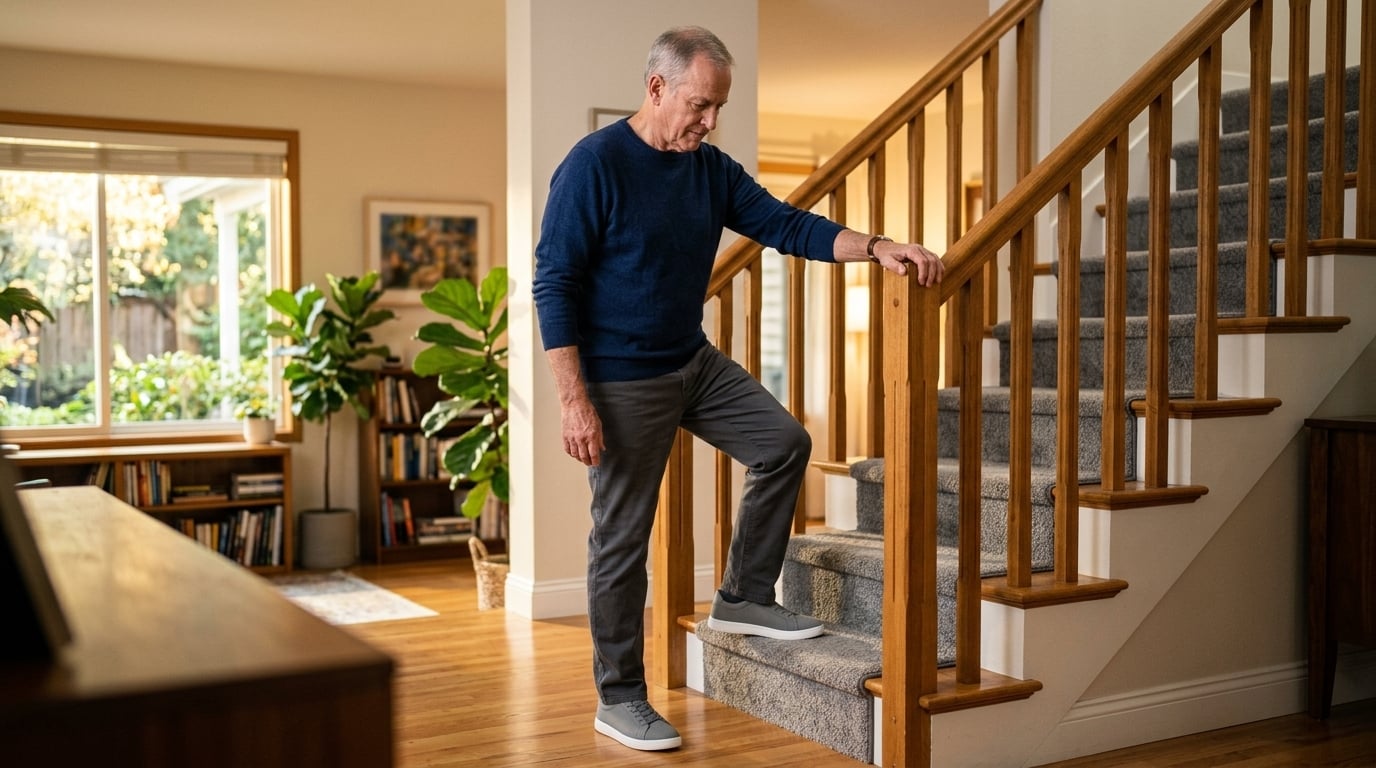
This is where most people go wrong. They do the exercises once, find them easy, and stop.
The World Health Organization's 2020 guidelines recommend that adults aged 65 and over do varied multicomponent physical activity that emphasises functional balance and strength training at moderate or greater intensity, on 3 or more days a week, to enhance functional capacity and to prevent falls. That is a strong recommendation based on moderate certainty evidence.
US guidance for the same age group adds at least 150 minutes a week of moderate aerobic activity and muscle strengthening on 2 or more days a week, plus balance activity.
The dose research is more specific and more interesting. A 2017 review with meta-regression pooled 88 trials and 19,478 participants. Overall, exercise cut the rate of falls by about 21 percent. But programs that genuinely challenged balance and totalled more than about 3 hours a week produced roughly a 39 percent reduction. Those two factors alone explained 76 percent of the difference between studies.
Two caveats matter. That is a comparison across trials, not proof that adding hours causes the extra benefit. And the same review found no evidence of fall prevention benefit in residential care settings, in stroke survivors, or in people recently discharged from hospital. If you are in one of those groups, this needs individual advice, not a general article.
So the practical rules are simple.
Three or more days a week. Short and frequent beats long and occasional for skill learning.
Make it hard enough to wobble. If you are not occasionally unsteady, you are practising a skill you already have. Wobble at the counter, not on the stairs.
Progress every two weeks. Take one thing away: the hand on the counter, the light in the room, the flat floor. Or add one thing: speed, a second task, an uneven surface.
Vary it. Do not do the same three exercises forever. Coordination is specific to what you practise, so practise widely.
What coordination training will and will not do
Here is what the evidence actually supports, stated plainly.
It reduces falls. The 2019 Cochrane review pooled 108 trials and 23,407 community-dwelling older adults with an average age of 76. Exercise reduced the rate of falls by about 23 percent, rated high-certainty evidence. Balance and functional exercise on its own reduced the fall rate by about 24 percent, also high certainty. Programs combining multiple exercise types probably reduced it by about 34 percent, rated moderate certainty.
It improves measurable balance and mobility. Studies of dual-task training consistently show gains on standard tests.
But the gains are often smaller than they sound. A 2025 review of 44 trials in 2,782 older adults found statistically significant improvements in balance and mobility scores that fell below the threshold clinicians consider clinically meaningful. Certainty ranged from very low to moderate, and the studies varied enormously.
And it may not transfer the way you would expect. A meta-analysis of 91 trials found that motor and cognitive training improved Timed Up and Go and Berg Balance scores, but did not significantly improve walking while doing a second task, which is the exact thing it was designed to train.
It will not fix a medical problem. Coordination exercise does not treat an inner ear disorder, nerve damage in the feet, a medication side effect or blood pressure that drops when you stand. Those need identifying and addressing on their own terms.
And it is not a guarantee. A 23 percent reduction in fall rate across a population is a real and valuable effect. It is not a promise about you.
When unsteadiness needs a professional look
Some things are not a training problem.
Call 911 immediately for sudden loss of balance or coordination, sudden numbness or weakness on one side of the body, face drooping, slurred speech, sudden vision changes or a sudden severe headache with no clear cause. These are stroke warning signs.
See a doctor soon if any of these apply.
- Your coordination changed noticeably over weeks rather than years.
- You feel the room spinning, not just wobbly.
- You have numbness, tingling or burning in your feet.
- You get lightheaded specifically when you stand up.
- You started a new medication and things got worse.
- You have fallen in the past year, whether or not you were hurt.
- One side of your body feels different from the other.
Consider a physical therapist if you are steady enough day to day but you can feel the margin shrinking. If the exercises above feel either impossible or pointless, that usually means the level is wrong for you, and getting the level right is most of the work.
Frequently asked questions
Can coordination really improve after 70?
Yes. The Cochrane fall-prevention evidence comes from trials with an average participant age of 76, and it found high-certainty benefit. Skills stay trainable. Progress may be slower than at 40, and it does require consistency.
How long before I notice a difference?
Most people notice the exercises themselves getting easier within two to three weeks, because early gains in any movement skill come largely from the nervous system rather than from new muscle. Whether that shows up in daily life takes longer and depends on how consistently you practise.
Is balance the same thing as coordination?
Balance is one kind of coordination. It is your body coordinating itself against gravity. Hand-eye skill, finger dexterity and rhythm are other kinds. They overlap but they do not automatically transfer, which is why the list above covers several types.
Do I need equipment or a balance board?
No. Everything above uses a counter, a hallway, a tennis ball and household objects. Balance boards and foam pads are useful ways to add difficulty later, but they are a progression, not a starting point.
Should I be doing strength work too?
Yes. Coordination is the timing, strength is the force, and you need both. Guidance for older adults recommends muscle strengthening on at least 2 days a week alongside balance work. Getting out of a chair without your arms is a good strength test and a good exercise.
My parent is unsteady and will not do exercises. What do I do?
Do not frame it around falling. That triggers defensiveness. Frame it around the specific thing they want to keep doing, whether that is the garden, the grandkids or the stairs to their own bedroom. Then start with the easiest version of one exercise, not ten.
If you want eyes on it
You can do everything above on your own. Most people should just start.
But if you have tried and the exercises are either too easy to matter or too hard to attempt safely, that gap is worth closing with someone who can watch you move. Guessing at your own challenge point is genuinely difficult.
At HWY Physical Therapy in Salem, Oregon, Dr. Raj Pusuluri, PT, DPT works specifically with adults over 50 on balance, coordination and staying independent. Care is direct-pay, no insurance required.
The place to start is a Wellness Screening Call, which is a short virtual conversation about what is actually going on and whether we can help. You can also start from home entirely, since we see patients by telehealth.
Book a Wellness Screening Call or call (971) 202-1979.
In Oregon you do not need a doctor's referral to see a physical therapist.
HWY Physical Therapy 2615 Portland Rd NE Salem, OR 97301 Phone: (971) 202-1979 Hours: Monday to Friday, 8:00 AM to 5:00 PM Walk-ins welcome.
Sources
- Sherrington C, et al. Exercise for preventing falls in older people living in the community. Cochrane Database of Systematic Reviews, 2019. 108 randomised trials, 23,407 participants.
- Sherrington C, et al. Exercise to prevent falls in older adults: an updated systematic review and meta-analysis. British Journal of Sports Medicine, 2017. 88 trials, 19,478 participants.
- World Health Organization. Guidelines on Physical Activity and Sedentary Behaviour, Recommendations for older adults, 2020.
- Centers for Disease Control and Prevention. Physical Activity for Older Adults.
- Centers for Disease Control and Prevention. STEADI: Older Adult Fall Prevention, including the Timed Up and Go and the 4-Stage Balance Test.
- Goble DJ, et al. Proprioceptive sensibility in the elderly: degeneration, functional consequences and plastic-adaptive processes. Neuroscience and Biobehavioral Reviews, 2009.
- Eckert MA. Slowing Down: Age-Related Neurobiological Predictors of Processing Speed. Frontiers in Neuroscience, 2011.
- Effectiveness of dual-task exercise in improving balance and preventing falls among older adults: systematic review with meta-analysis and meta-regression. 44 trials, 2,782 participants.
- Impact of Motor-Cognitive Interventions on Selected Gait and Balance Outcomes in Older Adults. Frontiers in Psychology, 2022. 91 trials, 3,745 participants.
- National Center for Health Statistics. Characteristics of Older Adults Who Met Federal Physical Activity Guidelines for Americans: United States, 2022.
- National Institute on Aging. Older Adults and Balance Problems and Falls and Fractures in Older Adults: Causes and Prevention.
- American Stroke Association. Stroke Symptoms.
- Guadagnoli MA, Lee TD. Challenge Point: A Framework for Conceptualizing the Effects of Various Practice Conditions in Motor Learning. Challenge Point: A Framework for Conceptualizing the Effects of Various Practice Conditions in Motor Learning. Journal of Motor Behavior, 2004; 36(2):212-24.
.png)